


16AWG US AC Power Cord Buying Guide: Avoid Overheating and Power Failure Risks
If your operation relies on servers, industrial control equipment, or medical diagnostics, the power cord connecting your devices to the wall outlet matters more than most buyers realize. A well-specified 16AWG US AC Power Cord – NEMA 5-15P to IEC C13 delivers stable 125V/13A power with minimal voltage drop, preventing thermal buildup that silently degrades hardware. This guide walks procurement engineers and purchasing teams through every critical decision point—from wire gauge physics to supplier qualification—so you source the right cable the first time and eliminate avoidable downtime.
What Exactly Is a 16AWG US AC Power Cord, and Why Does the Spec Matter?
Breaking Down the Core Components
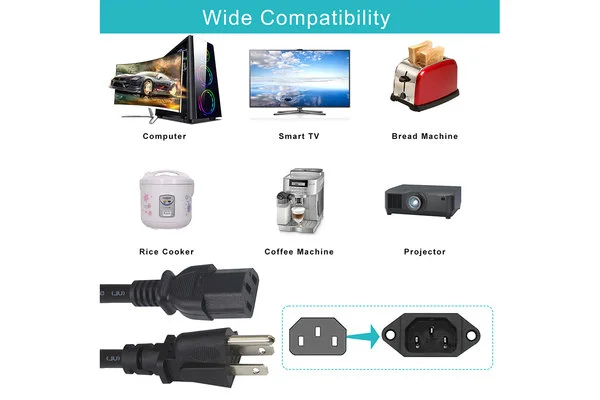
The NEMA 5-15P plug is the standard 15A/125V plug with three prongs that can be found in all North American buildings. The IEC 60320 C13 connection fits with it. This is the standard input on computers, laptops, network switches, and medical diagnostic units. This pair works together to make enterprise-grade AC power transfer possible.
The number "16AWG" stands for the copper conductors' American Wire Gauge. With a 1.31 mm² cross-section per wire, 16AWG can handle up to 13A continuously, which is a big step up from the 18AWG standard, which can handle about 10A. It's simple physics: thinner wire makes more resistance, resistance makes heat, and heat that lasts for a long time speeds up the breakdown of insulation and connection failure.
Our UL-Listed cord (File No. E484253) has a 16AWG x 3C pure copper core inside an SJTW or SJT jacket. It can handle 105°C and 300V and is flame retardant according to VW-1 standards. These are not marketing claims; they are real, measured factors that show how far the cord can be used.
How Do You Avoid Overheating and Power Failures on the Job?
Choosing the Right Gauge Eliminates the Root Cause
In commercial settings, load mismatch is more likely than age to cause a power cord to overheat. When you run a 12A load continuously through an 18AWG cord designed for 10A, resistive heating happens that gets worse over time. When temperatures stay high for a long time, PVC insulation gets softer, its dielectric strength goes down, and the risk of arcing goes up.
For agreement with the US market, you have to follow the rules for UL and CSA approval. We test every cord that we ship 100% in the plant using Hi-Pot (dielectric withstand at 1,500V) and continuity checks on all three wires. This two-test method finds tiny flaws in insulation that can't be seen with the naked eye.
Before approving any power cord supplier, buyers must make sure the following safety requirements are met:
Line up the wire gauge with the load rating: Make sure that the ampacity of the cord is at least as high as the equipment's rated continuous current + 20% for NEC derating.
- Wire gauge vs. load rating alignment: Confirm the cord's ampacity meets or exceeds the equipment's rated continuous current plus a 20% NEC derating margin.
- Jacket material and temperature rating: SJTW jackets withstand 105°C and outdoor humidity exposure; standard SPT-2 jackets are limited to 60°C and dry indoor use only.
- Certification file traceability: A genuine UL listing carries a verifiable file number. Our cords are listed under UL File No. E484253—publicly searchable in UL's Product iQ database.
These checkpoints protect your building from the two types of failure that lead to the most unplanned downtime: conductor continuity loss and thermal insulation breakdown with the 16AWG US AC Power Cord -NEMA 5-15P to IEC C13.
Which 16AWG Power Cord Configuration Fits Your Application?
Comparing Connector and Jacket Options Side by Side
Not every NEMA 5-15P to C13 cord is made for the same setting. The table below shows how configurations are matched to operational situations so that your team can easily match spec to application.
| Feature | SJTW (Outdoor-Rated) | SJT (Indoor Heavy-Duty) | Standard SPT-2 |
|---|---|---|---|
| Temperature Rating | 105°C | 105°C | 60°C |
| Weatherproof | Yes (moisture-resistant) | No | No |
| Flame Rating | VW-1 | VW-1 | UL 94 V-2 |
| Typical Use | Industrial/outdoor temporary | Server rack, control cabinet | Residential/light commercial |
| Current Capacity | 13–15A (16AWG) | 13–15A (16AWG) | 7–10A (18AWG) |
Beyond the type of jacket, the design of the connection also affects how the cables are managed. Straight NEMA 5-15P plugs work well in open panels, while right-angle setups make wall outlets less stressed in server racks with a lot of servers and lower the risk of disconnecting by accident in areas with a lot of foot traffic. We offer both configurations with our precision-molded connectors, which are made to last more than 10,000 insertion cycles.
Choosing the right cord length also has an effect on electricity: longer runs cause more resistive voltage drop. At 13A through 16AWG copper, a 6-foot cord causes a drop of only 0.4V, which is very small. Around 25 feet, that number goes up to about 1.7V, which may be too high for sensitive instruments. Before ordering a lot of cords, you should always compare the run length to the equipment's input voltage range.
Where Should You Source 16AWG NEMA 5-15P to IEC C13 Power Cords in Bulk?
What to Evaluate in a B2B Power Cord Supplier?
Teams looking for a supplier of a 16AWG US AC Power Cord – NEMA 5-15P to IEC C13 for OEM or large-scale projects need more than just a price sheet. Whether a relationship can grow depends on the supplier's list of certifications, the ability to track where the goods come from, and the level of customization available.
Kuncan Electronics is a verified business-to-business manufacturer that has been making power cables for 17 years. Our factory uses high-speed automatic extrusion and precise injection molding to make sure that the shape of the conductors and the thickness of the jackets stay the same from batch to batch. The RoHS and REACH environmental guidelines are followed by all products.
In our OEM/ODM program, you can place an order as little as 10 PCS, get a free review of your CAD design, and get an answer within 3 minutes for questions about custom length and color. As an example, standard lead times for bulk orders are 15–25 business days, depending on the amount, and delivery times for samples are 3–7 business days. There are black, white, and fully custom-matched color schemes to choose from so that you can support branded product lines or color-coded data center deployments.
How Do You Maintain and Inspect 16AWG Power Cords for Long-Term Reliability?
Practical Inspection and Troubleshooting Protocol
A power line is a wearable part that doesn't stay in place permanently. Regular inspections are important, especially in places where there are a lot of plug cycles, vibrations, or chemical exposure. Every time there is a repair, a trained worker should check the following:
- Jacket integrity: Look for cracking, discoloration, or surface abrasion near strain relief zones, which are the highest mechanical stress points.
- Connector retention force: A loose C13 connector indicates worn contact springs. Replace the cord immediately; a loose connection generates arcing heat at the interface.
- Continuity retest: Use a calibrated multimeter to verify sub-1Ω resistance across each conductor. Elevated readings indicate partial strand breaks inside the jacket.
Instead of putting all of the bend stress at the conductor crimp point, our molded strain relief design spreads it out over a graduated taper. This choice in construction greatly increases the cord's useful life in situations where it needs to be moved around a lot, like with mobile medical equipment trolleys or industrial workspaces that can be rearranged.
Conclusion
Choosing the right power line is not a simple buy; it requires careful thought. Three things that can cause real operational risk are wire gauges that are too small, jacket ratings that don't match, and claims of certification that can't be proven. If you get a 16AWG US AC Power Cord -NEMA 5-15P to IEC C13 with pure copper wires, a VW-1 rated SJTW jacket, and traceable UL approval, none of those things matter at all. Before a single unit ships, the cord's spec sheet should meet the load profile. This is true whether you're setting up a data center, an industrial control cabinet, or a medical imaging suite.
FAQ
What is the maximum safe amperage for a 16AWG power cord?
A 16AWG cord is rated for 13A continuous service under UL standards. For NEC compliance, apply the 80% derating rule to continuous loads—meaning a practical ceiling of approximately 12A for circuits operating longer than three hours.
Which certifications are required for US market compliance?
UL listing is the primary US requirement. cUL listing extends recognition to Canadian markets. Verify the UL file number against UL's Product iQ database before approving a supplier. RoHS compliance addresses environmental import requirements.
Can a damaged C13 connector be replaced in the field?
Field replacement of a molded C13 connector is not recommended. The molded construction integrates strain relief and conductor retention as a single component. A damaged cord should be replaced entirely rather than repaired, as field splices introduce resistance discontinuities and void certifications.
What is the difference between SJTW and SJT jacket designations?
The "W" suffix in SJTW indicates moisture resistance, making it suitable for outdoor temporary installations and humid industrial environments. SJT is rated for indoor heavy-duty use. Both carry the 105°C temperature rating and VW-1 flame rating.
Does wire gauge affect voltage drop over long cable runs?
Yes. Longer runs through thinner wire increase resistive voltage drop. At 13A through 16AWG, the voltage drop per foot is approximately 0.068V. Calculate total run length carefully for applications with tight input voltage tolerance.
Partner With Kuncan Electronics for Certified Bulk Power Cord Solutions
Kuncan Electronics offers verified 16AWG US AC Power Cord – NEMA 5-15P to IEC C13 options that are made for business, industry, and hospital purchasing programs. Your UL-listed (E484253), RoHS-compliant cords come with full tracking information, and our OEM team gets back to you in three minutes with custom requests. You can email our procurement expert at rhea@szkuncan.net or go to nema5-15.com to ask for samples, bulk prices, or a custom OEM configuration. We can't use a standard answer for your power infrastructure; let's work together to make the right one.

References
1. National Electrical Code (NEC) NFPA 70, National Fire Protection Association, 2023.
2. UL 817: Standard for Cord Sets and Power-Supply Cords, Underwriters Laboratories, 2022.
3. IEC 60320-1: Appliance Couplers for Household and Similar General Purposes, International Electrotechnical Commission, 2021.
4. American Wire Gauge (AWG) Conductor Ampacity Tables, IEEE Standard 835, Institute of Electrical and Electronics Engineers, 2020.
5. NEMA WD 6: Wiring Devices—Dimensional Requirements, National Electrical Manufacturers Association, 2021.
6. RoHS Directive 2011/65/EU Recast and Compliance Requirements for Electronic Components, European Commission Official Journal, 2022.

USER EVALUATE
Here is the customer's evaluation of us