


Avoid Overloading Risks: Choosing the Right 1 to 2 Power Extension Cord
Choosing the wrong power splitter for your workspace is not just an inconvenience—it is a liability. A 1 in 2 NEMA1-15P to NEMA5-15R extension cord solves a real operational problem: outlet scarcity in commercial and industrial environments. This Y-splitter configuration converts one standard wall outlet into two grounded receptacles, enabling safe dual-device power distribution without costly electrical retrofits. Whether you manage an assembly line, a test bench, or a commercial AV installation, selecting the right cord protects your equipment, your team, and your compliance record.
What Is a 1 to 2 Power Extension Cord and Where Is It Used?
Understanding the NEMA1-15P to NEMA5-15R Configuration
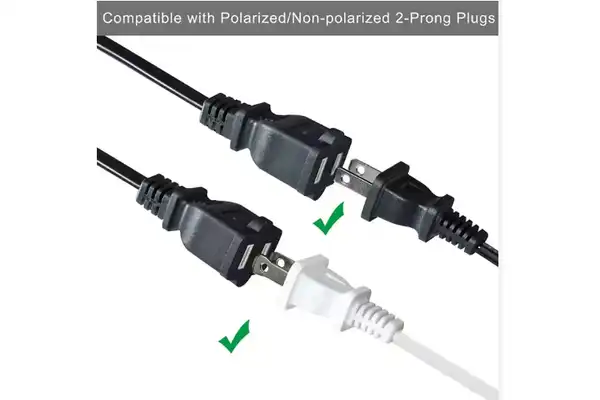
On one end of this cord is a standard 2-prong US plug (NEMA 1-15P), and on the other end are two 3-prong receptacles (NEMA 5-15R). The Y-splitter design turns a single wall plug that isn't connected into two sockets that are. This is important in commercial buildings that are older and still have 2-prong outlets, but newer equipment needs a 3-pin connection. This adapter line fills in the gaps without having to rewire everything, which would be unsafe and expensive.
Common B2B Applications Across Industries
This type of line is used every day by procurement teams in a number of different businesses. In the following situations, it consistently adds value:
- Manufacturing and assembly lines: Equipment clusters often share nearby outlets. A power splitter cord allows two low-to-medium draw devices—such as barcode scanners and inspection lights—to operate from a single outlet without interrupting workflow or requiring panel modifications.
- Test benches and laboratory settings: Engineers powering dual measurement instruments from one receptacle maximize existing infrastructure. The cord handles simultaneous dual-load conditions without voltage instability when properly rated.
- Commercial AV installations: Monitors, active speakers, and display hardware are often installed in tight spaces. The flexible Y-cable design routes cleanly behind walls and under desks, maintaining cable management integrity in professional environments.
These examples show that this is not a novelty item for consumers; it is an important part of organized power sharing schemes.
How Do Overloading Risks Happen and How Can You Prevent Them?
The Real Cause of Extension Cord Failures
The U.S. Consumer Product Safety Commission (CPSC) says that improper use of extension cords leads to about 3,300 home fires each year in the U.S. In business settings, the risk is higher because gadgets are often left on all the time. When two linked devices have wattages that are higher than the cord's maximum amperage, this is called overloading. A 16 AWG cord that can handle 10A at 125V can handle up to 1,250 watts. If you go over that limit, the insulation will break down, the system will get too hot, and there could be arc problems.
What Specifications Actually Protect You?
Understanding the numbers on your 1 in 2 NEMA1-15P to NEMA5-15R extension cord will help you avoid mistakes that cost a lot of money. The table below shows how different wire gages affect real-world capacity:
Wire Gage | Max Current | Max Wattage (125V) | Recommended Use Case | |---|---|---|| 18 AWG | 7A | 875W | Low-draw consumer devices only | 16 AWG | 10A | 1,250W | Office equipment, AV gear, chargers | 14 AWG | 13–15A | 1,625–1,875W | Industrial tools, steady dual loads |
| Wire Gauge | Max Current | Max Wattage (125V) | Recommended Use Case |
|---|---|---|---|
| 18 AWG | 7A | 875W | Low-draw consumer devices only |
| 16 AWG | 10A | 1,250W | Office equipment, AV gear, chargers |
| 14 AWG | 13–15A | 1,625–1,875W | Industrial tools, sustained dual loads |
Kuncan Electronics sells this Y-splitter cord with 99.9% bare copper conductors in both 16 AWG and 14 AWG sizes. Because the stranding pitch was tightened, there is less electrical resistance across the distance. This means that both devices that are linked will get stable power, even when they are under a steady load.
The most common mistake made when buying things is connecting too many splitters to one outlet. It increases the load without increasing the capacity of the circuit. Before choosing a cord rating, you should always add up all the wattages of all the devices you want to use.
How Do You Choose the Right Cord for Your Specific Business Environment?
Matching Cord Specs to Your Load Profile
First, add up the wattages of all the devices that will be connected at the same time to the splitter. To account for starting spikes, add 20% more to that number as a safety cushion. If your total load is close to or more than 1,000 watts, choose a 14 AWG cord rated at 13A or 15A instead of a regular 16 AWG unit.
Conditions in the environment are just as important. An SJT or SVT industrial PVC jacket is very resistant to abrasion, wetness, and normal wear and tear in business and industrial settings that are inside. Kuncan's cord has a flame-resistant outer jacket that goes out on its own when an ignition source is taken away. This is an important feature for installations that are kept inside.
Why the Y-Junction Design Quality Determines Longevity?
The weak spot in any Y-splitter's structure is the junction block. Low-quality units are made of thin PVC that breaks when mechanical force is applied, revealing the internal wires. Kuncan Electronics uses an over-sized, injection-molded PVC junction block that stops wires from coming apart at the split node and absorbs cable stress. Molded strain relief connectors on both the NEMA 1-15P plug and both NEMA 5-15R receptacles of the 1 in 2 NEMA1-15P to NEMA5-15R extension cord stop flex-induced fatigue during repeated insertion cycles. This is one thing that makes commercial-grade products different from consumer-grade ones.
What Should B2B Buyers Look for When Sourcing This Cord?
Certifications, Testing, and Supplier Transparency
Documentation is the first step to reliable procurement. Any reputable company that sells 1 in 2 NEMA1-15P to NEMA5-15R extension cords must have UL compliance certification, Hi-Pot dielectric withstand test results, and records of polarity verification. When used for business purposes in the US, these can't be changed.
Kuncan Electronics is an Alibaba Verified Supplier that has been directly making electronics for 17 years. Before shipping, they test every single unit in their factory. In this, Hi-Pot testing and tight polarity proof are included. All of the products follow RoHS rules and can be checked officially. The company has ETL, CE, and RoHS certifications, which make it easy for them to sell their products in North America and other countries.
Kuncan's bulk buying also lets OEMs make changes like custom cable lengths, jacket color matching, logo printing, and interface changes. The wait time for a bulk order is 15–25 days, based on the amount. Samples are delivered in 3–7 business days. For replenishment orders, there are no minimum order quantities. This gives buying teams real supply chain freedom.
When looking at a company that makes dual-outlet power cords, make sure you ask for batch-level load testing data and documentation that shows how the materials were made. Compliance risk is added to your supply chain when suppliers can't give you these papers.
Conclusion
Choosing the right Y-splitter extension cord is a technical choice that has direct effects on safety and compliance. If a cord has the right AWG rating, high-purity copper conductors, reinforced junction molding, and UL-verified assembly, it is either a useful commercial tool or a risk. A 1 in 2 NEMA1-15P to NEMA5-15R extension cord made to commercial standards, like the ones Kuncan Electronics sells, gets rid of the problem of not having enough outlets while still ensuring safe, stable dual-load power distribution in manufacturing, AV, lab, and office settings. Make sure that your load profile matches the right gage, check the certifications of the seller, and treat this part as the safety-critical piece that it really is.
FAQ
What is the maximum combined load for a 16 AWG Y-splitter cord?
At 125V, a 16 AWG cord with a 10A rating can handle up to 1,250 watts. Add up the wattages of both devices that are connected and keep the total power output 20% below the rated limit for continuous use.
Is this cord suitable for outdoor environments?
The basic SJT/SVT PVC jacket is made for business use inside. It's resistant to water and wear, but it's not meant to be used directly outside or in wet places. When used outside, wire systems with UV-resistant jacketing must be rated IP67.
How do I verify that the cord maintains correct polarity?
Reliable manufacturers test their products in a way that checks for polarity. Before you accept a package, ask your provider for the test report. In an unground circuit, the wrong voltage can damage sensitive electronics over time.
Can I use this splitter with medical or industrial automation equipment?
This cord can handle up to 125V/15A. For medical uses, you need IEC-certified items that can keep leaking currents below 100µA. Cables that can handle temperatures from -40°C to +85°C are needed for industrial automation equipment that works in harsh conditions. Before choosing this type of cord, make sure you know what your equipment needs.
What certifications should I require from the supplier?
For the North American market, you should need UL listing or ETL approval, proof that the product meets RoHS standards, and records of each batch's Hi-Pot tests. These three papers give you basic peace of mind about safety and following the rules.
Get a Custom Quote from Kuncan Electronics — Your Trusted 1 in 2 NEMA1-15P to NEMA5-15R Extension Cord Manufacturer
Kuncan Electronics offers approved and factory-tested power splitter options that are made for large businesses and factories. Our team gets back to you within 24 hours whether you need standard settings or fully customized OEM parts. Email us at rhea@szkuncan.net to talk about your load needs, bulk prices, or custom specs, or go to nema5-15.com to see our whole line of products.

References
1. U.S. Consumer Product Safety Commission (CPSC). Extension Cords and Surge Protectors Safety Information. 2022.
2. National Fire Protection Association (NFPA). NFPA 70: National Electrical Code (NEC). 2023 Edition.
3. Underwriters Laboratories (UL). UL 817: Standard for Cord Sets and Power-Supply Cords. 2020.
4. International Electrotechnical Commission. IEC 60320: Appliance Couplers for Household and Similar General Purposes. 2021.
5. Electrical Safety Foundation International (ESFI). Electrical Safety in the Workplace Annual Report. 2022.
6. National Electrical Manufacturers Association (NEMA). NEMA WD 6: Wiring Devices—Dimensional Requirements. 2016.

USER EVALUATE
Here is the customer's evaluation of us