


How GFCI Power Cords Help Reduce Electric Shock and Leakage Risks in Wet Locations
Electrical Safety in Wet Locations Requires More Than a Basic Power Connection
In applications such as pressure washers, water pumps, garden tools, outdoor lighting, and temporary power supply, power cords often face moisture, rain, wet ground, and frequent movement. For B2B buyers, equipment manufacturers, and OEM project managers, a standard power connection only delivers electricity. It does not fully address the more critical risks in wet locations: leakage current, electric shock, nuisance tripping, cable aging, and specification mismatch.
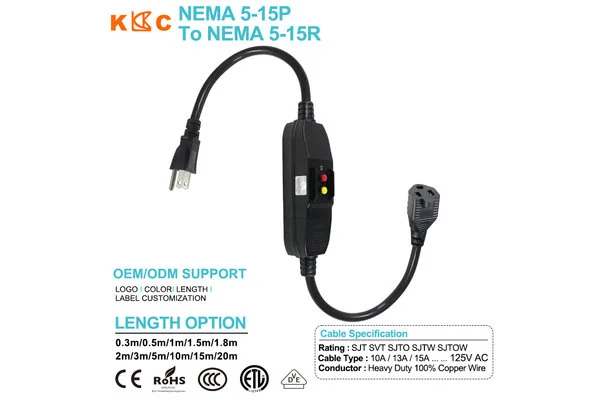
Dongguan (Shenzhen) Kuncan Electronics Co., Ltd. provides NEMA 5-15P to NEMA 5-15R GFCI Power Cord solutions designed for North American wet-location and outdoor equipment applications. The product uses NEMA 5-15P plug and NEMA 5-15R receptacle configuration, supports common electrical ratings such as 10A / 13A / 15A, 125V AC, and can be matched with SJT / SVT / SJTO / SJTW / SJTOW cable types according to project requirements. It is suitable for cleaning machines, garden tools, water pumps, and other power connection applications requiring leakage protection.
Why Do Wet-Location Devices Need GFCI Leakage Protection?
Wet environments significantly increase electrical connection risks. A pressure washer produces water spray during operation, a water pump may work near standing water, and garden tools are often used around grass, soil, and dew. When equipment housings, connectors, or ground surfaces are wet, insulation damage, grounding faults, or abnormal leakage current can become more dangerous. A standard power cord cannot actively identify these risks.
The value of a GFCI (Ground Fault Circuit Interrupter) leakage protection module is that it can cut off power when abnormal leakage is detected, helping reduce electric shock risk. For equipment accessories in the North American market, GFCI is not a decorative selling point. It is an important safety structure for wet-location and outdoor power applications.
The product shown in the image includes clear TEST / RESET buttons. The TEST button allows users or inspectors to check whether the protection function works properly, while the RESET button helps restore power after troubleshooting. For OEM equipment manufacturers and channels, this visible and operable structure can help reduce after-sales communication caused by users not understanding the protection status.
Incorrect Current Rating May Cause Nuisance Tripping and Heat Complaints
A GFCI power cord must support both safety protection and stable power delivery. If the current rating is too low, the device may trip frequently during startup or load fluctuation. If the cable specification does not match the load, heat rise, voltage drop, or insufficient long-term stability may occur.
Common current options for this type of product include 10A / 13A / 15A, with a rated voltage of 125V AC. For pressure washers, water pumps, electric tools, and similar equipment, buyers should not choose only by appearance or cable length. Equipment wattage, startup current, continuous operating time, and target certification requirements should all be considered before confirming the current rating.
For example, low-power portable equipment may be suitable for 10A or 13A options, while higher-load or long-running outdoor devices usually require a more careful evaluation of 15A configuration and matching cable construction. Accurate current matching helps reduce nuisance tripping, equipment shutdown, and the risk that end users mistake normal protection behavior for product failure.
Cable Type Defines Outdoor Durability and Application Boundaries
Many GFCI power cord failures are not caused by the protection module itself, but by mismatched cable construction. In wet-location, outdoor, cleaning equipment, and garden tool applications, the cable may be exposed to moisture, soil, oil, low temperature, or mechanical dragging. If the jacket material is unsuitable, it may harden, wear, crack, or reduce insulation performance.
The cable specifications shown in the image include SJT / SVT / SJTO / SJTW / SJTOW. These cable types differ in flexibility, jacket thickness, water resistance, oil resistance, and outdoor suitability. For general indoor equipment, SVT or SJT may be sufficient. For wet-location or outdoor applications, SJTW deserves closer attention. If the application involves oil exposure or more demanding industrial environments, SJTOW can be further evaluated.
For B2B buyers, cable selection is not just a technical detail. It determines whether the product fits the target channel. An incorrect cable type may cause inspection questions, shorter service life, increased after-sales complaints, or a negative impact on the overall safety perception of the equipment brand.
NEMA 5-15P/5-15R Is a Basic Requirement for North American Projects
If the target market is the United States, Canada, or other channels using North American standards, plug and receptacle configuration must be confirmed early. NEMA 5-15P to NEMA 5-15R is a common 125V grounded power connection format in North America and is suitable for many outdoor equipment, portable appliance, and tool accessory applications.
Interface mismatch seems like a basic error, but it still happens in OEM projects. If the plug standard, receptacle direction, cable length, label, certification mark, and packaging requirements are not clearly defined during sourcing, later issues may include sample rework, inconsistent certification documents, or delayed channel approval.
Therefore, in GFCI power cord sourcing, the NEMA interface should be confirmed together with current rating, cable type, and certification direction rather than checked at the final stage. For equipment manufacturers, writing these parameters into the BOM and purchasing specification helps reduce project communication costs.
How Can OEM Buyers Reduce Safety and Compliance Risks?
Before confirming a GFCI power cord order, buyers are advised to check the following points:
- Target market: North American projects should confirm NEMA 5-15P/5-15R interface and ETL, UL/cUL, or related certification direction
- Electrical rating: confirm 10A, 13A, or 15A and 125V AC according to equipment wattage
- Cable type: choose SJT, SJTW, SJTOW, or other types according to indoor, outdoor, wet, oily, or industrial environments
- GFCI function: confirm TEST / RESET structure, reset logic, and target certification requirements
- Conductor material: the image indicates Heavy Duty 100% Copper Wire, which supports conductive stability and heat-rise control
- Cable length: 0.3m, 0.5m, 1m, 1.5m, 1.8m, 2m, 3m, 5m, 10m, 15m, and 20m should be selected according to equipment installation methods
- Customization: logo, color, label, warning text, and packaging should meet channel regulations and brand requirements
These confirmation points help OEM customers identify potential problems during the sample stage rather than dealing with risks after mass production or market feedback.
Conclusion: The Value of a GFCI Power Cord Is Risk Management in Advance
Power connection in wet locations should not be judged only by whether it can deliver electricity. For pressure washers, water pumps, garden tools, and outdoor equipment, user experience and brand reputation depend on whether leakage protection is properly matched, whether the cable type fits the environment, whether the current rating is reasonable, and whether the interface meets target market requirements.
Dongguan (Shenzhen) Kuncan Electronics Co., Ltd. provides OEM/ODM customization support for NEMA 5-15P to NEMA 5-15R GFCI Power Cord, including cable length, color, logo, label, cable type, and current rating. For B2B customers serving North American wet-location and outdoor equipment markets, confirming GFCI protection, current rating, cable specification, and NEMA interface in advance is a key step in reducing electric shock risks, after-sales complaints, and compliance uncertainty.


USER EVALUATE
Here is the customer's evaluation of us