
C13 Power Cable vs C19: What's the Difference?
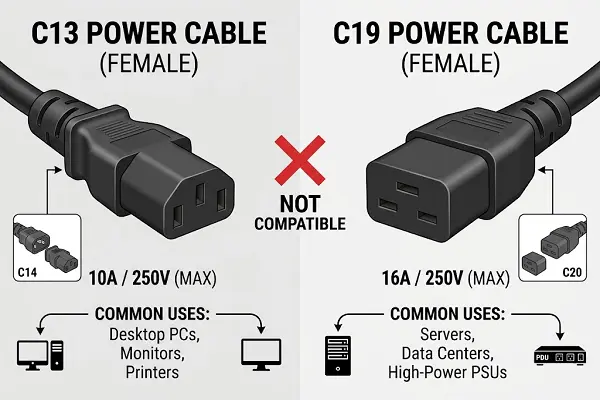
When planning power systems for business settings, it's important to know the difference between interconnect/c13-to-c14-cable/">C13 cable power options and C19 variants. IEC 60320 standards say that the C13 plug can handle up to 15A at 250V or 10A at 250V in other countries. This makes it perfect for normal servers, desktop computers, monitors, and network switches. The C19 socket, on the other hand, can handle higher amperage rates (16A to 20A), making it perfect for power-hungry devices like blade servers, high-density UPS systems, and PDU connections. In data centers and factories, picking between these two types of connectors has a direct effect on the safety of the equipment, how well it works, and how easily it can be expanded in the future.
Understanding C13 and C19 Power Cables: Specifications and Functions
The electrical rates, pin configurations, and intended uses of C13 cable power and C19 power cords are very different, so it is very important to identify them correctly before they are used. Knowing these technical differences can help you avoid mistakes that cost a lot of money and make sure that your equipment gets the right amount of power within safe limits.
C13 Power Cable: Technical Overview
The C13 cable power connection, which is also known as the "kettle lead" or computer power cord, is the most common type of power link in offices and businesses. The standardized 3-pin female connector on this wire fits the IEC C14 plug that can be found on many electronic products. Industrial-grade IEC C13 cables must meet strict physical, chemical, and electrical standards that make sure they are safe and last a long time in a variety of settings.
Electrical requirements for C13 cable power circuits are usually 10A/250V for versions that meet VDE/ENEC standards or 15A/125V-250V for versions that meet UL/CSA standards. The dielectric withstand voltage is more than 2000V AC for one minute without breaking, and the insulation resistance is more than 100MΩ at 500V DC. These strong scores give you a lot of safety gaps for both normal use and temporary situations.
Stranded, annealed 99.99% Oxygen-Free Copper is used in conductor material to reduce resistance and heat buildup when the load is on all the time. In North America, common wire sizes range from 18AWG to 14AWG. In other parts of the world, they range from 0.75mm² to 1.5mm². Other than normal PVC, insulation and jacket materials can be made of rubber mixtures or halogen-free options with names like H05VV-F, SJT, and SVT. These materials are flame retardant and meet UL VW-1 or IEC 60332-1 standards. They are also resistant to oil, making them useful in industrial settings.
The design of the connector ensures that the pull-out force resistance is usually between 10N and 50N. This keeps the connector from disconnecting by accident but lets you remove it on purpose. Mating cycle durability testing goes beyond 3,000 insertion and removal cycles, which proves life in places where equipment needs to be reconfigured often. When made to exact specifications, the C13 to C14 wire design lets you hot-swap in multiple power setups without the risk of arcing. This makes it very useful for keeping things running during maintenance.
C19 Power Cable: High-Amperage Specifications
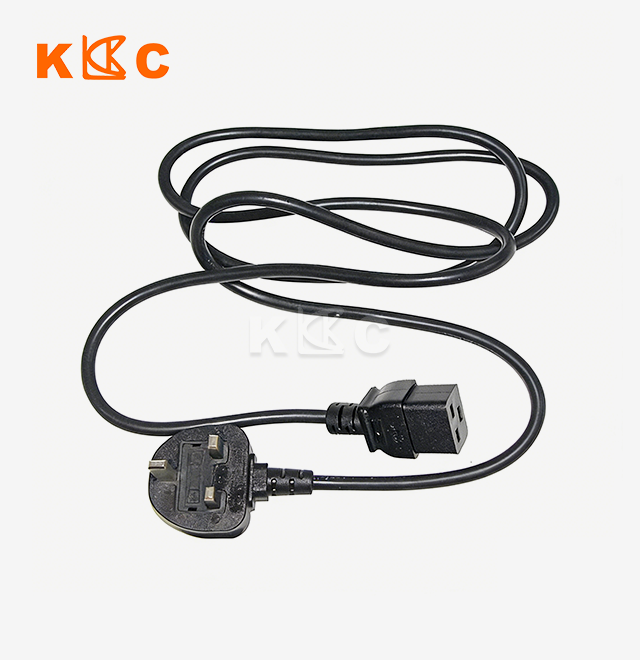
The C19 plug is used for high-power-density devices that need a lot more current than regular office gadgets. This connector has a wider profile and pins that are spread differently, which physically stops it from fitting into C14 inlets. This is an important safety feature that stops cross-connection risks between power levels that are not suitable.
Most C19 circuits can handle 16A to 20A constantly at 250V, but some heavy-duty models can handle up to 32A in certain industrial settings. Because of the higher ampacity, the wire sizes need to be bigger. In North America, this means 12AWG or 14AWG, and around the world, it means 1.5mm² to 2.5mm². This bigger cross-section of the wire lowers the voltage drop along the length of the cable and keeps heat to a minimum when the current is running at a high level for a long time.
The measurements of C19 connectors are very different from those of C13 cable power connectors. For example, the width of C19 connectors is about 36mm, while the length of C13 cable power connectors is 19mm. Because of this size growth, the contact surfaces can be bigger, which spreads the current flow over a larger area and lowers both contact resistance and thermal stress. The mechanical retention force also rises in the same way, making sure that links are safe even in industrial automation settings where equipment is constantly working under tough conditions and is prone to shaking.
Common Applications and Compatibility
Desktop computers, monitors, printers, network switches, professional audio amplifiers, and normal rack-mounted servers can all be connected with C13 cable power. They are the standard for general-purpose power distribution because they work with all consumer products and IT tools. We make C13 cable power that are universally compatible and have stable power links for everyday office work. These cables meet the needs of clients who work with consumer gadgets and need to produce a lot of them quickly.
Power distribution units, industrial motor controls, large-format medical imaging tools, and business storage arrays all use C19 connectors to connect to power sources. C19 inlets are often used to make sure that enough power is delivered without going over the safe ampacity limits for equipment that needs to draw a lot of current over a long period of time or that needs backup power sources. Our industrial-grade goods can handle temperatures as low as -40°C and as high as +85°C. They can also handle the dust, vibration, and chemicals that are common in tough working conditions.
C13 vs C19: Key Differences and Performance Comparison
To tell these connection types apart, you have to look at a number of technical factors that have a direct effect on safety, compatibility, and operating performance. Professionals in procurement should know about these differences so that they don't make design mistakes that hurt the reliability of tools or put people in danger.
Electrical Rating and Ampacity
The main difference is the amount of power they can carry. In North America, C13 cable power assemblies handle 15A, while overseas they handle 10A. This is enough for machines that use up to 2,400 watts at 240V or 1,800 watts at 120V. This grade covers the great majority of desktop computers, monitors, and networking gear that you'll find in an office.
Power supply of up to 4,800 watts at 240V or 2,400 watts at 120V is possible with C19 connectors, which can handle 16A to 20A constantly. This higher ampacity works with power-dense devices like blade servers, which can have many storage devices, multiple processors, and large memory arrays all in one frame. If you use equipment that has a C13 cable power ampacity grade, the wires could get too hot, damage the insulation, and even start a fire. This is why choosing the right connectors is so important for safety.
Physical Design and Pin Configuration
Once you understand the changes in dimensions, visual recognition is easy. C13 cable power connectors are about 19 mm wide and have three pins set up in a certain way: two flat blades that are parallel to each other and a round or flat ground pin. The small size allows for multiple links in racks with limited room, which makes cable handling difficult.
The C19 profile is about 36 mm wide, which is almost twice as wide as the C13 cable power profile. The pin design is very different, which keeps them from connecting accidentally to lower-rated inlets. This mechanical keying system is a fail-safe that keeps workers from connecting high-power equipment to weak power sources or the other way around by accident. The bigger body of the connector also provides better strain relief where the wires leave the housing of the connector, which lowers the mechanical stress on the terminations of the conductors.
Cable Construction and Materials
For higher ampacity, wires need to be heavier and thermal control needs to be better. For shorter runs, C13 cable power assemblies usually use 18AWG to 16AWG wires. For longer lines, where voltage drop becomes noticeable, they switch to 14AWG conductors. Most of the time, the insulation can withstand temperatures up to 70°C. There are also high-temperature versions that can withstand temperatures up to 105°C that are designed for server air zones that get very hot and where the temperature outside is higher than normal for an office.
It is normal for C19 cables to have 14AWG or 12AWG conductors so that the voltage drop and temperature rise are okay when the current is high for a long time. Because these cables are used in equipment that is constantly running in industrial settings, the jacket materials often list higher wear resistance and flame retardancy. Our wires are made of industrial-grade PVC or rubberized plastics, such as SJT, SJTOW, or H05VV-F. They have flame retardance ratings of VW-1 or FT1 and can handle oil and wear and tear found in data centers and factories.
Use Case Scenarios and Application Guidelines
Finding the right connection type starts with figuring out how much power the equipment needs. Standard business machines that use 300 to 500 watts are safe to connect to a C13 cable power port, as are network switches that use 100 to 200 watts and monitors that use 30 to 100 watts. Rack-mounted computers with two 700-watt power supplies each are also within C13 cable power, as long as the load is evenly spread between the two backup supplies.
For high-density blade server cases with 10–16 server blades, each using 200–400 watts, the total power needs must be over 3,000 watts. This can only be met by C19 links. Large UPS systems that back up power for whole racks of equipment use C19 input ports. So do power distribution units that send power to many devices downstream. Heavy machinery and medical imaging equipment like MRI machines and CT scanners are often controlled by industrial automation systems that specify C19 lines because they need a lot of power and can run all the time.
How to Choose the Right Power Cable for Your Business Needs?
When buying C13 cable power for business-to-business use, you need to do more than just look at the ampacity scores. We've helped a huge number of clients make this choice, and there are some things that always decide long-term happiness and operational dependability.
Assessing Power Requirements and Load Calculations
Start by writing down the base power values of all the equipment that needs to be plugged in. The highest power usage of equipment is usually listed in watts or amps, which helps you choose the right cable. When you turn on your equipment, you need to account for the inrush current that may quickly be 50–200% higher than the steady-state usage. This can happen based on how the power source is designed and how the connected load works.
To find the total amperage, divide the wattage by the working voltage and add 20% as a safety cushion so that you don't go over the highest cable rate. When something uses 1,200 watts of power at 120V, it constantly takes 10A, which is already above the standard C13 cable power limit. Adding the safety cushion makes the minimum 12A, which suggests that C19 would be a better choice for headroom. This cautious method increases the life of the wire, lowers thermal stress, and stays in line with electrical codes that usually don't allow continuous use above 80% of maximum capacity.
Cable Length and Voltage Drop Considerations
Due to wire resistance, power drops more when cables are longer. A 6-foot C13 cable power wire with 14AWG strands has a resistance of about 0.4 ohms, which means that at 10A current, the voltage drops by 4 volts, or 3.3% at 120V. While source levels outside of ±5% tolerance are fine for most equipment, they may not work right for sensitive devices.
When you extend the wire length to 15 feet, the resistance goes up by the same amount, which could cause the voltage drop to go beyond what is allowed. This problem can be fixed by switching to stronger wires or shorter cable runs. We offer custom cable lengths that are made to fit particular rack plans. This makes sure that the voltage is delivered optimally while minimizing extra cable that gets in the way of airflow and makes managing cables more difficult.
Environmental Factors and Operating Conditions
Data centers have their own problems, like high temps, limited airflow, and a lot of cables stacked on top of each other. When cables are grouped tightly with dozens of other conductors or run through hot exhaust paths, they can't carry as much current because they can't get rid of the heat. Temperature derating formulas in wire standards show how much power is safe to use in these situations.
Cables in industrial control settings are subject to vibration, chemical exposure, and big changes in temperature. Our industrial-grade goods can withstand temperatures ranging from -40°C to +85°C. This means that control systems, sensors, and tools can keep working without any problems, and downtime is kept to a minimum. Choosing wires with the right environmental grades keeps them from breaking down too soon and keeps safety standards met in tough situations.
Certification and Compliance Standards
With the right approval, you can be sure that the cables you use meet the safety standards for your area and business. Certifications like ETL cover markets in the US and Canada, VDE covers markets in Europe, SAA covers markets in Australia and New Zealand, and CE marking shows compliance with EU rules. We have certifications for our goods from ETL, BS, VDE, SAA, CE, and RoHS. These make sure that they meet world safety and environmental standards so that they can be sold anywhere.
In medical settings, products must be certified according to IEC 60601-1 and have Class II insulation, precise leakage current control below 100µA, and multiple layers of safety protection. Our medical-grade goods that are IEC-certified meet these requirements and can be sterilized, so they are in line with strict international standards for hospitals, clinics, and medical devices. In industrial settings, outdoor or wet areas may need UL Type SOOW or SJOOW grades. Standard SJT or SVT constructions are usually required in IT settings.
Conclusion
If you want to choose between C13 cable power options and C19 variants, you need to carefully think about electrical ratings, physical compatibility, the surroundings, and the infrastructure needs of the future. Standard IT equipment works well with C13 cable power connectors, which reliably send power to servers, laptops, and networking devices that use modest amounts of power. C19 connectors are used in high-density computing, industrial robotics, and power-hungry tasks that need strong ampacity and long-lasting sturdiness. Achieving success in procurement involves more than just choosing the right connectors. It also involves qualifying suppliers, making sure quality standards are met, minimizing waste, and forming strategic partnerships with makers who are dedicated to providing technical support and constant innovation. Knowing these differences helps you make smart choices that improve the safety of tools, the dependability of operations, and the long-term value of infrastructure.
FAQ
Can C13 and C19 connectors be used interchangeably?
Because they are different sizes and electrical values, C13 cable power and C19 connections can't be used together. The C19 connector is about 36 mm wide, while the C13 cable power connector is only 19 mm wide. This means that the two can't physically connect to inlets that aren't suitable. If you try to make connections, you could damage tools and put people in danger. Always make sure that the type of connection you use matches the power and inlet specs of the equipment.
How do I verify cable quality before bulk purchases?
Before agreeing to bulk sales, ask for sample units to try. Using a micrometer to measure the wire gauge, checking the writing on the certification against official paperwork, and doing simple electrical tests like checking for continuity and measuring insulation resistance. During a physical check, the proper strain relief, secure conductor terminations, and quality jacket materials that don't have any obvious flaws should all be confirmed.
What factors influence power cable pricing?
The price of a cable depends on the quality of the conductor material, the cost of approval testing, how precisely it was made, and the name of the brand. Oxygen-free copper wires are more expensive than regular copper, but they last longer and carry electricity better. Certified wires go through a lot of tests, which raises the cost of production but makes sure they meet safety standards. Established names charge higher prices because they are known to be reliable and offer warranties.
Partner with Kuncan Electronics for Reliable Power Solutions
With 17 years of experience, Kuncan Electronics has made C13 cable power kits and C19 high-amperage solutions that work well in tough business settings. As an Alibaba Verified C13 cable power seller, we offer high-quality connection backed by ETL, VDE, SAA, CE, and RoHS certifications that make sure your rollout needs are met around the world. Our flexible OEM/ODM capabilities turn your ideas into custom-branded goods. Our flexible supply chain gets samples to you in 3–7 business days and bulk orders to you in 15–25 days, with no minimum order number requirements. We work as an extension of your procurement team, whether you need to find parts for mass production of consumer goods, industrial automation that needs to be able to handle temperatures between -40°C and +85°C, or medical uses that need IEC-certified accuracy. Get in touch with rhea@szkuncan.net right away to talk about your power cable needs and find out how our one-year guarantee, quick technical support, and low bulk prices can help your business succeed.
References
International Electrotechnical Commission. (2021). IEC 60320-1: Appliance Couplers for Household and Similar General Purposes - Part 1: General Requirements. Geneva: IEC Publications.
Underwriters Laboratories. (2020). UL 817: Standard for Safety Cord Sets and Power-Supply Cords. Northbrook, IL: UL Standards & Engagement.
National Electrical Manufacturers Association. (2019). NEMA WD 6: Wiring Devices - Dimensional Specifications. Rosslyn, VA: NEMA Publications.
Institute of Electrical and Electronics Engineers. (2022). IEEE 1100: Recommended Practice for Powering and Grounding Electronic Equipment. New York: IEEE Press.
Telecommunications Industry Association. (2021). TIA-942-B: Telecommunications Infrastructure Standard for Data Centers. Arlington, VA: TIA Publications.
European Committee for Electrotechnical Standardization. (2020). EN 60320-1: Appliance Couplers for Household and Similar General Purposes. Brussels: CENELEC Publications.

USER EVALUATE
Here is the customer's evaluation of us