


From PDU to UPS: How Locking C19 Power Cords Help Reduce Maintenance Unplugging, Heat Rise, and After-Sales Complaints
In Critical Power Applications, “Non-Failure Failures” Matter
In PDUs, UPS systems, server racks, network communication equipment, and industrial control devices, a power cord is rarely the most visible component, but it often determines whether equipment can run continuously and stably. For B2B buyers, OEM equipment manufacturers, and system integrators, the value of a power cord is not only to deliver power. It is also to reduce maintenance unplugging, loose connection, continuous-load heat rise, and after-sales complaint risks.
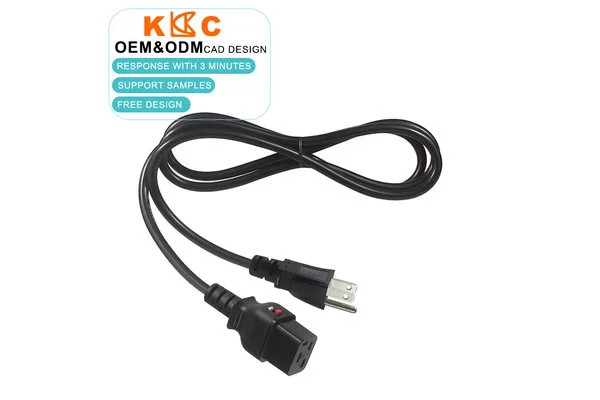
Dongguan (Shenzhen) Kuncan Electronics Co., Ltd. provides NEMA 5-15P to Locking IEC C19 Power Cord solutions for North American equipment power applications. One end uses a NEMA 5-15P plug, while the equipment side uses a locking IEC C19 female connector, matching devices with IEC C20 inlets. Compared with a standard C19 power cord, the locking structure improves cable retention and is more suitable for PDUs, UPS systems, data center racks, and critical equipment that operates for long periods.
Why Are PDU and UPS Applications More Exposed to Maintenance Unplugging?
PDUs and UPS systems are often installed inside racks, equipment rooms, or industrial control cabinets, surrounded by power cords, network cables, and equipment harnesses. During equipment adjustment, cable management, module replacement, or troubleshooting, maintenance personnel may unintentionally pull or touch adjacent power cords. A standard IEC connector mainly relies on insertion friction to stay connected. Under high-density wiring, long-term vibration, or cable tension, it may loosen or disconnect.
For ordinary office equipment, a power interruption may only cause a restart. For PDUs, UPS systems, servers, or network equipment, however, unexpected power loss may cause equipment shutdown, data interruption, backup power abnormality, service interruption, and customer complaints. In rack-based power distribution, one loose power connection may affect more than a single device; it can influence the stability of the whole system.
The function of a locking IEC C19 connector is to enhance cable retention through a locking mechanism, helping reduce unplanned pull-out caused by accidental contact, cable tension, or maintenance operations. For equipment requiring continuous operation, this structure is not a cosmetic feature. It is a practical design for real maintenance risks.
Heat Rise Under Continuous Load Often Comes from Wire Gauge and Current Rating Mismatch
PDUs, UPS systems, and industrial equipment usually operate for long periods. The power cord must remain stable under continuous load. If the wire gauge is too small, the cable is too long, or the current rating does not match the equipment load, cable heat rise, voltage drop, or connector temperature complaints may occur.
This type of North American power cord is commonly used in 125V AC applications. The current rating should be confirmed according to plug construction, wire gauge, and certification requirements. For continuous-load or higher-power equipment, buyers should carefully evaluate 14AWG or 12AWG wire gauge. 16AWG should only be considered for lighter loads where certification allows it.
Incorrect wire gauge selection may not be obvious during sample review, but it can appear during bulk use, long operating hours, or rack environments with limited airflow. When end users report cable heat, unstable power supply, or higher connector temperature, brands and equipment manufacturers often need to handle additional after-sales explanation, testing, and returns. Confirming load, current, cable length, and wire gauge in advance is the foundation of reducing heat-related complaints.
C19/C20 and C13/C14 Confusion Can Cause OEM Rework
In IT equipment and industrial equipment power cord sourcing, IEC connector confusion is a common issue. C13/C14 is often used for lower-power equipment, while C19/C20 is generally used for higher-current or higher-power devices. They differ in shape, size, rating level, and equipment compatibility.
If an OEM sourcing request only says “server power cord” or “PDU power cord” without clearly defining the equipment-side connector, the received sample may not fit the device, or the current rating may fail to meet project requirements. This can lead to sample rework, certification document review, packaging label changes, inventory issues, and delivery delays.
Before purchasing a NEMA 5-15P to Locking IEC C19 Power Cord, buyers should confirm whether the equipment side uses an IEC C20 inlet and whether the wall side requires NEMA 5-15P. Connector specification, current rating, wire gauge, and certification direction should be confirmed as a complete parameter set rather than separately.
Cable Type and Strain Relief Also Affect After-Sales Performance
A locking C19 structure helps reduce connector pull-out, but the stability of the entire power cord also depends on cable type, jacket material, and strain relief design near the plug tail. In PDU, UPS, and rack equipment applications, the cable may be bent, bundled, or under slight tension for long periods. If the tail structure is insufficient, poor contact or jacket wear may still occur.
Common cable type options include SJT / SJTW / SJTOW. SJT is suitable for general indoor equipment connection. If the application involves moisture or outdoor use, SJTW can be considered. If the industrial environment involves oil exposure, abrasion, or more complex conditions, SJTOW may require further evaluation.
For B2B buyers, cable type is not just a cost difference. It is a key factor in determining whether the product fits the target usage scenario. Incorrect cable selection may increase inspection questions, reduce service life, and raise after-sales complaint risks.
How Can OEM Customization Reduce Maintenance and After-Sales Risks?
In addition to electrical parameters, cable identification efficiency in racks should also be considered. Multiple black power cords are often arranged around PDUs and UPS systems. If labels are unclear, cable length is unsuitable, or colors are not differentiated, maintenance personnel may be more likely to unplug, reconnect, or troubleshoot the wrong cable.
OEM projects can reduce operation and maintenance risks through:
- Cable length customization: reduce excessive cable accumulation and improve rack cleanliness
- Label customization: identify equipment number, current rating, connector type, or brand information
- Color customization: help distinguish different devices, circuits, or power paths
- Packaging customization: match retail channels, project delivery, or equipment kit requirements
- Locking structure confirmation: ensure locking direction, release method, and device compatibility
These details may seem small, but they affect on-site maintenance efficiency and end-user experience. For equipment manufacturers and system integrators, the earlier the usage scenario is translated into a specification sheet, the smoother sample approval, system testing, and bulk delivery can become.
What Specifications Should OEM Buyers Confirm Before Ordering?
To reduce maintenance unplugging, heat rise, and after-sales complaints, buyers are advised to confirm the following items before placing an order:
- Plug type: whether North American NEMA 5-15P is required
- Equipment-side connector: whether locking IEC C19 is needed and whether the equipment uses an IEC C20 inlet
- Rated voltage: commonly 125V AC
- Current rating: confirm according to equipment load and certified construction, commonly evaluated up to 15A
- Wire gauge: 14AWG or 12AWG is recommended for continuous-load applications
- Cable type: choose SJT, SJTW, or SJTOW according to rack, moisture-exposed, or industrial environments
- Certification direction: North American projects should confirm UL/cUL, ETL/cETL, or CSA requirements
- Customization items: cable length, color, label, locking structure, and packaging should meet project specifications
These confirmation points help buyers identify potential risks during the sample stage instead of facing complaints, rework, or channel review pressure after the equipment goes live.
Conclusion: Locking C19 Power Cords Support Stable Operation Before Problems Occur
From PDU to UPS, a locking C19 power cord does more than make the connection harder to pull out. It is connected to continuous operation, rack maintenance safety, load matching, wire gauge selection, and OEM specification management.
Dongguan (Shenzhen) Kuncan Electronics Co., Ltd. provides OEM/ODM customization support for NEMA 5-15P to Locking IEC C19 Power Cord, covering wire gauge, cable length, color, label, locking structure, and packaging. For B2B customers serving PDU, UPS, server rack, industrial control equipment, and North American equipment markets, confirming connector type, wire gauge, current rating, and locking structure in advance is an effective way to reduce maintenance unplugging, heat-rise complaints, and after-sales costs.


USER EVALUATE
Here is the customer's evaluation of us