


How Locking C19 Power Cords Help Reduce Loose Connections and Unexpected Shutdowns in Data Center Equipment
In Critical Equipment Power Supply, a Loose Plug Is Not a Small Issue
In data centers, server racks, PDUs, UPS systems, and network communication equipment, a power cord may look like a basic connection component, but it directly affects continuous equipment operation. For B2B buyers, system integrators, and OEM project managers, the real question is not only whether the cord can be plugged in. It is whether the cord can reduce loose connection, accidental unplugging, and specification mismatch risks during high-density rack operation, long working hours, maintenance, and cable management.
Dongguan (Shenzhen) Kuncan Electronics Co., Ltd. provides NEMA 5-15P to Locking IEC C19 Power Cord solutions for critical equipment power applications in the North American market. The product uses a NEMA 5-15P plug on the wall side and a locking IEC C19 female connector on the equipment side, matching devices with IEC C20 inlets. The locking structure helps improve cable retention during rack maintenance, cable pulling, or vibration, making it suitable for servers, PDUs, UPS systems, industrial control equipment, and laboratory equipment.
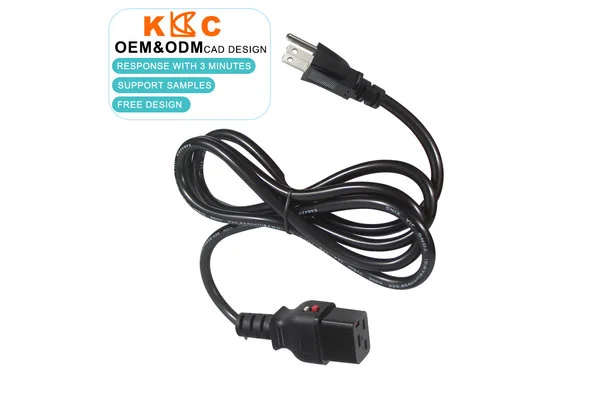
Why Are Data Centers More Exposed to Loose Power Connection Risks?
Inside data center racks, cable density is high. Power cords, network cables, and equipment harnesses are often arranged closely together. During equipment replacement, cable organization, PDU adjustment, or troubleshooting, maintenance personnel may unintentionally touch or pull a power cord. A standard IEC connector mainly relies on insertion friction to maintain connection, which may not be enough under long-term use, vibration, or cable tension.
For ordinary office equipment, power interruption may only cause a restart. For servers, UPS systems, communication equipment, or industrial control systems, unexpected power loss may lead to service interruption, abnormal data processing, higher maintenance costs, or customer complaints.
This is where the locking IEC C19 connector becomes valuable. Its locking mechanism enhances cable retention and helps reduce the possibility of accidental pull-out. For critical equipment that needs continuous operation, this structural detail has more practical value than a simple appearance feature.
NEMA 5-15P and IEC C19 Must Be Verified Together
In North American equipment power projects, both the plug and the equipment-side connector must match. NEMA 5-15P is a common 125V grounded plug in North America, while the IEC C19 female connector is normally used with equipment that has an IEC C20 inlet. If buyers confirm only one end of the cord, project rework may occur.
For example, some IT equipment uses IEC C13/C14 interfaces, while higher-current equipment may use IEC C19/C20 interfaces. C19 and C13 are different in shape, rating level, and application positioning. If OEM buyers do not confirm the equipment inlet during sourcing, samples may fail to fit the device, inventory may become unusable, and packaging labels may need to be redone.
Therefore, when sourcing a NEMA 5-15P to Locking IEC C19 Power Cord, buyers should confirm the wall-side plug, equipment inlet, target voltage, current rating, certification direction, and full application scenario together. This helps reduce specification mismatch and OEM inspection risks.
Why Should Continuous-Running Equipment Pay Attention to Wire Gauge and Heat Rise?
Servers, PDUs, UPS systems, and industrial equipment often operate for long periods. If the power cord uses an insufficient wire gauge or if the current rating does not match the equipment load, heat rise, voltage drop, or connector temperature complaints may occur during continuous load. In rack environments, limited airflow and concentrated cable routing can further increase thermal management pressure.
This type of North American power cord is commonly used in 125V AC applications. The current rating should be confirmed according to NEMA 5-15P, wire gauge, and certified construction. For higher-load or continuous-running equipment, buyers should prioritize evaluating 14AWG or 12AWG wire gauge. 16AWG should only be considered for lighter-load applications where certification allows it.
Wire gauge is not merely a cost item. It is a basic parameter that affects continuous power stability. For B2B buyers, confirming equipment wattage, operating duration, cable length, and wire gauge in advance is more efficient than handling heat-rise complaints or inspection questions later.
Locking Design Should Work Together with Strain Relief and Cable Type
Anti-loose design does not mean the locking connector alone is enough. In data center and industrial equipment applications, cables may be bent, bundled, or under slight tension for long periods. If the plug tail lacks proper strain relief or if the cable jacket does not match the environment, unstable contact, jacket wear, or shorter service life may still occur.
Common cable type options include SJT / SJTW / SJTOW. SJT is suitable for general equipment connections. SJTW can be used for environments with certain moisture or outdoor requirements. SJTOW is more suitable when oil exposure or more complex equipment environments need to be considered. For racks, laboratories, or industrial sites, buyers should select cable type according to ambient temperature, movement frequency, oil exposure, and flexibility requirements.
Clear labeling and cable length planning are also important. In high-density racks, multiple black power cords may be arranged together. Without labels or proper length planning, maintenance personnel may be more likely to unplug or connect the wrong cable. OEM label, color, length, and packaging customization can improve cable identification efficiency in rack management.
What Key Specifications Should OEM Buyers Confirm?
To reduce loose connection, unexpected shutdown, heat rise, and specification mismatch risks, buyers should confirm the following points before placing an order:
- Wall-side plug: whether the project requires North American NEMA 5-15P
- Equipment-side connector: whether locking IEC C19 is required and whether the device uses an IEC C20 inlet
- Rated voltage: common application is 125V AC
- Current rating: confirm according to equipment load, wire gauge, and certified construction, commonly evaluated up to 15A
- Wire gauge: 14AWG or 12AWG is recommended for continuous-load equipment
- Cable type: choose SJT, SJTW, or SJTOW according to standard rack, moisture-exposed, or more complex industrial environments
- Locking structure: confirm locking direction, compatibility, and release method for the target equipment
- Certification direction: North American projects should confirm UL/cUL, ETL/cETL, or CSA requirements
- Customization needs: cable length, color, label, packaging, and branding should meet project specifications
The earlier these details are defined, the smoother sample approval, system testing, channel inspection, and mass delivery can become. Especially in data center and critical equipment applications, a power cord is not a random replaceable accessory. It is part of the whole power reliability design.
Conclusion: Locking C19 Power Cords Support Connection Stability for Critical Equipment
In data center equipment, unexpected shutdowns are not always caused by large system failures. They may come from a loosened connector, a mismatched power cord, or an accidental operation during maintenance. For B2B buyers, selecting the right locking C19 power cord means actively managing these detail-level risks at the early project stage.
Dongguan (Shenzhen) Kuncan Electronics Co., Ltd. provides OEM/ODM customization support for NEMA 5-15P to Locking IEC C19 Power Cord, including wire gauge, cable length, color, locking structure, label, and packaging. For server, PDU, UPS, industrial control, and laboratory equipment customers, confirming NEMA interface, IEC C19/C20 compatibility, current rating, and wire gauge in advance is an effective way to reduce loose connections, unexpected shutdowns, heat-rise complaints, and OEM specification mismatch.


USER EVALUATE
Here is the customer's evaluation of us