


How Can 277V Commercial Lighting Reduce Cord Heat? Wire Gauge and Connection Design for NEMA L7-15P Extension Cords
In warehouse high-bay lighting, commercial buildings, and facility equipment, power cords may carry stable loads for extended operating periods. For buyers, the real question is not merely whether the plug fits. They also need to know whether the plug body will develop abnormal heat, whether a long cable run will create excessive voltage drop, and whether routine movement could loosen the connection. When specifying a NEMA L7-15P Adapter Extension Cord, Dongguan Kuncan Electronics Co., Ltd. recommends evaluating the electrical rating, conductor size, connection design, and installation environment together rather than selecting the cord by appearance or length alone.
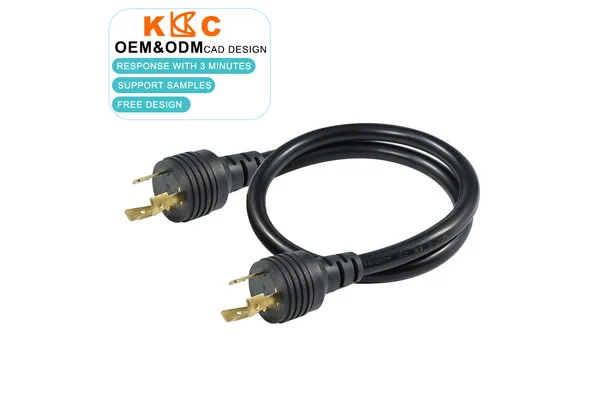
Why Are 15A and 277V Only the Starting Point?
NEMA L7-15P is a locking male plug intended for 277V AC systems. It is rated at 15A and uses a 2-pole, 3-wire grounding configuration. This format is commonly associated with North American commercial lighting and facility equipment, but the plug rating does not remove the need to evaluate every other part of the cord assembly.
The permissible load of the complete assembly is limited by its lowest-rated component, including the cable, female connector, equipment-side interface, and termination method. If the adapter end is not an L7-15R but another connector, an open-end termination, or a proprietary equipment interface, the purchase specification must identify its configuration, gender, wiring assignment, voltage, and current rating. A component rated below 15A or unsuitable for 277V can become the limiting point of the complete cord.
How Does Wire Gauge Affect Heat and Voltage Drop?
For a conventional 15A, 277V application, a three-conductor 14 AWG copper cable can serve as a baseline for engineering evaluation. Conductor size matters because electrical resistance accumulates as cable length increases. Current flowing through that resistance generates heat and causes voltage loss. A nominal 15A label alone is therefore insufficient when the cable is long, the ambient temperature is elevated, or the equipment operates near its continuous load for many hours.
For longer runs or projects with stricter voltage-drop requirements, buyers can evaluate a 12 AWG conductor. Its larger cross-sectional area can reduce cable resistance, but it does not increase the L7-15P plug rating beyond 15A. OEM buyers should provide the actual load, finished length, operating duration, ambient temperature, and installation method so that voltage drop and temperature rise can be reviewed before production. This avoids vague specifications that later lead to warm-connector complaints or field rewiring.
How Does the Locking Interface Reduce Unexpected Shutdowns?
Commercial-lighting cables may be exposed to equipment vibration, maintenance activity, pulling, or repositioning. A straight-blade connection can gradually loosen under repeated mechanical stress, potentially causing unstable contact, localized heating, or intermittent power loss. The NEMA L7-15P interface is inserted and then rotated into a locking position. When paired with the correct L7-15R receptacle, this geometry adds mechanical retention and reduces the likelihood of unintended disconnection.
A locking interface does not replace correct installation. The plug must be fully rotated into position, terminals must follow the applicable assembly process, and the plug-to-cable transition needs suitable strain relief. For repeat OEM production, a molded plug can support more consistent assembly. A field-wireable design may be considered when serviceability or on-site replacement is a project requirement.
Should Buyers Choose SJT or SJTW Cable?
Two cables with the same wire gauge may not be suitable for the same environment. For compatible indoor commercial-lighting installations, buyers may evaluate a 300V SJT cable according to the complete product certification and installation conditions. Where outdoor, damp, or weather exposure is expected, a 300V SJTW construction with the required environmental properties should be considered. Using an indoor jacket in an incompatible environment can increase the risk of hardening, cracking, or insulation damage over time, resulting in maintenance and inspection problems.
Buyers should also confirm the temperature range, abrasion exposure, bending frequency, and local compliance requirements. Approval of an individual plug or cable component does not automatically certify the complete adapter cord. Finished-product markings, testing, and documentation must be reviewed for the target market and application.
What Must Be Confirmed Before an OEM Order?
Before quotation or production, the specification should define the L7-15P male plug, exact adapter-end connector, 15A/277V system requirement, three-conductor 14 AWG or 12 AWG copper cable, finished length, SJT or SJTW jacket, color, molded or field-wireable construction, and required finished-product certification. The phrase “adapter extension cord” does not identify the opposite endpoint. Leaving it undefined can produce inaccurate quotations, unusable samples, or costly batch rework.
For continuously operated 277V commercial-lighting systems, dependable selection comes from complete specification matching rather than one isolated feature. Dongguan Kuncan Electronics Co., Ltd. recommends reviewing the actual load, cable length, adapter endpoint, and installation environment before finalizing a NEMA L7-15P Adapter Extension Cord. This engineering-first approach helps buyers reduce heat-rise complaints, voltage-drop concerns, loose connections, inspection delays, and after-sales risk.


USER EVALUATE
Here is the customer's evaluation of us