


How Certified 3 Prong Laptop Power Cords Reduce Workplace Power Risks
Certified 3 prong laptop power cords are one of the most practical tools for reducing electrical hazards in modern workplaces. The third prong functions as a dedicated ground conductor, redirecting fault current away from users and sensitive equipment. When a cord carries UL, ETL, or CE certification, it has passed rigorous testing for insulation integrity, thermal tolerance, and leakage current thresholds. For procurement teams managing dozens or hundreds of endpoints, choosing a certified grounded laptop power cord is not optional—it is a baseline safety requirement that directly affects compliance, liability, and operational continuity.
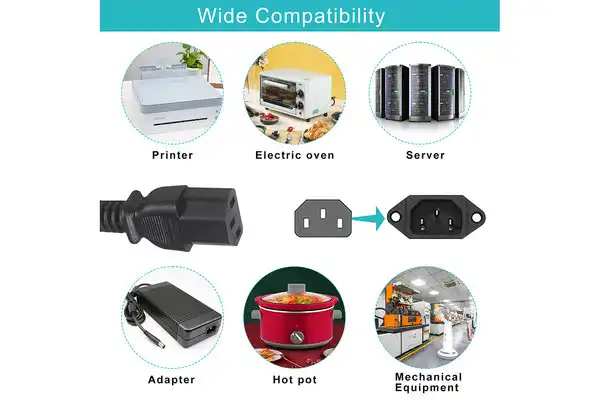
Understanding the Role of 3 Prong Laptop Power Cords in Workplace Safety
What Does the Third Prong Actually Do?
A hot blade, a neutral blade, and a round ground pin make up the NEMA 5-15P plug standard, which is used in all business buildings in North America. That ground pin connects to the chassis of the equipment, making a path to earth with low resistance. If the insulator breaks down or a live wire touches the frame, the fault current goes through the ground circuit instead of the person. The National Fire Protection Association (NFPA) says that electrical problems and failures are still the main reason why office and business buildings catch fire every year. This risk can be stopped before it gets worse with a 3 Prong Laptop Power Cord that is properly grounded.
Marks of certification like UL Listed, ETL, and CE are not just for looks. Standards-based tests were used to make sure the cord passed. These tests included dielectric strength, flammability grade (UL 94 V-0 or similar), circuit resistance, and mechanical endurance. Products that aren't certified may look the same, but they often use conductors that are too thin or PVC compounds that aren't up to par, which break under long-term load.
Key Differences Between 2 Prong and 3 Prong Laptop Power Cords and Their Impact on Safety
A Direct Comparison of Grounding Capability
There is more to the difference between a 2-prong and 3 Prong Laptop Power Cord line than just the number of pins. A 2-prong NEMA 1-15P configuration only carries hot and neutral. This means that the device chassis is free to pick up any stray voltage. Here's how the two types of cord stack up against the most important factors for business buyers:
| Specification | 2-Prong (NEMA 1-15P / IEC C7) | 3 Prong Laptop Power Cord (NEMA 5-15P / IEC C5) |
|---|---|---|
| Ground Conductor | Absent | Present (dedicated ground pin) |
| Shock Hazard Mitigation | Minimal | Effective fault-current redirection |
| Compatible Equipment | Class II double-insulated devices | Class I grounded devices (most enterprise laptops) |
| UL/ETL Certification Availability | Limited | Broadly available |
| Typical AWG | 18 AWG | 18 AWG / 16 AWG / 14 AWG |
| Max Current Rating (North America) | 10A / 125V | 10A / 125V (standard configuration) |
| Enterprise Suitability | Limited | Recommended for corporate IT fleets |
Dell, HP, Lenovo, and Asus business laptops usually come with AC adapters that have IEC C5 (cloverleaf) connectors. This means that they are designed to work with a grounded NEMA 5-15P 3 Prong Laptop Power Cord. If you use an ungrounded 2-prong cord with these adapters, they won't work together, and there is a real risk of shock in damp or busy places.
Common Power Risks in the Workplace and How Certified Laptop Power Cords Address Them
Overheating, Surge Events, and Short Circuits
Electrical accidents at work don't usually make a noise. Undersized conductors that carry steady loads often cause cables to overheat. This is a problem that often happens with uncertified cords that use conductors that are smaller than the labeled gauge. Surges can happen when equipment is turned back on or when the power goes out, sending short-term charges through shared lines. Short circuits can happen when insulation fails near tight bend points. This is another problem that often happens in open-plan offices where cables go under desks.
Certified grounded power lines are made to protect against these types of failure, not just by chance. Here are the main safety features that a well-made 3 Prong Laptop Power Cord should have:
- Heavy-duty flame-retardant PVC jacket with strain-relief molding: The jacket of a good SVT-rated cord protects against oil, abrasion, and moisture. Molded strain relief at both ends of the cord stops conductor fatigue at the most vulnerable flex points, which are where the cord meets the plug and connector bodies. Without strain relief, repeated bending cuts the wire strands inside, creating a resistance point that heats up when the load is put on it.
- Oxygen-free copper (OFC) conductors at accurate AWG rating: OFC with a high conductivity level reduces resistive heat for a given current. An 18 AWG OFC conductor rated for 10A / 125V keeps that capacity across its entire length without voltage sag. This makes sure that the laptop adapter always gets a stable input voltage.
- Certified IEC 60320 C5 connector with positive retention: The molded C5 socket on an approved cord snaps tightly into the laptop adapter's input, so the cord doesn't disconnect by accident. Arcing happens when connections come and go, which is a known cause of workplace fires.
All of these design features work together to provide stable, temperature-controlled power that keeps both the user and the connected equipment safe. Before going to the adapter level for diagnostics, maintenance teams that are trying to figure out why breakers or adapters keep failing should check the status of the cord's certification.
Selecting and Procuring Certified 3 Prong Laptop Power Cords for Corporate Needs
What Specifications Should Procurement Managers Prioritize?
When buying a lot of 3 Prong Laptop Power Cords, the specs determine how reliable they will be in the long run. The Kuncan Electronics NEMA 5-15P to IEC C5 power cord is designed to be used for high-volume B2B distribution, replacement parts, and connecting IT equipment. Its fully molded assembly gets rid of the loose internal links that cause cheaper options to fail in the field. There are three different sizes of SVT jackets: 18AWG, 16AWG, and 14AWG. All of them use pure copper conductors, so they can handle a variety of load profiles across laptop fleets.
Before making a bulk order, it's important to check the following buying criteria:
- Certifications: The cord meets North American safety and environmental standards as shown by its UL/cUL listing and RoHS compliance. For companies that do business around the world, ETL and CE marks mean that their products are accepted more widely around the world.
- Conductor material: You must choose oxygen-free or high-conductivity pure copper. Copper-clad aluminum (CCA), which is used in some cheap wires, has a higher resistance and a lower mechanical wear tolerance.
- Cable length options: There are different lengths of cables available. Standard lengths of 6ft and 10ft work for most desk setups. For special installations, you can get lengths that aren't standard.
- Packaging for logistics: Individual polybagged units with part number labeling support asset tracking; master carton packaging makes receiving items in the warehouse and managing inventory easier.
When you compare OEM original cords to certified third-party alternatives, you can see that certified third-party products from well-known brands often match OEM electrical performance at a lower cost per unit, as long as the certifications are real and can be checked.
Building a Safer Workplace Through Informed Power Cord Procurement
Establishing a rule that all laptops and other IT equipment must have certified, grounded power lines cuts down on the risk of electrical accidents by a measurable amount. When companies only use UL-listed or ETL-certified cords, they cut down on the number of service calls related to cords and the risk that comes with having non-compliant equipment in covered buildings. According to OSHA's General Industry rules (29 CFR 1910.303), electrical equipment must be approved and used according to the instructions on the label. This includes power supply lines used in businesses.
During compliance reviews, the audit cycle can be cut down by teaching procurement staff to check certification marks, cross-reference part numbers against public UL or ETL databases, and keep a vendor-approved list. The long-term financial benefit is clear: less equipment failure means less unplanned downtime, lower replacement costs, and less risk of liability claims at work.
Conclusion
Certified grounded 3 Prong Laptop Power Cords are a low-cost, high-impact way to protect workers from electrical hazards. The third point, the right size of the conductors, flame-resistant jacketing, and approval marks that can be checked all deal with a known failure mode. Standardizing on products like the Kuncan Electronics NEMA 5-15P to IEC C5 cord—made to 10A/125V ratings with OFC conductors and full UL/cUL compliance—makes safety results predictable on a large scale for buying teams in charge of corporate IT fleets. The security it offers is not small, but the expense is.
FAQ
How do I verify that a laptop power cord is genuinely UL or ETL certified?
Look on the jacket of the cord and the body of the molded plug for the printed file number and certification mark. You can use UL's Product iQ database to find ETL file numbers and Intertek's directory to find UL file numbers. The logo of the licensing body, the file number, and the product group are all part of a real mark. Watch out for marks that look like they were printed instead of molded or that don't have a file number to go with them.
Are certified 3-prong cords compatible with all major laptop brands?
Most business computers from Dell, HP, Lenovo, Asus, and Acer have AC chargers with IEC 60320 C5 plugs. This means that a NEMA 5-15P to C5 cord will work with all of those laptops. Before you buy, you should always check the adapter's input type. If you're not sure, send us a picture of the adapter, and we'll help you find the right port setup.
What warranty and support should I expect from a B2B supplier?
A reliable seller will offer a warranty that covers production flaws for at least one year and keep records of quality control. Kuncan Electronics backs up every package with full electrical testing, materials that are RoHS-compliant, and quick customer service after the sale. It takes 3–7 business days to ship a sample order, and 15–25 days for bulk production, depending on the amount ordered.
Elevate Your Facility's Safety Standards with Kuncan Electronics' 3 Prong Laptop Power Cord Supplier Solutions
Kuncan Electronics sells certified, industrial-grade power cords for laptops that are made for tough B2B buying processes. As a reliable 3 Prong Laptop Power Cord manufacturer with 17 years of experience, we offer UL/cUL-listed, RoHS-compliant cords that can be fully customized for OEMs. This includes custom lengths, jacket materials, and branded packaging. Keep your employees safe and make your supply chain run more smoothly. To get samples and bulk pricing right away, email our procurement experts at rhea@szkuncan.net or visit nema5-15.com today.

References
1. National Fire Protection Association (NFPA). NFPA 70: National Electrical Code. 2023 Edition.
2. Underwriters Laboratories (UL). UL 817: Standard for Cord Sets and Power-Supply Cords. 2019.
3. Occupational Safety and Health Administration (OSHA). 29 CFR 1910.303: General Requirements for Electrical Equipment. U.S. Department of Labor, 2022.
4. International Electrotechnical Commission (IEC). IEC 60320-1: Appliance Couplers for Household and Similar General Purposes. 2021.
5. Intertek ETL. Electrical Safety Testing and Certification for Power Cords and Assemblies. Intertek Group, 2022.
6. National Institute of Standards and Technology (NIST). Guidelines on Electrical Safety and Grounding in Commercial Buildings. NIST Special Publication, 2020.

USER EVALUATE
Here is the customer's evaluation of us