


Key Compliance Checks Before Importing 16AWG AC Power Cords from Suppliers
Importing a 16AWG US AC Power Cord – NEMA 5-15P to IEC C13 without verifying compliance is one of the costliest mistakes a procurement manager can make. Non-compliant power cords trigger CBP holds, retailer rejections, and—worst case—product recalls. This guide walks you through every critical checkpoint: applicable safety certifications (UL, CSA, RoHS, REACH), wire gauge selection rationale, supplier audit protocols, and pre-shipment inspection standards. Whether you source for data centers, industrial automation, or medical equipment, these checks protect your supply chain and your reputation.
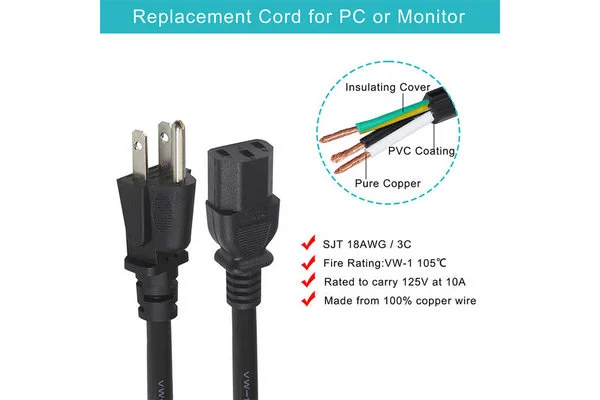
Understanding 16AWG AC Power Cords and Their Compliance Requirements
Why Compliance Matters Before a Single Unit Clears Customs
A normal NEMA 5-15P to IEC C13 power line has three wires and two molded ends, which makes it look very easy. But U.S. Customs and Border Protection (CBP) regularly holds shipments that don't have UL or ETL marks that can be checked. The National Electrical Code (NEC) Article 400 says that power supply cords used in the workplace must meet the standards set by OSHA 29 CFR 1910.303. Failure quickly spreads: delayed cargo, legal fees, faster air freight to replace stock that was refused, and the possibility of being sued if a non-compliant cord starts a fire.
Several standards combine when it comes to the rules that apply to this type of wire. UL 817 sets the rules for wire sets and power supply lines in the US. Canada's market is covered by CSA C22.2 No. 21. The RoHS Directive 2011/65/EU limits dangerous chemicals, and the REACH Regulation (EC) No. 1907/2006 requires that substances of very high concern (SVHCs) be made public. For goods that will be sold in Europe, the CE mark means that they meet EU low-voltage and EMC standards.
The difference between a "listed" product and a "labeled" product is often missed by procurement teams. UL's online Product iQ database can be used to track down a listed UL file number, but a fake UL mark stays the same and can't be checked. Before making an order, you should always check the file number that the seller gives you against UL's live registry.
Key Criteria for Selecting Compliance-Ready 16AWG Power Cords
Which Wire Gauge Is Right for Your Application?
The 16AWG specification can handle 13A continuously at 125V with very little resistive voltage drop. This is a clear advantage over the 18AWG cords that are usually used for lighter consumer applications. The table below shows the actual trade-offs between the three measuring sticks that are most often used in IT and industry procurement:
This cable has a 14AWG, 16AWG US AC Power Cord -NEMA 5-15P to IEC C13, and 18AWG gauge. Its maximum current (125V) is 15A, 13A, and 10A. It is usually used in heavy industry, PDUs, server racks, workstations, and light consumer electronics. The voltage drop at 6 feet is very low, low, moderate, and moderate. The cable is stiff, balanced, and flexible. The jacket cost index is higher, moderate, and lower.
| Parameter | 14AWG | **16AWG** | 18AWG |
|---|---|---|---|
| Max Current (125V) | 15A | 13A | 10A |
| Typical Application | Heavy industrial, PDU | Server racks, workstations | Light consumer electronics |
| Voltage Drop (6ft) | Very low | Low | Moderate |
| Cable Flexibility | Stiffer | Balanced | Most flexible |
| Jacket Cost Index | Higher | Moderate | Lower |
For people in charge of server racks, the 16AWG sweet spot is important because it can handle constant high-draw loads without being as bulky as 14AWG and doesn't get as hot as 18AWG does close to its rated ceiling. In UL file E484253, Kuncan Electronics confirms its 16AWG (3x1.31mm²) pure copper wires as stable at 125V/13A under long-term load conditions.
Connector Compatibility: NEMA 5-15P, IEC C13, and IEC C14
The grounded three-blade plug NEMA 5-15P is used in 125V/15A outlets all over North America. The IEC 60320 C13 plug fits into C14 ports on computers, KVM switches, and power distribution units (PDUs). When you choose a right-angle C13, the horizontal clearance drops by about 40 mm in rack environments with a lot of equipment. This is helpful for managing 42U cabinets. Make sure the connection body meets the standards of IEC 60320 for retention force. Loose contacts make arcing and insulation degradation happen faster.
Compliance Verification and Supplier Audit Checklist
What Documents Should You Request Before Placing a Bulk Order?
It is necessary to authenticate documents. Here are the main papers that every seller who is following the rules must provide without any doubt:
- UL/cUL Certificate of Compliance referencing a traceable file number (e.g., E484253) cross-checked against UL Product iQ. This confirms the specific cable construction—conductor cross-section, jacket type, voltage rating—matches what the supplier ships.
- RoHS and REACH Declarations of Conformity (DoC) signed by an authorized representative, supported by third-party XRF or ICP-OES test reports identifying restricted substance concentrations in all homogeneous materials.
- Hi-Pot and Continuity Test Reports generated at 100% production-line testing. A dielectric withstand voltage of at least 1,500V AC for one minute between conductors and the outer jacket confirms insulation integrity across every unit.
- Factory Audit Report from a recognized third-party auditor (e.g., SGS, Bureau Veritas, Intertek) covering process controls, raw material incoming inspection, and statistical process control (SPC) data on conductor diameter and jacket wall thickness.
All of these papers together make a paper trail that protects you in case the CBP questions you or a customer disputes their warranty. If a provider doesn't want to share any of these, that should be a red flag right away.
Check the labeling as well as the documentation for the 16AWG US AC Power Cord -NEMA 5-15P to IEC C13. Article 400 of the NEC says that cord sets must have the maximum voltage, ampacity, and certification mark firmly molded or written on the jacket. The SJTW or SJT cable type designation must also be there. These jacket classifications tell you where the cord can legally be used.
Comparing Suppliers: How to Evaluate Safety, Quality, and Compliance?
How Do You Balance Price, MOQ, and Compliance Without Compromising Quality?
There's more to evaluating a supplier than just the unit price. A cheaper cord made with CCA (copper-clad aluminum) conductors instead of pure copper will have higher resistivity, faster thermal cycling fatigue, and might not be able to keep its UL listing, since most UL-listed cord constructions call for annealed copper. Make sure you get specific statements, not guesses.
Customization by OEM adds more compliance factors. If you ask for jackets in colors or lengths that aren't standard, the supplier has to re-certify or get a follow-up inspection from the listing agency in case the construction is different from what's shown in the file. Kuncan Electronics can handle OEM/ODM orders starting at 10 PCS and offers free CAD design. Our engineering team also sets up follow-up inspections to make sure your custom build stays within the certified building limits.
Not just the number given, but also your product cycle should be used to compare wait times. Kuncan ships large orders within 15–25 business days and turns around samples in 3–7 days. This gives purchasing teams time to compare physical samples to specification sheets before committing to large orders.
Best Practices and Final Recommendations for Smooth Import and Procurement
What Pre-Shipment Steps Prevent Costly Customs Delays?
Before the cargo leaves the origin facility, get a pre-shipment inspection (PSI) from a reputable third-party agency. Random-sample Hi-Pot tests, cross-section microscopy to check the dimensions of the wire gauge, and label readability checks should all be part of the PSI. According to CPSC guidelines, electrical goods should be tested at least to the AQL 2.5 level.
Keep an ongoing supplier scorecard that tracks the number of defects per shipment, the percentage of on-time deliveries, and the speed at which documentation is turned around. When there are non-conformances, suppliers who respond with root cause analysis reports instead of just replacement units show the kind of manufacturing discipline that keeps compliance high over time.
A strategic tool is having an open and ready-for-audit partnership with your supplier. Compliance isn't a one-time thing; it needs to be checked again and again, especially when the provider changes where the raw materials come from or the tools used to make the goods.
Conclusion
Importing compliant 16AWG US AC Power Cord -NEMA 5-15P to IEC C13 demands systematic verification at every stage—certifications, conductor materials, connector ratings, documentation authenticity, and pre-shipment inspection. The NEMA 5-15P to IEC C13 configuration is a workhorse in data center and industrial procurement precisely because it balances current capacity, mechanical durability, and broad device compatibility. Cutting corners on any single compliance checkpoint exposes your organization to regulatory, financial, and reputational risk. Treat compliance as an ongoing discipline, and your supply chain becomes a competitive advantage rather than a liability.

FAQ
What certifications should a 16AWG power cord carry for the U.S. market?
At minimum, the cord must carry a UL or ETL listing to NEMA WC-57/ICEA S-73-532 or UL 817. The file number must be verifiable in the listing agency's live database. RoHS compliance is required for products also distributed in the EU.
Can I substitute 18AWG cords for 16AWG in server rack applications?
Not reliably. At continuous 13A loads, an 18AWG cord operates near its rated ceiling, generating excess heat and accelerating insulation degradation. UL 817 restricts 18AWG cord sets to 10A in cord-and-plug connected equipment.
What does SJTW jacket designation mean?
SJTW denotes a junior hard-service thermoplastic cord rated for 300V, with a "W" suffix indicating weather and moisture resistance. It is suitable for both indoor heavy-duty and temporary outdoor applications, meeting NEC Article 400 Table 400.4.
How do I verify a UL file number is authentic?
Enter the supplier's stated file number at UL's Product iQ portal (iq.ul.com). Confirm that the listed construction—wire gauge, conductor type, jacket material—matches the physical product you receive.
What is the minimum insertion cycle rating I should require?
Specify a minimum of 10,000 mating cycles per IEC 60320 mechanical endurance requirements. Kuncan Electronics' connectors are validated to exceed this threshold through 100% factory continuity and Hi-Pot testing.
Partner with Kuncan Electronics for Certified 16AWG US AC Power Cord – NEMA 5-15P to IEC C13 Supply
Kuncan Electronics is a reliable company that has been making 16AWG US AC Power Cord – NEMA 5-15P to IEC C13 for 17 years and has UL file E484253 certification. When you order 10 PCS or more of our SJTW/SJT jacketed cords, we'll be happy to help you with OEM support and all the paperwork you need for RoHS/REACH. You can email our team at rhea@szkuncan.net or go to nema5-15.com to ask for a compliance sample package and speed up your buying process with trust.
References
1. Underwriters Laboratories. UL 817: Standard for Cord Sets and Power-Supply Cords. UL Standards & Engagement, 2023.
2. National Fire Protection Association. NFPA 70: National Electrical Code (NEC), Article 400 – Flexible Wiring Methods. NFPA, 2023.
3. International Electrotechnical Commission. IEC 60320-1: Appliance Couplers for Household and Similar General Purposes. IEC, 2021.
4. European Parliament. RoHS Directive 2011/65/EU on the Restriction of the Use of Certain Hazardous Substances in Electrical and Electronic Equipment. Official Journal of the European Union, 2011.
5. Occupational Safety and Health Administration. OSHA 29 CFR 1910.303: Electrical – General Requirements. U.S. Department of Labor, 2019.
6. CSA Group. CSA C22.2 No. 21: Cord Sets and Power Supply Cords. Canadian Standards Association, 2020.

USER EVALUATE
Here is the customer's evaluation of us