


16AWG Power Cord vs Standard Cables: Which Option Prevents Long-Term Failures?
Picture this: a data center technician arrives Monday morning to find three servers offline. The culprit — an 18AWG power cord that overheated overnight under continuous load. Downtime costs average $9,000 per minute in enterprise environments, according to Gartner. That single cable choice triggered a cascade of equipment damage, emergency procurement, and lost revenue. Choosing the right power cord is not a minor specification detail; it is a frontline decision that directly protects your operation. The 16AWG US AC Power Cord with NEMA 5-15P to IEC C13 connectors exists precisely to prevent scenarios like this one.
What Do 16AWG Specifications Actually Mean for Your Equipment?
How Wire Gauge Affects Current Capacity and Heat?
In the American Wire Gauge method, a smaller number means the conductor is thicker. The cross-sectional area of a 16AWG conductor is about 1.31 mm², and that of an 18AWG conductor is about 0.82 mm². That change in size directly affects how much power it can carry. A 16AWG cord can handle up to 13A constantly at 125V, but an 18AWG cord can only handle 10A in the same situation. That 3A gap is what separates stable operation from thermal failure in long-term, high-draw environments like server racks or industrial control cabinets.
What NEMA 5-15P to IEC C13 Connector Pairing Delivers?
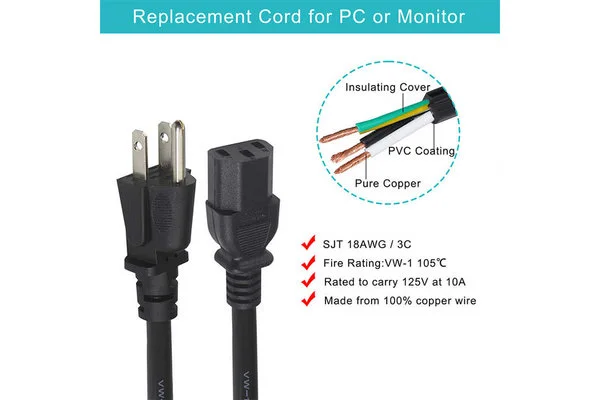
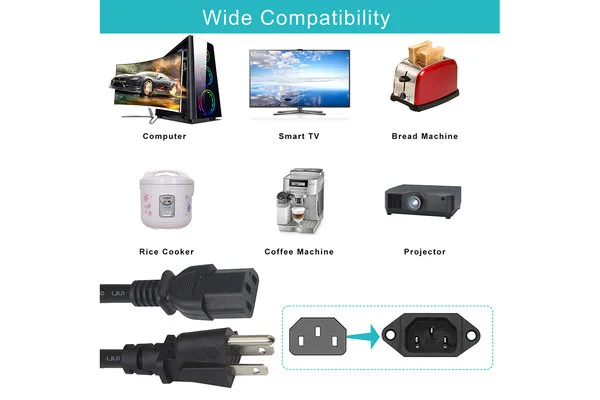
Standard three-prong US wall switches rated at 125V/15A can connect to the NEMA 5-15P plug. The IEC 60320 C13 connector fits into the ports on almost all servers, workstations, network switches, and lab equipment. The most common power cord link in North American IT infrastructure is this NEMA 5-15P to IEC C13 pair. Because it has three grounded poles, it protects both people and equipment from ground faults.
What Happens When You Choose an Undersized Power Cable?
The Hidden Costs of 18AWG Cords in High-Draw Environments
Undersized wires don't break in a big way; they break down quietly. When an 18AWG cord is loaded continuously and close to its rated limit, resistance goes up and heat builds up in the insulation. Over the course of weeks and months, the jacket becomes less flexible, the wires oxidize, and the contact resistance at the connecting ends increases. Equipment power sources get voltage that isn't stable, which can cause restarts, bad data writes, and premature component wear. A study published in 2022 in IEEE Transactions on Industry Applications confirmed that thermal fatigue in power conductors that are too small is a real cause of some unplanned failures in industrial equipment every year.
In addition to electrical degradation, the problem is made worse by mechanical wear. When cables are run through tight rack areas, they have to bend over and over again. Without the right jacket thickness and conductor cross-section, internal strand breakage happens without being seen until partial transmission causes periodic faults, which are one of the hardest problems for any maintenance team to figure out and fix.
Why 16AWG Power Cords Deliver a Stronger Long-Term Return?
When buying cables, procurement teams often only look at the price per unit. That lens makes the real cost picture look different. Here are the main structural benefits of 16AWG US AC Power Cord -NEMA 5-15P to IEC C13 that make it a good choice for tough settings:
- Higher ampacity headroom: Running at 10A on a 13A-rated 16AWG cord keeps the conductor at roughly 77% of its capacity, which significantly suppresses resistive heat buildup and prolongs insulation life compared to an 18AWG cord operating near its ceiling.
- SJTW/SJT jacket construction: The SJTW designation certifies the jacket for outdoor and wet-location use, with a 105°C temperature rating and VW-1 flame-retardant classification. This dual-environment suitability makes the same cord appropriate for server rooms, industrial floors, and temporary outdoor installations.
- Molded strain relief at both connectors: Strain relief absorbs mechanical stress at the junction between cable and connector — the point statistically most prone to internal conductor fracture under repeated insertion and movement cycles.
- UL Listed certification under File No. E484253: UL certification is not a marketing stamp. It confirms that the product was independently tested against UL 817 standard requirements, including dielectric withstand, conductor resistance, and flammability.
All of these benefits cut down on unplanned replacement cycles and the labor costs that come with them. When procurement managers look at the total cost of ownership over 36 months, they always find that higher-specification cords result in lower overall costs.
How Does Kuncan's 16AWG Cord Compare Against Standard Market Options?
The following table shows a straight comparison based on the most important factors for B2B buying decisions:
| Criteria | Kuncan 16AWG NEMA 5-15P to C13 | Standard 18AWG Market Cable |
|---|---|---|
| Wire Gauge | 16AWG (1.31mm² pure copper) | 18AWG (0.82mm² copper or CCA) |
| Current Rating | 125V / 13A–15A | 125V / 10A |
| Jacket Type | SJTW / SJT, 105°C rated | SPT-1 or SPT-2, 60°C–75°C rated |
| Flame Rating | VW-1 | Often unrated or V-2 |
| UL Certification | UL Listed, File No. E484253 | Varies; many lack UL listing |
| Conductor Material | 100% pure copper | Often copper-clad aluminum (CCA) |
| Insertion Cycle Life | 10,000+ cycles (Hi-Pot tested) | Typically 1,000–2,500 cycles |
| Connector Options | Straight and right-angle C13 | Straight only |
| OEM/ODM Support | Yes, MOQ 10 PCS, free CAD design | Rarely available |
| Environmental Compliance | RoHS and REACH compliant | Inconsistent |
At the same gauge, copper-clad aluminum conductors, which are popular in cheap lines, carry about 61% of the current of pure copper. When there is a steady current, CCA conductors get hotter, expand and contract more quickly, and oxidize at the join points more quickly than pure copper 16AWG US AC Power Cord -NEMA 5-15P to IEC C13. CCA is not a good alternative for industrial and medical uses where cable integrity is very important.
What Should Procurement Managers Verify Before Placing a Bulk Order?
To choose the right cable standard, you need to consider three factors: the maximum input current of the equipment, the installation environment, and the connector design. Check each device's nameplate amperage to make sure it is correct. According to NEC Article 400, a 16AWG cord is the least that can be used if any unit continuously takes more than 10A.
Make sure that the provider you're working with has a real UL file number and not just a UL logo on their packaging. In the cable market, fake certificates are known to be a problem. You can look directly on UL's Product iQ database for a real UL file number like E484253, which lets you check it yourself in less than two minutes.
When a rack is used and a horizontal line exit is needed to reduce bending stress and free up space on the back panel, right-angle C13 connections should be considered. Kuncan Electronics has both straight and right-angle configurations, and you can change the cable lengths and jacket colors starting with just 10 pieces. This is a reasonable minimum quantity for both test runs and small-batch restocking orders.
Conclusion
It's not a matter of personal taste when deciding between a 16AWG heavy-duty power cord and a standard 18AWG cable. It's a matter of risk management that has real-world financial effects. Thinner wires, worse jacket materials, and no approvals all add up to more failure paths that lower equipment uptime over time. There are no more weaknesses with the 16AWG US AC Power Cord with NEMA 5-15P to IEC C13 connectors. It has UL approval and has been tested at the plant 100 percent of the time. Getting the right specification from the start protects your equipment, your team, and the continuity of your operations.
FAQ
Is a 16AWG power cord necessary for typical office computers?
Most desktop computers draw between 3A and 6A at full load. While an 18AWG cord can technically handle that range, a 16AWG cord provides greater thermal headroom and longevity in environments where cables remain plugged in continuously for months. For server-class hardware drawing 8A–12A, the 16AWG specification is a practical requirement rather than an optional upgrade.
What makes the NEMA 5-15P to IEC C13 combination the standard for IT equipment?
The IEC 60320 C13 inlet is specified by virtually every major server and networking equipment manufacturer globally. The NEMA 5-15P plug matches the standard three-prong outlet found throughout North American facilities. This pairing creates a universally interchangeable power ecosystem, simplifying spares management across mixed-equipment environments.
Can a 16AWG cord reduce overheating risks in dense server racks?
Yes. Resistive heat generation in a conductor scales with the square of current and inversely with conductor cross-section. A 16AWG conductor running at 10A generates significantly less heat per unit length than an 18AWG conductor at the same load. In high-density racks where ambient temperatures are already elevated, that thermal reduction meaningfully lowers the risk of insulation degradation and connector failure.
How do I verify a cable's UL certification is genuine?
Search the supplier's UL file number on UL's Product iQ database at ul.com/piq. Kuncan Electronics' products are listed under File No. E484253, which you can verify independently.
Partner with Kuncan Electronics for Certified 16AWG Power Cord Solutions
Kuncan Electronics is a reliable company that has been making 16AWG US AC Power Cord NEMA 5-15P to IEC C13 for 17 years and has world approvals such as UL, cUL, RoHS, and REACH. Our factory-tested, pure copper cords can be bought in bulk, and you only need to order 10 PCS to get free CAD design help. You can also choose your own length and color. Protect your infrastructure with cables that are made to last longer than the things they power. To get a quote right away, email your requirements to rhea@szkuncan.net or go to nema5-15.com.
References
1. Gartner Research. (2014). The Cost of Data Center Downtime. Gartner, Inc.
2. IEEE Transactions on Industry Applications. (2022). Thermal Fatigue Analysis of Power Conductors in Industrial Environments. IEEE.
3. National Fire Protection Association. (2023). NFPA 70: National Electrical Code (NEC), Article 400 — Flexible Wiring Methods. NFPA.
4. Underwriters Laboratories. (2021). UL 817: Standard for Cord Sets and Power-Supply Cords. UL Standards & Engagement.
5. IEC. (2020). IEC 60320-1: Appliance Couplers for Household and Similar General Purposes. International Electrotechnical Commission.
6. U.S. Consumer Product Safety Commission. (2019). Electrical Fire Hazards: Wire Gauge and Overcurrent Risks in Commercial Environments. CPSC.

USER EVALUATE
Here is the customer's evaluation of us