


When the Wall Outlet Is Out of Reach: How a Short NEMA 10-30 Extension Cord Can Reduce Installation Rework
After a dryer arrives at the jobsite, an installer may discover that the wall outlet is out of reach, the original appliance cord cannot follow a natural route, or there is not enough clearance for the plug and cable behind the machine. Relocating fixed wiring adds labor, while an unnecessarily long extension may leave excess cable crowded behind the appliance. For this limited-distance connection requirement, the NEMA 10-30P to 10-30R short extension cord from Dongguan Kuncan Electronics Co., Ltd. uses a confirmed 30A, 250V AC, STW 10AWG/3C, and 2FT configuration to provide focused distance compensation for a compatible existing 3-prong dryer circuit.
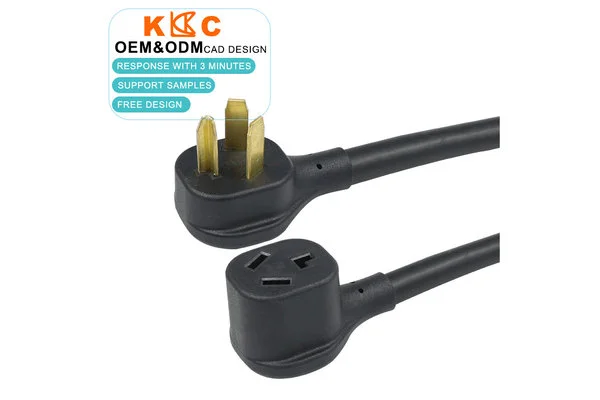
A 2FT Cord Solves a Specific Distance Gap
Dryer installation spaces are often compact. The wall receptacle may be positioned behind one side of the appliance, while the original plug exit direction may not suit the site layout. When the connection is short by only a limited distance, relocating the fixed outlet may create unnecessary labor and wall work. Choosing a much longer extension can instead leave excess cable coiled, pinched, sharply bent, or placed near a heat source.
Two feet is approximately 0.61 m, making this configuration suitable for bridging a small outlet-to-appliance gap while reducing excess cable behind the dryer. For OEM buyers, the value of this length comes from matching a defined installation problem rather than replacing every other length option. The actual routed distance should still be measured before ordering, with clearance allowed for a natural bend rather than using only a straight-line measurement.
An Incorrect Connector Direction Prevents Installation
In a NEMA designation, “P” identifies a male plug and “R” identifies a receptacle or female connector. A straight-through extension assembly should use the NEMA 10-30P male end for the existing 10-30R wall outlet and the NEMA 10-30R female end for the appliance’s 10-30P plug. A purchase specification that says only “NEMA 10-30 cable” does not fully define the connector direction or application.
Engineering drawings, product titles, and packaging should consistently state “10-30P to 10-30R” and include front-view connector images for blade and slot verification. This reduces the likelihood of confusing 10-30 with different configurations such as 10-50 or 14-30 and helps prevent returns or delivery delays caused by a cord that cannot connect on site.
A Short 30A Cord Still Requires Contact-Heat Control
The confirmed product specification is 30A, 250V AC with an STW 10AWG/3C cable. The three-conductor 10 AWG construction establishes a clear conductor baseline for the 30A application, while the 2FT length limits unnecessary extension distance. Actual performance still depends on conductor material, termination quality, receptacle condition, ambient temperature, and equipment load.
A short cord is not automatically free from heat-related concerns. Reduced contact pressure in an aged wall receptacle, incomplete engagement at the female connector, or excessive termination resistance can create localized temperature rise. Buyers should verify the complete cable printing, plug and receptacle ratings, and finished-product electrical tests. Installers should also inspect the existing outlet for looseness, discoloration, or damage rather than using a new extension cord to conceal a problem in the original circuit.
Molded Strain Relief Must Match Rear Clearance
The pictured assembly uses molded male and female connector bodies with integrated strain-relief transitions at the cable exits. This construction helps distribute mechanical stress from insertion, pulling, and repeated bending away from the conductor terminations. If the appliance is pushed too close to the wall, however, the connector body or strain relief may still remain under constant pressure.
Before selecting the 2FT version, OEM buyers should provide the receptacle orientation, appliance-to-wall clearance, connector size restrictions, and intended cable route. Installation needs a suitable bending radius and should avoid sharp bends, crushing, or continuous tension. Projects with especially limited clearance should complete a fit test on the actual appliance during sample approval instead of relying on length data alone.
The 3-Wire Structure Limits the Application
NEMA 10-30 uses a 3-pole, 3-wire, non-grounding configuration, generally consisting of two line conductors and one neutral without a separate equipment-grounding conductor. It differs fundamentally from the 4-wire NEMA 14-30 configuration in both grounding method and connector geometry. The two formats are not interchangeable simply because both may carry a 30A marking.
This short extension cord should therefore be positioned for a compatible existing NEMA 10-30 dryer circuit. Buyers must verify the equipment nameplate, wall receptacle, and local installation requirements. Without confirmation from the equipment manufacturer or a qualified electrical professional, it should not be generalized for EV charging, industrial equipment, or loads that require a separate equipment ground. Clear application boundaries help reduce returns and after-sales disputes.
How Can OEM Buyers Reduce Field Rework?
An actionable purchase specification should state: NEMA 10-30P male, NEMA 10-30R female, 30A 250V AC, STW 10AWG/3C, 2FT finished length, 3-pole 3-wire non-grounding configuration, molded construction, cable printing, target equipment, testing requirements, and finished-product certification requirements. Because an image cannot verify conductor material, temperature rating, weather-resistance scope, or certification status, these points still require confirmation through technical documentation and samples.
A short extension cord reduces rework only when its dimensions and electrical specifications both match the installation. Dongguan Kuncan Electronics Co., Ltd. recommends completing site measurements, drawing approval, and an actual fit test before mass production so that the 2FT extension length, 10-30P-to-10-30R interface, and 30A load requirements form a complete specification. This helps reduce the risk of insufficient rear clearance, compressed connectors, interface errors, and repeated installation work.


USER EVALUATE
Here is the customer's evaluation of us