


Why Is Connector Shape Not Enough? Compatibility Checks for Saf-D-Grid Data-Center Power Cords
In power connections for servers, network switches, and telecommunications hardware, a connector that appears to fit is not necessarily compatible. Saf-D-Grid includes different series, housing designs, and application configurations. If buyers order from a product photo or connector outline alone, they may discover after delivery that the keying is different, the latch cannot engage, the equipment-inlet rating does not match, or the point-to-point wiring is incorrect. When sourcing a NEMA 5-15P to Saf-D-Grid Power Cord, Dongguan (Kuncan Electronics Co., Ltd. recommends reviewing compatibility across five layers: mechanical interface, electrical rating, wiring, installation, and compliance.
1. Saf-D-Grid Does Not Mean Every Series Is Intermateable
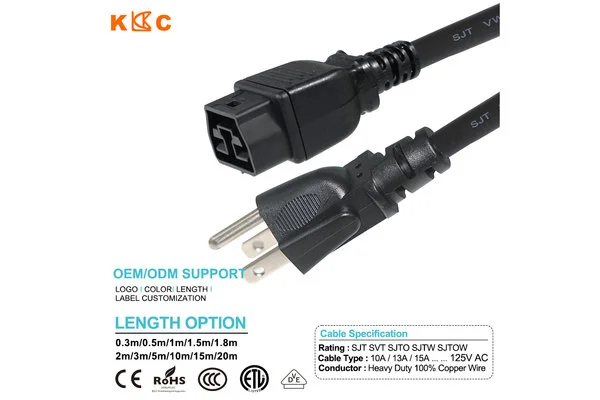
Saf-D-Grid is a connector family rather than one undifferentiated interface. Different series may use different housing dimensions, keying, contact arrangements, ratings, and target applications. The pictured product uses a T-latch structure, but appearance alone cannot confirm the exact series or manufacturer part number.
An OEM inquiry should include the equipment-inlet front view, dimensional drawing, series name, and part number, while defining connector gender and keying. Sample approval should include an actual mating test to confirm full insertion, latch engagement, and smooth release. This identifies “similar-looking but incompatible” interfaces before production and reduces batch returns or rack-commissioning delays.
2. NEMA 5-15P Defines the Input Boundary of the Complete Cord
The supply end of this cord is NEMA 5-15P. Even if the selected Saf-D-Grid series has a higher component rating, the complete assembly cannot exceed the supply-side limitation. For conventional North American AC applications, 15A at 125V AC maximum should be treated as the cord-evaluation ceiling, subject to the lowest-rated component among the plug, cable, Saf-D-Grid connector, and equipment inlet.
The image presents 10A, 13A, and 15A options, which should be managed as separate configurations. A 15A version may use 14 AWG/3C as an engineering baseline, but the jacket construction, length, ambient temperature, continuous load, and finished-cord approval still require confirmation. Applying a high connector-family voltage or current rating directly to the complete cord can result in incorrect labels, failed acceptance, or load misuse.
3. A Wiring Mismatch Can Produce a Cord That Mates but Does Not Work
After confirming the mechanical interface, buyers still need to verify the point-to-point relationship for line, neutral, and protective earth from the NEMA 5-15P to the Saf-D-Grid end. Pin assignments should not be inferred from conductor color, housing orientation, or a previous order because series, customer equipment, and OEM wiring requirements may differ.
The engineering drawing should identify which NEMA blade corresponds to each Saf-D-Grid contact number and fix the conductor color and function definition. Finished production cords need point-to-point continuity and wiring tests according to the approved documentation. If protective earth, line, or neutral reaches the wrong contact, the connector may still mate while equipment tests fail, assembly rework increases, or the protective path no longer matches the equipment design.
4. The T-Latch Must Fit the Available Rear Clearance
The T-latch adds retention at the equipment connection and helps reduce unintended disengagement when neighboring cables are moved during maintenance. The latch, however, requires sufficient room for insertion, engagement, and release. If a rack panel, cable manager, or adjacent interface is too close, the technician may be unable to confirm that the latch is fully engaged.
Sample review should measure the clearance around the equipment inlet and simulate server installation, cable support, and service removal. Buyers should also check cable-exit direction, bending radius, and continuous tension. A cord that is too short pulls on the connector, while an excessively long one can accumulate and obstruct airflow. The image presents lengths from 0.3 m to 20 m, but the correct length should follow the actual rack route and service slack rather than straight-line distance or stock availability.
5. Jacket and Certification Scope Are Also Part of Compatibility
The image lists SVT, SJT, SJTO, SJTW, and SJTOW cable options. These are not merely visual variations; they relate to cable construction and application conditions. Indoor data-center routing, industrial areas with oil exposure, and locations subject to moisture or weather do not necessarily require the same jacket.
Buyers should confirm the complete cable printing, ratings, temperature range, and target environment before selecting a jacket. Any conductor material shown or claimed in the image should be treated only as a configuration requiring confirmation, not as proof that the finished cord uses a particular copper grade, purity, or conductor construction. Buyers should verify the final conductor material through the approved drawing, bill of materials, cable marking, and supplier documentation. ETL, CE, or RoHS marks shown in promotional artwork do not automatically prove identical approval for every wire gauge, length, and connector combination. Finished-cord certification status, tests, labeling, and batch traceability should be checked against the exact final configuration.
How Can Buyers Build an Actionable Compatibility Checklist?
A complete OEM specification should include the NEMA 5-15P supply end, exact Saf-D-Grid series and part number, connector gender and keying, T-latch structure, equipment-inlet drawing, maximum 15A/125V AC assembly boundary, wire gauge and conductor count, jacket designation, finished length, line/neutral/protective-earth wiring table, test requirements, and finished-cord certification status.
Sample approval should verify more than whether the connector can be inserted. It should confirm full mating, latch engagement and release, correct wiring, rear clearance, cable support, and maintenance access. Dongguan Kuncan Electronics Co., Ltd. recommends placing these checks in the drawing and incoming-inspection requirements so that the NEMA 5-15P to Saf-D-Grid Power Cord has consistent mechanical, electrical, and equipment-level definitions. This helps reduce batch incompatibility, installation rework, unintended power loss, and documentation disputes.


USER EVALUATE
Here is the customer's evaluation of us