


How Can Saf-D-Grid T-Latch Power Cords Reduce Accidental Server Power Disconnection?
In a high-density server rack, an unexpected shutdown does not always originate from the upstream power system. A technician moving an adjacent cable, limited rear clearance, or continuous pulling from cable weight can gradually loosen the equipment-side connection and cause intermittent power loss, a server restart, or longer troubleshooting. Dongguan Kuncan Electronics Co., Ltd. views the NEMA 5-15P to Saf-D-Grid Power Cord as more than a power link. Its value comes from combining a correctly matched Saf-D-Grid T-latch with appropriate cord length and strain management to reduce the risk of unintended disengagement during maintenance.
Why Can Servers Lose Power During Rack Maintenance?
The rear of a rack commonly contains power cables, network cords, fiber, and management connections. When technicians replace a server or reorganize the harness, they may contact nearby power cords. If an equipment connector relies mainly on friction, external force, vibration, or cable weight can partially withdraw it. A connection that has not fully separated may produce intermittent contact, making the fault difficult to reproduce and diagnose.
The Saf-D-Grid T-latch adds mechanical retention at the equipment end. After the connector is fully inserted into a compatible inlet, the latch helps reduce unintended disengagement caused by ordinary pulling or cable movement. It does not mean that the connection can withstand unlimited force, nor can it compensate for incorrect mating, housing damage, or incomplete insertion. Rack design must still provide access for engagement and release.
Why Must Buyers Confirm the Saf-D-Grid Series and Equipment Inlet?
“Saf-D-Grid” identifies a connector family rather than one universally interchangeable interface. Different series can vary in housing, keying, ratings, and application. If a purchase order states only “Saf-D-Grid cable,” the supplier cannot determine from that term alone whether it will mate with a particular server, network switch, or telecommunications inlet.
An OEM order should record the exact series, connector part number, keying, gender, interface drawing, and target equipment model, followed by an actual mating test during sample approval. Buyers should verify complete latch engagement, smooth release, and clearance from rack panels and adjacent cables. Clear interface control reduces the risk of discovering batch incompatibility during rack commissioning.
Why Does NEMA 5-15P Limit the Complete Cord Rating?
The supply end of this cord is NEMA 5-15P. Even if a Saf-D-Grid component series has a higher component rating, the complete assembly cannot exceed the application boundary created by the NEMA 5-15P side. For conventional North American AC input, 15A at 125V AC maximum should be treated as the assembly evaluation ceiling, subject to the lowest-rated component among the plug, cable, equipment-side connector, and equipment inlet.
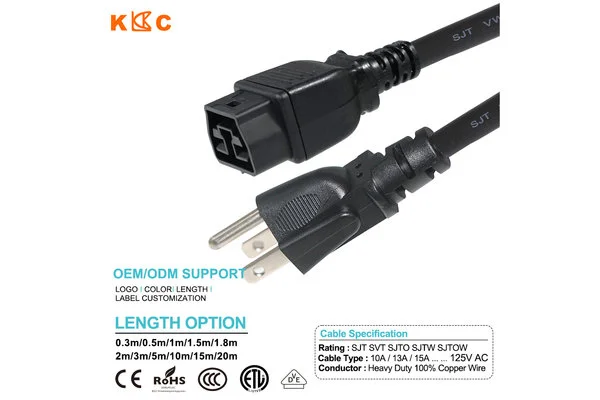
The product image also presents 10A, 13A, and 15A options. These should be managed as separate configurations. If a 15A version uses 14 AWG/3C as its engineering baseline, the jacket type, finished length, ambient temperature, continuous load, and applicable approval requirements still need confirmation. A higher connector-family rating must not be transferred directly to a finished NEMA 5-15P cord.
How Do Cord Length and Strain Management Affect Latch Performance?
The image presents length options from 0.3 m to 20 m. A shorter cord can reduce excess cable behind the rack and limit continuous pulling from cable weight, while a longer cord can cover a greater routed distance between the PDU and equipment inlet. The correct length should be based on the actual cable route, support points, and service slack rather than straight-line distance alone.
A cord that is too short can place continuous tension on the connector. An excessively long cord can block airflow, become entangled with neighboring cables, and increase maintenance complexity. Cable supports and strain-relief points should carry the cord weight so that the T-latch provides connection retention rather than supporting the entire cable. Longer configurations also require renewed evaluation of voltage drop, conductor size, and thermal conditions.
What Heat-Related Factors Still Matter Under Continuous Load?
The T-latch primarily addresses mechanical retention; it does not automatically reduce electrical contact resistance. A worn equipment inlet, incomplete contact engagement, insufficient wire gauge, or inconsistent plug termination can still create localized temperature rise during continuous operation. Servers and telecommunications equipment are often energized for extended periods, so buyers should not evaluate only whether the latch “holds.”
The production specification should identify the wire gauge, conductor count, conductor material, jacket type, complete cable printing, and point-to-point wiring. Finished cords should undergo continuity, wiring, and project-required electrical tests according to the applicable documentation. The 10A, 13A, and 15A configurations need separate cable, labeling, and compliance records to prevent mix-ups in storage or assembly.
How Can OEM Documents Turn Retention into a System Requirement?
An actionable purchase specification should include the NEMA 5-15P input, exact Saf-D-Grid series and part number, T-latch structure, wire gauge and conductor count, jacket designation, finished length, line/neutral/protective-earth pinout, equipment-inlet reference, test requirements, labeling, and finished-cord certification status. ETL, CE, or RoHS marks visible in promotional artwork do not automatically establish identical approval for every length, gauge, and connector combination.
Sample approval should include actual equipment mating, latch engagement and release, rear-clearance checks, cable support, and simulated maintenance activity. A NEMA 5-15P to Saf-D-Grid Power Cord can reduce loosening and unintended disengagement more effectively only when the interface, electrical rating, cord length, and rack routing are compatible. Dongguan Kuncan Electronics Co., Ltd. recommends treating connection retention as a complete system-validation process rather than an isolated connector feature, helping buyers reduce unexpected shutdowns, installation rework, and after-sales troubleshooting costs.


USER EVALUATE
Here is the customer's evaluation of us