


How to Evaluate NEMA1-15P to NEMA5-15R Extension Cords for Electrical Safety
Evaluating a NEMA1-15P to NEMA5-15R extension cord starts with understanding what separates a safe, compliant product from a liability risk. The NEMA 1-15P plug is a standard two-prong, ungrounded input rated at 125V/15A. The NEMA 5-15R receptacle is a three-prong grounded output. A 1 in 2 NEMA1-15P to NEMA5-15R extension cord bridges this configuration into a Y-splitter, doubling outlet availability from a single wall socket. Evaluating these cords means verifying conductor quality, certification status, insulation rating, and junction integrity—not just price per unit.
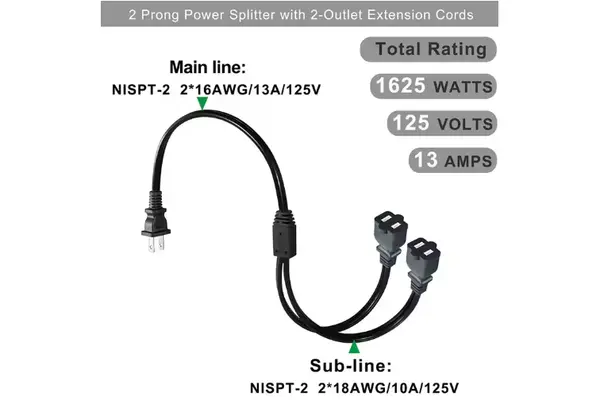
What Exactly Is a NEMA1-15P to NEMA5-15R Extension Cord?
Construction and Configuration
On one end of this type of cord is a two-prong NEMA 1-15P plug that connects to either one or two three-prong NEMA 5-15R plugs on the other end. The Y-splitter version turns a single outlet into two usable AC outlets without the need for a big power strip. The conductors are usually 14 AWG or 16 AWG bare copper that is 99.9% pure. They are covered in SJT or SVT industrial-grade PVC covers that can handle 125V indoor use for a long time.
Key Electrical Ratings and Certifications
For business-to-business purchases in the US, UL listing under UL 817 is a must. Canada now follows the rules thanks to CSA approval. The wire gauge directly affects the cord's highest current capacity, which can be 10A, 13A, or 15A. A heavier AWG can handle more sustained load without getting too hot. During the screening process, any cord that doesn't have UL documentation that can be tracked should be thrown out right away.
What Are the Critical Safety Factors to Evaluate?
Voltage ratings are not the only thing that affects electrical safety in business settings. The most physically weak spot in a Y-splitter line is where the two ends meet. When inferior PVC is put under repeated mechanical stress, it breaks, leaving internal conductors open to the risk of an arc fault. That weakness is taken care of by an injection-molded, oversized PVC connection block that is sealed directly to the inner copper insulation.
Here are the most important technical factors that every person evaluating a procurement must look at:
- Conductor purity and stranding pitch: 99.9% bare copper with a tightened stranding geometry minimizes electrical resistance across both output branches, ensuring stable voltage delivery to connected devices. Voltage drop compounds when powering two devices simultaneously, making this specification critical for lab equipment and AV systems.
- Thermal performance under load: Conductors sized correctly operate below 45°C at full rated amperage. The PVC outer jacket must carry a UL 94 V-0 or V-1 flame-retardant rating, meaning it self-extinguishes upon removal of the ignition source rather than propagating flame.
- Strain relief integrity at both ends: Molded strain reliefs on both the NEMA 1-15P plug and each NEMA 5-15R receptacle prevent flex-induced wire fatigue. A loose internal connection creates arc faults—one of the leading causes of electrical fires in commercial installations.
All of these things together show whether a 1 in 2 NEMA1-15P to NEMA5-15R extension cord can safely handle sustained dual-load conditions or if it becomes a thermal and arc hazard when commercial power is drawn.
How Do Different Configuration Options Compare?
If you need to choose between a single-output and a dual-output cord, you need to make sure that the setup fits your needs. This table shows some of the most important changes that buying teams should think about:
The features include 1 NEMA1-15P to 1 NEMA5-15R and 1 in 2 NEMA1-15P to 2 NEMA5-15R. The outputs are 1 x NEMA 5-15R and 2 x NEMA 5-15R. The load distribution is a single device or dual low-to-mid draw devices. The junction complexity is a straight cord or Y-splitter junction required. The AWG requirement is 16 AWG on average, and 14–16 AWG is recommended. The ideal application is for a single monitor, lamp, AV installation, test bench, or charger pair. Surge protection is an optional add-on.
| Feature | 1 NEMA1-15P to 1 NEMA5-15R | 1 in 2 NEMA1-15P to 2 NEMA5-15R |
|---|---|---|
| Output Receptacles | 1 x NEMA 5-15R | 2 x NEMA 5-15R |
| Load Distribution | Single device | Dual low-to-mid draw devices |
| Junction Complexity | Straight cord | Y-splitter junction required |
| AWG Requirement | 16 AWG typical | 14–16 AWG recommended |
| Ideal Application | Single monitor, lamp | AV install, test bench, charger pair |
| Surge Protection | Optional add-on | Optional add-on |
| Space Efficiency | Standard | Eliminates need for power strip |
The version with two outputs works well in commercial AV setups where a power source is shared by both a monitor and an active speaker array. Engineers who work on test benches also use the Y-splitter configuration to power two low-draw measuring instruments from a single outlet, which saves them the cost of replacing panels. The bendable Y-cable design lets it go through small areas like behind desks, server racks, or under nightstands without any problems with cable management.
How Should You Maintain These Cords for Long-Term Safety?
Regular inspections protect both the health of the cord and the safety of the workplace. In high-use business settings, look at the PVC coating visually every 90 days. Watch out for jacket discoloration, cracks near the strain relief zones, or any exposed conductors that you can see. These are signs that you need to replace the cable right away, not just to be safe.
Storage control is just as important. Make sure the cords don't have any tight kinks and don't hang them by the plug head of the 1 in 2 NEMA1-15P to NEMA5-15R extension cord. Standard eye checks may miss the main cause of internal wire separation, which is mechanical stress at the plug-to-cord junction.
Do not connect Y-splitter cords in a daisy chain. The total amount of current drawn by both NEMA 5-15R outputs must not go over the cord's maximum current limit. A 16-AWG cord that is designed for 10A can't safely hold two gadgets that each draw 8A. When there is too much stress, heat builds up and breaks down PVC insulation from the inside out, long before any visible signs show up on the outside. Companies that use these cords in business settings can get a lot out of giving their staff short training sessions on how to calculate loads and do visual inspections.
What Should B2B Buyers Prioritize When Procuring These Cords?
Not only unit price, but also source transparency is important for successful procurement. A good company that makes 1 in 2 NEMA1-15P to NEMA5-15R extension cords includes proof of UL compliance, Hi-Pot dielectric withstand test data, and RoHS material certification with every shipment, not just when asked, but all the time.
When checking out providers, make sure they have these operating skills:
- 100% factory testing before shipment: Every unit should undergo Hi-Pot testing (typically 1,250–1,500V applied between conductors) and polarity verification to confirm internal wiring integrity.
- Material traceability: RoHS-compliant, legally verifiable raw materials—particularly the copper conductor and PVC compound—should carry documented batch records.
- OEM/ODM flexibility: Custom wire gauge, cord length, jacket color, and logo printing should be available without minimum order quantity restrictions that obstruct small-batch replenishment cycles.
- Realistic lead times: Samples delivered within 3–7 business days and bulk orders fulfilled within 15–25 days represent functional supply chain benchmarks for commercial procurement planning.
By buying in bulk from a direct factory source, you can avoid the markups that distributors add on and cut down on wait times. It also allows for incremental customization, which means that the length of the cord or the AWG can be changed to fit different installation shapes without having to change the sourcing deals.
Conclusion
It's not a simple matter of checking a NEMA1-15P to NEMA5-15R extension cord for electrical safety. It needs close attention to the quality of the conductors, the engineering of the junctions, the thermal performance, the certification paperwork, and the accountability of the suppliers. When made to the right standards, the 1 in 2 NEMA1-15P to NEMA5-15R extension cord Y-splitter configuration has real practical value in business and industry settings. If you skimp on any of these factors, a useful tool for distributing power can become a source of arc faults or fires. When procurement teams use the evaluation criteria laid out in this guide, they protect both their investments in tools and their compliance standing.

FAQ
Which safety certifications should I prioritize when sourcing these cords?
It is necessary for the US market to be listed under UL 817. Canada now follows the rules thanks to CSA approval. For use in factories, make sure the cord has a flame-resistant jacket that meets UL 94 V-0 or V-1 standards. RoHS compliance makes sure that the materials meet rules About Using banned chemicals in the environment.
Can a Y-splitter cord safely power heavy-duty industrial equipment?
It is safe to use a 1 in 2 NEMA1-15P to NEMA5-15R extension cord with 125V. It works with two low-to-medium draw devices, which can handle up to 10A–15A.A group, based on AWG. It's not made for industrial machinery that needs specific grounded lines and a lot of amps. Before launch, you should always figure out the total load.
How often should I inspect or replace these cords in commercial use?
A good rule of thumb is to do a visual check every 90 days in high-cycle settings. If you see any discoloration in the jacket, cracks near the strain reliefs, or exposed conductors, you should replace the whole thing right away. In places where plugs and sockets are often plugged in and out, replacing them every 18 to 24 months lowers the risk of an arc fault, even if the condition isn't obvious.
What wire gauge should I specify for dual-device commercial use?
14 AWG supports up to 15A and is the suggested standard for industrial uses that need to handle steady dual loads. For lighter loads like lamps and phone chargers, 16 AWG at 10A is enough.
Source Your Safety-Certified Dual-Outlet Power Cord Directly from Kuncan Electronics
Kuncan Electronics sells factory-direct 1 in 2 NEMA1-15P to NEMA5-15R extension cords. They have been making these cords for 17 years and have full UL compliance paperwork and units that have been tested 100% Hi-Pot. We are a confirmed provider of 1 in 2 NEMA1-15P to NEMA5-15R extension cords. We can make custom AWG, length, and OEM packaging, and there are no minimum order quantities. Lead times for large orders are 15–25 days. To get a quote or look through our catalog of products, email our procurement specialists at rhea@szkuncan.net or go to nema5-15.com.
References
1. Underwriters Laboratories. UL 817: Standard for Cord Sets and Power-Supply Cords. UL Standards, 2023.
2. National Electrical Manufacturers Association. NEMA WD 6: Wiring Devices—Dimensional Requirements. NEMA, 2022.
3. National Fire Protection Association. NFPA 70: National Electrical Code (NEC). NFPA, 2023.
4. Consumer Product Safety Commission. Extension Cords and Surge Protectors Safety Guidelines. CPSC Publication, 2021.
5. Electrical Safety Foundation International. Home Electrical Safety Inspection Checklist and Industrial Power Distribution Guide. ESFI, 2022.
6. International Electrotechnical Commission. IEC 60320: Appliance Couplers for Household and Similar General Purposes. IEC, 2021.

USER EVALUATE
Here is the customer's evaluation of us