


3 Prong Laptop Power Cord Buying Guide: Avoid Compatibility and Safety Issues
Picking the wrong laptop power cord sounds like a minor oversight—until a fleet of 200 workstations goes dark mid-shift because an ungrounded cable triggered a surge-protection shutdown. A 3 prong laptop power cord is not simply a commodity wire; it is a grounded safety circuit that protects both equipment and personnel. The three conductors—live, neutral, and ground—work together to stabilize voltage delivery and route fault current away from sensitive hardware. This guide helps B2B procurement managers, OEM integrators, and IT resellers navigate compatibility, certification, and sourcing decisions with confidence, reducing costly downtime and compliance risk.
Understanding 3 Prong Laptop Power Cords: Features and Functions
What Makes the Third Prong So Important?
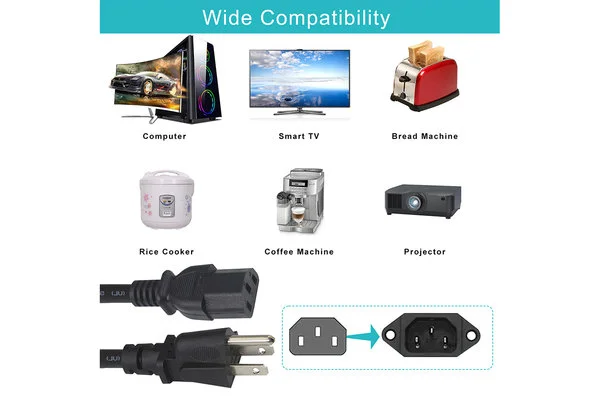
The metal body of a laptop adapter is linked to the building's electrical earth by the ground wire in a 3 Prong Laptop Power Cord. Fault current safely flows to ground instead of through the user's body when shielding breaks down or a surge happens. Because it acts as a safety measure, the National Electrical Code (NEC, NFPA 70) requires equipment with a rating above certain levels to be grounded. The NEMA 5-15P plug should be on the wall end, and the IEC 60320 C5 (cloverleaf) socket should be on the adapter end. This is the connection that works with most business computers sold in North America.
This kind of construction can be seen in Kuncan's NEMA 5-15P to IEC C5 power cord. The cable has 18AWG oxygen-free copper conductors inside a heavy-duty PVC jacket that doesn't catch fire. Strain-relief molding built into both terminal ends spreads out mechanical stress, keeping the inner wire from wearing out from repeated bending in crowded offices. The system is rated at 10A / 125V AC, which is exactly what the North American building code says it needs to be.
Visual verification tips for procurement teams:
- Confirm the NEMA 5-15P plug has a clear UL or ETL listing mark on the body of the plug.
- Check that the IEC C5 connector has a tight, audible click when seated—a loose fit signals a counterfeit mold.
- Inspect the jacket for a smooth, even finish; uneven texture is often a sign of poor PVC compounding.
A lot of field problems can be avoided by doing these easy visual checks when the gear is being inspected when it comes in.
Compatibility and Safety Comparison: 3 Prong vs. 2 Prong and USB-C Power Cords
Not every connector is interchangeable, and substituting the wrong cable type can void OEM warranties or create genuine shock hazards. The table below maps the three most common laptop power cord configurations against the criteria that matter most to enterprise buyers of 3 Prong Laptop Power Cord.
| Criteria | 3 Prong (NEMA 5-15P / C5) | 2 Prong (NEMA 1-15P / C7) | USB-C PD |
|---|---|---|---|
| Grounding | Yes — earth conductor present | No | Varies by charger |
| Current Capacity | Up to 10A / 125V | Up to 10A / 125V | Up to 5A (100W PD) |
| Legacy Laptop Compatibility | Broad — Dell, HP, Lenovo, Asus, Acer | Limited | Requires USB-C port |
| Certification Path | UL, ETL, CE, RoHS | UL, CE | USB-IF, UL |
| Best Use Case | Enterprise laptop fleets, industrial environments | Class II double-insulated devices | Modern ultrabooks with PD support |
| Surge/Fault Protection | High | Low | Moderate |
The trade-off is clear from the numbers. USB-C Power Delivery looks great on today's thin and light devices, but it doesn't have a dedicated ground conductor and needs hardware that supports the protocol. Two-prong lines don't have an earth link at all, which is fine for Class II devices that are double-insulated. The grounded 3 Prong Laptop Power Cord is still the safest and most widely compatible choice for mixed enterprise fleets that use a lot of legacy adapters.
How to Choose the Right 3 Prong Laptop Power Cord for Your Business Needs?
Material Selection — Why Conductor Quality Drives Long-Term Value
Resistance, heat output, and service life are all directly affected by the material of the conductor. Oxygen-free copper (OFC) conductors degrade more quickly and lose more heat when they are loaded, but oxygen-free copper conductors keep their low electrical resistance over thousands of bend cycles. Kuncan's cord is made of 18AWG pure OFC, which means that the voltage doesn't drop during ongoing high-load operation. This is important in a data center or business campus where hundreds of adapters are drawing power at the same time.
Mold Design — How Terminal Engineering Reduces Field Failures
A fully formed assembly stops the tiny movements that happen between the wires and plug pins that lead to connection faults over time. The NEMA 5-15P plug and C5 connector from Kuncan are injection-molded, so there is no space for air around the terminal joints. This design choice alone lowers the number of field failures in high-volume distribution settings, where the cost of RMA processing can be several times the cost of the original wire.
Testing Standards — What Certifications Actually Guarantee
Certifications turn claims made by engineers into safety promises that can be checked. Kuncan's NEMA 5-15P to IEC C5 cord is UL/cUL compliant and RoHS compliant. Other products in the company's line are also CE, VDE, and ETL listed. Before being sent out, every batch of 3 Prong Laptop Power Cord products goes through 100% electrical testing. When procurement teams are qualifying a seller, it is normal practice to ask for a test report along with a Certificate of Conformance. This completes the audit trail.
Beyond certifications, the ability to change the length of the cord is important for operational efficiency. Kuncan has lengths of 6 feet, 10 feet, and custom lengths. They also offer a variety of bulk packing choices, from polybagged units with P/N labels to master cartons designed for warehouse delivery.
Troubleshooting and Maintenance Tips for 3 Prong Laptop Power Cords
Almost always, intermittent charging starts at one of three places in the field: the C5 connector seat, the strain-relief joint, or an internal conductor break close to a contact. A basic diagnostic sequence helps tech teams figure out what's wrong without having to replace hardware that is still working.
Put the C5 plug all the way in and gently move it around. If the charging light blinks, either the connection or the adapter's C5 socket is worn out and needs to be replaced. Under bright light, look at the jacket near both molded ends. Hairline cracks in the PVC show that the inner strands are wearing out. If you use a continuity tester on the ground pin and get a reading above 0.1 ohm at the far end of an 18AWG line that is loaded, it means that the conductor is breaking down.
When replacing something, it's best to keep the same IEC connection type and match the original AWG grade. When you put a C7 line on an adapter that was made for a C5 seat, there is a mechanical mismatch that causes heat at the contact interface. This is a real fire risk in rack settings with a lot of cables.
Where and How to Buy 3 Prong Laptop Power Cords: Procurement Best Practices?
When buying a lot of laptop AC cords, enterprise procurement teams should give preference to sellers who keep up-to-date certification documents, offer clear lead times, and can meet custom packing needs. From its Dongguan facility, Kuncan Electronics ships samples within 3–7 business days and completes mass production orders within 15–25 days. The company has logistics options that include air, sea, and rail to get the best freight cost for each destination.
Ask for a copy of the UL listing file number during source qualification and compare it to the UL Product iQ database. This step takes less than two minutes and makes sure that the certification is up-to-date and covers the type of cord being bought. Also, check the RoHS compliance paperwork, because many states, like California's Proposition 65, have stricter rules on substances than the EU RoHS directive.
When you place a large order, make sure the terms include a clear warranty clause, first-article inspection reports, and agreed-upon AQL sampling levels. Kuncan's standard one-year warranty against manufacturing flaws is the kind of contract that most corporate purchasing policies need.
Conclusion
Picking a grounded laptop power cord is not a way to save money; it's a way to reduce risk. In North American business settings, the NEMA 5-15P to IEC C5 design of a 3 Prong Laptop Power Cord is still the most widely functional and certified option. Most field failures can be avoided by specifying oxygen-free copper conductors, fully molded terminals, and up-to-date UL/ETL listings. Power that is always on protects hardware investments, keeps workers productive, and makes sure that buying teams follow safety rules and OEM guarantee terms.
FAQ
Is a 3 Prong Laptop Power Cord Compatible with All Laptop Brands?
The NEMA 5-15P to IEC C5 cord works with most laptop devices in North America that end in a C5 (cloverleaf) socket. This includes popular names like Dell, HP, Lenovo, Asus, and Acer. Before you buy, make sure you know what kind of input socket your adapter has. Some models use a C7 or proprietary connection instead.
Why is it important for a laptop power cord to be grounded?
When the insulator fails, or the voltage goes up, the ground wire carefully sends fault current to earth. If it's not there, fault current can flow through the user and shock them. Also, grounded lines cut down on electromagnetic radiation, which is important in places where sensitive measuring or industrial control equipment is close by.
Can I use a two-prong cord instead of a three-prong cord to save money on big orders?
Only if the device being connected has a Class II double-insulation rating. Using a cord that isn't grounded on a device that needs one goes against NEC rules and usually voids the OEM warranty. Most of the time, the small price difference between a grounded cord and a two-prong cord is not worth the extra compliance and legal risk.
What AWG rating should I choose for a group of business laptops?
In North America, 18AWG is the standard for laptop charger lines that can handle 10A and 125V. For uses with higher loads, 16AWG or 14AWG conductors may be needed. Kuncan can also help you with your special sourcing needs.
Partner With Kuncan Electronics for Certified 3 Prong Laptop Power Cord Supply
Kuncan Electronics has been helping business-to-business customers around the world since 2008. They make electronics and have certifications for UL, ETL, CE, VDE, and RoHS. As a reliable 3 Prong Laptop Power Cord provider, we can make the lengths, wire gauges, jacket materials, and packaging to fit your supply chain needs exactly. Our products come with a 1-year guarantee. To get a sample or bulk quote today, email our procurement experts at rhea@szkuncan.net or go to nema5-15.com.

References
1. National Fire Protection Association. NFPA 70: National Electrical Code. 2023.
2. Underwriters Laboratories. UL 817: Standard for Cord Sets and Power-Supply Cords. 2022.
3. International Electrotechnical Commission. IEC 60320: Appliance Couplers for Household and Similar General Purposes. 2021.
4. U.S. Consumer Product Safety Commission. Electrical Safety in the Home and Workplace. 2022.
5. Occupational Safety and Health Administration (OSHA). OSHA 29 CFR 1910.303: Electrical General Requirements. 2021.
6. RoHS Compliance Guide. Restriction of Hazardous Substances in Electrical and Electronic Equipment — Directive 2011/65/EU Recast. European Commission, 2022.

USER EVALUATE
Here is the customer's evaluation of us