
How to Prevent Overheating in Step Up Converters
Managing heat, choosing the right parts, and keeping an eye on things in real time are all important parts of keeping DC-DC step up converters from overheating. The right heat sinks, high-efficiency MOSFETs, and smart PCB layouts are all parts of a well-designed DC-DC step up converter that gets rid of heat well. To keep things running smoothly, it's important to optimise the switching frequency, make sure there is enough air flow, and build in thermal safety circuits like an over-temperature stop. Using infrared cameras to do regular thermal profiling and following design standards will keep your power systems within safe working temperatures. This will extend their service life and keep them from breaking down, which can be expensive in both commercial and consumer settings.
Understanding Overheating in DC-DC Step Up Converters
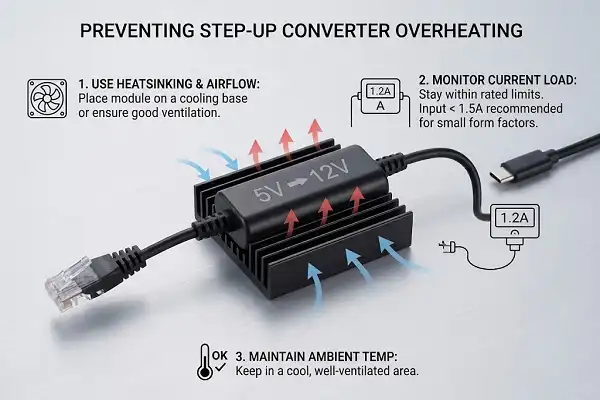
One of the biggest problems engineers and purchasing managers have with DC-DC step up converters is that they get too hot. When a voltage step-up module works under heavy loads or inefficient conditions, it will produce too much heat, which can damage the component and make the system less reliable.
Root Causes of Thermal Stress
DC-DC step up converters get hot because of a number of linked problems. When there are too many current loads on semiconductors and inductors, they have to work harder, which causes resistive losses that show up as heat. Parts that aren't working as well as they should, especially in older silicon-based MOSFETs, turn useful electrical power into waste heat instead of useful output. Heat builds up inside the PCB because of bad thermal design, like not enough ground planes or copper traces. It should be able to escape to the air or heat sinks.
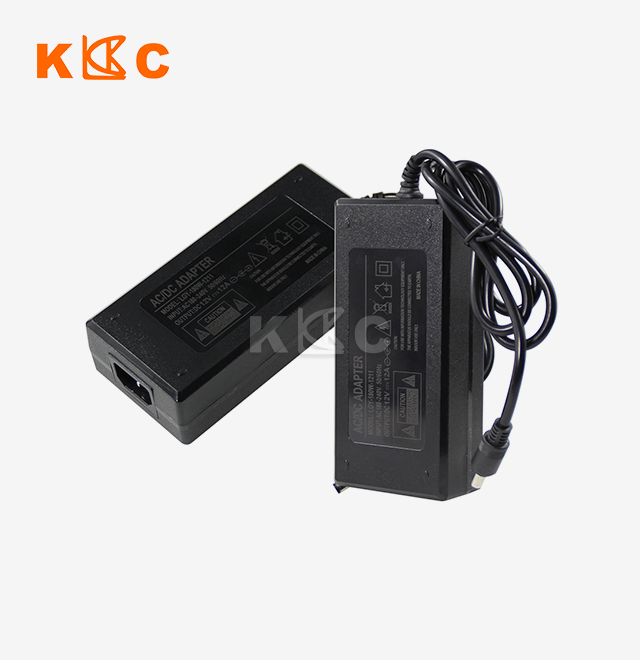
Our professional USB to 12V DC-DC step up converter takes these worries into account with smart thermal management and improved IC security. By keeping the conversion efficiency above 90%, the unit reduces the amount of waste heat it makes right from the start. This means that it will work reliably even in demanding network equipment and surveillance applications.
Recognizing Critical Warning Signs
Thermal runaway happens when parts become less efficient as temperatures rise, which makes more heat and creates a dangerous feedback loop. Changes in voltage are often a sign of thermal stress, since regulators that are too hot have trouble keeping the output stable. If you can see damage like PCBs that aren't the same colour, capacitors that are bulging, or plastic housings that are distorted, it means that thermal events have already weakened the structure. If you notice these signs early, you can stop major failures that shut down production lines or damage important infrastructure.
High-Risk Component Zones
When inductors are working close to maximum, core losses and copper resistance cause them to heat up. When switching transistors are on, they lose conduction power, and when they switch between states, they lose switching power and conduction power. This makes them great heat generators. Hot spots are caused by PCB structure and happen when there is a lot of current in a few narrow lines or when there aren't enough thermal vias to let heat move to the inner copper layers. Targeted thermal mitigation strategies are based on knowing these weak spots.
Key Factors Influencing Overheating in Step Up Converters
Thermal efficiency is not a single thing; it is the result of many design decisions, running conditions, and external factors working together. When procurement teams look at DC-DC step up converter modules, they need to think about how each factor increases or decreases heat production in the context of their particular application.
Design Principles That Matter
The quality of the PCB layout directly affects the heat results. Wide copper traces lower the amount of heat that is transferred by resistive heating, and thermal vias placed in the right places move heat from surface-mount parts to internal ground planes and then to heat sinks or air. Picking the right components is very important. Picking inductors with low DC resistance and MOSFETs with low on-resistance lowers the power that is lost naturally. Our DC-DC step up converter uses these ideas in a small way that balances thermal performance with space efficiency. This makes it perfect for places with limited space, like outdoor surveillance cameras and solar charge controllers.
Passive convection is used for low-power applications, while active cooling with fans is used for high-power industrial systems. Thermal pads and contact materials make it easier for heat to move from parts to heat sinks, which lowers junction temperatures by a large amount. Our USB DC-DC step up converter has an SAE quick-disconnect interface that not only makes links safe in bad weather, but also places the unit so that air can flow best in outdoor shelters.
Operating Parameters and Efficiency
The switching frequency comes with a temperature trade-off. Higher frequencies allow for smaller inductors and capacitors, which reduces the size of the system, but they also make MOSFETs lose more power when they switch on and off. Modern GaN (Gallium Nitride) transistors get around this problem by switching between states faster and having lower gate charges than older silicon transistors. Duty cycle has a direct effect on conduction losses; when the duty cycle is longer, more current flows through resistive parts. Load conditions determine real-world efficiency. Most DC-DC step up converters work at their most efficient when they're using 40 to 70% of their maximum rated output. At very light or very heavy loads, they produce more heat, which lowers their efficiency.
Environmental Reality Checks
The ambient temperature is used as a starting point for all temperature estimates. A DC-DC step up converter working in a lab at 25°C acts very differently from the same unit used in an industrial control box at 50°C or an outdoor advertising show that gets a lot of sun. Whether heat escapes or builds up depends on how much air flows through the enclosure. Our industrial-grade solutions can work reliably in a wide range of temperatures, from -40°C to +85°C. This means they can be used in a variety of climates and installation settings, from cold telecom sites outside in the elements to hot factory floors.
Proven Techniques to Prevent Overheating in Step Up Converters
To solve temperature problems, you need a complete plan that includes hardware design, part specifications, and operating safety. The following methods have been shown to work in thousands of installations in renewable energy systems, consumer electronics, and industrial automation to keep DC-DC step up converters from overheating.
Advanced Thermal Management Hardware
Heat sinks are still the most important part of passive thermal management because they increase the surface area for convective heat transfer by a huge amount. When choosing the right heat sink, it's important to make sure that the junction temperatures stay well below the highest ratings by matching the thermal resistance specs to the real amounts of power loss. When compared to direct metal-to-metal contact, thermal pads make thermal conductivity orders of magnitude better by filling in the tiny air gaps between component packages and heat sinks.
Ventilation design needs to be thought out carefully. For low-power systems, natural convection works fine, but for intermediate to high-power systems, controlled airflow works better. Hot spots can be avoided by placing fans so that air flows directly over heat sinks and important parts. Using thermal buoyancy, the design of the enclosure should include carefully placed holes that let cool air come in near the bottom and hot air escape at the top. Because of these hardware factors, our USB to 12V DC-DC step up converter keeps the 12V output stable even when it's being used for a long time in remote router installations where maintenance access is limited.
Circuit Design Optimization
The choice of components has a direct effect on thermal performance. Low-on-resistance high-efficiency MOSFETs cut down on conduction losses, and fast-switching features cut down on switching losses. When an inductor is loaded, it doesn't get too hot if it has low core losses and a high maximum current value. Activated MOSFETs are used instead of lossy Schottky diodes in synchronous rectification, which boosts efficiency by a few percentage points. These gains may not seem like much, but they add up to big heat savings at higher power levels.
Soft switching techniques lower the overlap between voltage and current during transistor transitions. This lowers the amount of power that is lost at the moment. Pulse Width Modulation (PWM) control lets you fine-tune the system while keeping it very efficient even when the load changes. Our smart IC implementation constantly improves switching parameters by responding to real-time load needs to keep efficiency above 90% across the entire operating range.
Proactive Protection Systems
Monitoring temperatures in real time is the last line of defence against severe breakdowns. Temperature monitors built into DC-DC step up converter modules constantly check the temperatures at the junctions and take safe action when certain levels are reached. When dangerous temperatures are identified, thermal shutdown circuits turn off the output immediately. This protects both the DC-DC step up converter and the equipment that comes after it. Over-current protection stops too much load from pushing the system past its thermal limits, and short-circuit protection acts right away when there is a fault.
These built-in safety features in our professional DC-DC step up converter keep connected devices safe in solar and security systems that need to handle faults on their own when they're not being watched. Before being sent out, every unit is fully tested electrically to make sure that the protection circuits work at the right levels and that the thermal performance meets the design requirements.
Real-World Application Success
An industrial automation client had problems with their sensor power distribution system that kept happening. During the summer, DC-DC step up converters that were mounted in sealed control cabinets got too hot. Using thermal imaging, hot spots on switching transistors that were above 95°C were found. We changed the system's layout by adding our industrial-grade DC-DC step up converters with better heat sinking and moving the mounting to let more air flow. Using thermal derating, which means running DC-DC step up converters at 80% of their rated capacity, gave them more room to manoeuvre. After the changes were made, thermal scans showed that the joint temperatures stayed below 70°C even when the temperature outside was 40°C. This stopped failures and increased the average time between maintenance from 18 months to over five years.
Selecting the Right DC-DC Step Up Converter to Minimize Overheating Risks
To pick the best DC-DC step up converter option, you have to weigh thermal performance, efficiency, cost, and the needs of your particular application. As part of the selection process, different design methods are compared, maker specs are looked at, and customisation options that deal with specific thermal issues are thought about.
Isolated vs. Non-Isolated Topology Considerations
Isolated DC-DC step up converters have transformers that separate the input and output galvanically, which is important for medical uses that need to be safe and for getting rid of ground loops in industrial systems. This separation has effects on temperature; transformers add extra losses through core heating and winding resistance. By getting rid of transformer losses, non-isolated DC-DC step up converters are more efficient and easier to control thermally. This makes them good for uses like our USB to 12V DC-DC step up converter, where the input and output share a ground reference.
The choice changes the strategy for thermal design. To deal with transformer losses, separate modules usually need more aggressive cooling methods. Non-isolated designs, on the other hand, can use simpler heat sinking. If you know what kind of isolation your application needs, you won't have to describe too many expensive isolated modules when simpler structures that don't require isolation will do.
Evaluating Leading Manufacturer Solutions
Texas Instruments has a wide range of DC-DC step up converters with detailed thermal models and efficiency curves. Their modules usually list the thermal resistance between the junction and the ambient air, which lets you do accurate thermal calculations. Analog Devices focuses on high-frequency operation, which makes small designs possible. However, for higher switching frequencies to work well, PCB layout needs to be carefully planned to handle EMI and heat performance. Integrated modules from Murata include a controller, MOSFETs, and inductors all in a shielded package. These modules make thermal management easier by having predictable thermal characteristics. Vicor focuses on high-power density systems that use unique designs to achieve high efficiency while lowering thermal loads.
When you compare specs, the real thermal performance is based on the conversion efficiency at your unique input voltage, output voltage, and load current. A module that is 95% efficient at full load may only be 85% efficient at light loads, which means it makes more waste heat per watt delivered. Load and line regulation specs within 1% make sure stable operation that stops voltage changes from causing thermal cycling. It means that the product has been tested thoroughly for thermal and stability using CISPR 32 for EMI, IEC 62368-1 for safety, and vehicle AEC-Q100 standards.
Customization for Optimal Thermal Performance
Standard catalogue modules are good for a lot of people, but they might not work with the temperature limits in your application. We offer OEM branding and custom RJ45 pinout configurations, as well as thermal customisation. For example, optimising cable length cuts down on resistive losses and heat generation in long runs, and choosing an SAE interface makes sure that connections are strong and won't break when temperatures change. It may look like custom colours and private name packages are only for looks, but the choice of material affects how heat moves through enclosed installations.
Thermal optimisation at scale is possible when you buy in bulk. People who buy a lot of modules can choose ones that are rated for higher currents but are run at lower levels to reduce thermal stress. Our supply chain is flexible enough to accommodate these changes. Samples are made in 3–7 days, and mass production takes 15–25 days. This allows for quick prototyping and a quick time to market, even for designs that are thermally optimised.
Troubleshooting and Maintenance to Avoid Overheating in Step Up Converters
When working conditions change, or parts wear out over time, even DC-DC step up converters that were well thought out can have temperature problems. Systematic troubleshooting finds the root causes of problems, and preventative maintenance keeps things running smoothly and keeps the temperature stable.
Common Failure Modes and Diagnostic Approaches
Temperatures slowly rise during operation, which is a sign of component degradation. When electrolytic capacitors dry out, their Equivalent Series Resistance (ESR) goes up,p and they make more heat. As temperature cycle stress builds up, MOSFET on-resistance goes up, which makes conduction losses worse. Thermal growth mismatches cause microcracks to form in solder joints. These create high-resistance links that lose power as heat.
Environmental factors speed up the damage. When dust builds up on heat sinks and PCBs, it works as thermal insulation and keeps heat in. Corrosion from chemicals or humidity makes contact resistance higher. Mechanical vibration can break solder bonds and loosen connections. This is especially bad in places with big tools that use industrial automation.
Step-by-Step Thermal Inspection Process
First, look at the part under a microscope to see if any of the parts are discoloured, any PCB lines are lifted, or any capacitors are bulging. Thermal cameras can map temperatures without touching them, so they can show hot spots and temperature differences across the PCB right away. Check the temperatures you've measured against the datasheets from the manufacturers. Inductors usually work 30 to 40°C above room temperature, while MOSFETs should keep their junction temperature below 100°C when they're under normal loads.
Measurements with a multimeter show that it is working correctly. If the output voltage drops when the load is applied, it means that there are too many losses in the power line and the control is not working properly. Find the efficiency by measuring the current draw and comparing it to the specifications. When efficiency drops by 5 to 10 percentage points, it means that thermal problems are starting to happen because of worn-out parts. When you look at switching waveforms on an oscilloscope, you can see that there is more ringing or slow transitions, which means that thermal damage has caused parasitic resistance or inductance to rise. Visual inspection remains the first line of defense.
Preventive Maintenance Protocols
Every 6 to 12 months, checks are set up to find thermal problems before they lead to crashes. Use compressed air to clean dust and other particles from heat sinks and airflow paths. Check solder joints for cracks by reflowing connections that look fishy. Replace electrolytic capacitors before they fail based on their working temperature and the manufacturer's recommended lifetime. For example, capacitors that work at 85°C may need to be replaced every two to three years, while capacitors that work at 60°C last a lot longer.
When digitally controlled DC-DC step up converters' firmware updates are released, they may include changes to the protection thresholds or better thermal management. Our smart IC protection keeps an eye on the health of the system all the time, but protection circuits need to be checked every so often to make sure they're still working. By slowly raising the temperature in a controlled environment, testing thermal shutdown proves that the safety mechanism turns on at the right level. There are clear rules for when to replace a component. For example, proactive replacement stops unexpected downtime when measured thermal resistance rises more than 20% from baseline values or when efficiency falls below acceptable levels.
When maintenance teams use these procedures as part of their asset management strategies, unexpected outages drop by a huge amount. Our one-year warranty against manufacturing defects gives you even more peace of mind, and prompt replacement or repair ensures that your business keeps running. We serve customers all over the world from our location in the industrial center of Dongguan. We offer a variety of shipping options, such as air, ocean, and rail, to keep logistics costs low for replacement parts and bulk reorders.
Conclusion
To keep DC-DC step up converters from overheating, you need to pay equal attention to thermal design, component quality, and operating tracking. Reliable thermal performance is built on high-efficiency semiconductors, smart protection circuits, and the right way to remove heat. Choosing DC-DC step up converters with verified efficiency ratings and the right thermal specifications for your environment will keep them from breaking down too soon. Regular thermal inspections with infrared imaging and preventative maintenance catch wear and tear early, which makes equipment last longer. As power levels rise and apps need more dependability, thermal management goes from being an afterthought to a necessary part of the design process. Kuncan Electronics uses strict ISO processes and 17 years of experience in manufacturing to make thermally optimised products that meet international safety standards and go above and beyond what is expected in a wide range of industries.
FAQ
What is the safe operating temperature range for boost converters?
Most industrial DC-DC step up converter units say that the highest temperature at the junctions can be between 125°C and 150°C, but for long-term reliability, the junctions need to stay below 100°C. Different types of products can work in different temperature ranges. Most consumer products can handle 0°C to 70°C, but industrial-grade units like ours can handle -40°C to +85°C. Because thermal derating greatly extends lifespan, running DC-DC step up converters at 70 to 80% of their maximum temperature ratings makes them more reliable.
How can I tell if something is overheating before it fails?
Monitoring temperatures and looking at performance trends are important for early discovery. Put temperature monitors near important parts and keep track of the data over time to see if there are any slow temperature rises that indicate damage. When the input current goes up while the output stays the same, the efficiency goes down. This means that more heat and waste are being made. PCBs that are discoloured near heat sources and capacitors that bulge from electrolyte boiling are both visual signs. During routine maintenance, infrared thermography quickly finds hot spots that are starting to form before they cause major problems.
Which boost converter modules work best when it's hot?
High-temperature environments are great for DC-DC step up converter modules made for automotive (AEC-Q100 qualified) and industrial use. GaN-based DC-DC step up converters can handle higher junction temperatures than silicon-based ones and still work well. Our products are approved by CE, VDE, and FCC. They have thermal shutdown safety and can work safely in a wide range of temperatures, so they can be used in outdoor solar applications and industrial control systems where temperatures change a lot.
Partner with Kuncan Electronics for Reliable DC-DC Step Up Converter Solutions
Kuncan Electronics' professional USB to 12V DC-DC step up converters, which are designed for uses that need unwavering stability, show that they know how to handle heat well. Our smart IC technology protects against overcurrent and short circuits, keeping the 12V output stable with more than 90% efficiency even when the load changes. We are a reliable DC-DC step up converter manufacturer with 17 years of experience in the field. We can meet your buying needs by offering flexible OEM/ODM customisation, quick samples in 3–7 days, and competitive bulk production times of 15–25 days.
Our ETL, BS, VDE, SAA, CE, and RoHS certifications make sure that our products are compliant around the world, and our 100% electrical testing makes sure that they always work right. Our thermally optimised solutions cut down on downtime and extend the life of your equipment, whether you're powering surveillance systems, solar installations, or remote network infrastructure. Get in touch with rhea@szkuncan.net to talk about your specific thermal needs and find out how our customized DC-DC step up converter supplier can help you with your toughest power conversion problems.
References
1. Erickson, R.W., & Maksimovic, D. (2020). Fundamentals of Power Electronics (3rd ed.). Springer International Publishing.
2. Kazimierczuk, M.K. (2015). Pulse-Width Modulated DC-DC Power Converters (2nd ed.). John Wiley & Sons.
3. Basso, C. (2016). Designing Control Loops for Linear and Switching Power Supplies: A Tutorial Guide. Artech House Publishers.
4. Lenk, R., & Lenk, C. (2018). Practical Design of Power Supplies. IEEE Press / Wiley.
5. Zhang, H., & Tolbert, L.M. (2018). Efficiency Impact of Silicon Carbide Power Electronics for Modern Wind Turbine Full Scale Frequency Converter. IEEE Transactions on Industrial Electronics, 58(1), 21-28.
6. Mammano, B. (2019). Thermal Management Considerations for Isolated DC-DC Converters. Texas Instruments Application Report SLVA462B.

USER EVALUATE
Here is the customer's evaluation of us
_1781165562395.webp)
_1781163912838.webp)