
DC-DC Step Up Converters for Solar Energy Systems
Boost converters, which are also known as DC-DC step up converters, raise the voltage in solar energy systems. They do this by changing the low DC voltages from photovoltaic panels into the higher output levels that loads and battery banks need. The main problem with renewable energy installations is that the voltages that solar panels make change with the amount of sunlight they get, and they may drop below the level needed for charging or equipment to work. These power conversion devices solve this problem. Modern boost converters are more than 90% efficient because they use smart switching topologies and inductive energy storage. This means that they lose very little power and keep the output voltage stable even when the input conditions change. This feature is especially useful for off-grid solar setups, portable charging stations, and distributed energy systems where stable power has a direct effect on how well the system works and how long it lasts.
Understanding DC-DC Step Up Converters: Basics and Operating Principles
A DC-DC step up converter is made up of three main parts that all work together: an inductor that stores energy, a switching element (usually a MOSFET) that controls the transfer of energy, and a diode that controls the flow of current in one direction. When procurement professionals understand this topology, they can better compare converter specifications to project needs.
How Boost Converters Elevate Voltage
When the switching element shuts off, electricity runs through the inductor and creates a magnetic field that holds power. When the switch is opened, the magnetic field collapses, creating a voltage spike that adds to the input voltage and makes the output potential higher. This process happens over and over at frequencies that are usually between 50 kHz and 2 MHz. Pulse-width modulation controls the exact amount of the output voltage. The duty cycle, or the percentage of time the switch is closed, affects the voltage gain. This makes it possible to precisely control the voltage even though the output of the solar panels changes throughout the day.
Critical Performance Metrics
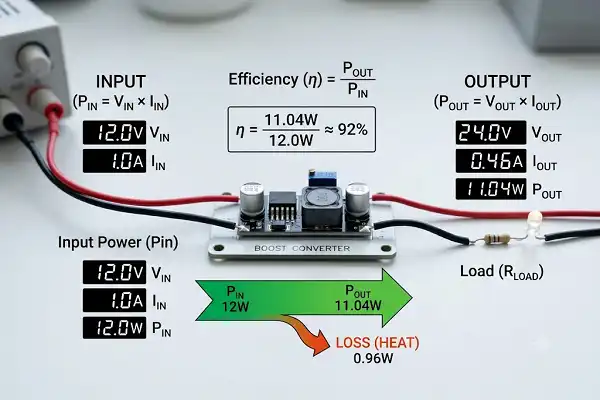
The conversion efficiency is the amount of power that goes in to the power that comes out. In ideal situations, professional-grade units get 92–95% efficiency. Output voltage control checks how well the converter keeps the goal voltage even when the input voltage changes. For high-quality devices, this is usually stated as ±1-2%. For fragile electronics, ripple voltage (the AC part on top of the DC output) should stay below 50mV. Stable temperature means consistent operation in all kinds of weather, which is especially important for outdoor solar systems that see changes with the seasons.
Distinguishing Boost from Buck Topologies
The job of boost converters is to raise the voltage, while the job of buck converters is to lower the output level from higher input voltages. Depending on how the system is built, both types may be used in solar panels: boost converters raise the voltage from the panels for charging batteries or grid-tie inverters, while buck converters lower the voltage from the batteries for USB ports or 5V logic circuits. Understanding this difference keeps design mistakes from happening during the buying process.
Why Use DC-DC Step Up Converters in Solar Energy Systems?
Voltage boost converters are necessary for the best system performance because solar setups have special power control needs. The power output from solar panels changes a lot depending on the amount of sunlight they get, the temperature, and the effects of ageing. This makes the equipment further down the line unstable.
Addressing Voltage Mismatch Challenges
In standard test conditions, photovoltaic panels usually make 15–22V, but in real life, the output drops to 12–18V depending on the amount of sunlight. A lot of battery charging systems need a stable 24V or 48V input, which leaves a voltage gap that boost converters fill. Without the right voltage elevation, charging efficiency drops, batteries don't get enough current, and the system's full capacity isn't used. Boost converters automatically change to keep the best charging power, even if there are clouds for a short time or not much light in the morning or evening.
Maximizing Energy Harvesting Efficiency
Maximum Power Point Tracking (MPPT) algorithms are built into modern boost converters. These algorithms constantly change the operating parameters to get the most power from solar panels. This smart control can increase energy capture by 20–30% compared to connecting directly to the battery, which means big performance gains over the life of the system. The technology is especially useful in installations that are partly shaded or that use systems with different panel orientations, since the outputs of each panel vary a lot.
Enabling Versatile System Integration
Boost converters make it easier to connect low-voltage solar sources to a wide range of loads, such as phones, security cameras, remote sensors, and battery banks. This is shown by our professional USB to 12V DC-DC step up converter, which changes the output of a normal 5V USB solar panel into a stable 12V that can be used for charging, video systems, and network routers. Intelligent IC security against overcurrent and short-circuits is built into the device. This makes sure that related equipment is safe even when there is a fault. With an efficiency of more than 90%, the small design keeps power loss to a minimum, and output stays constant even when input changes.
How to Choose the Right DC-DC Step Up Converter for Solar Energy Systems
To choose the right DC-DC step up converter technology, you need to carefully look at the electricity requirements, the surroundings, and the supplier's abilities. This organised method makes sure that the features of the product match the needs of the project while lowering the risks of purchase.
Defining Technical Requirements
Voltage specifications are the basis for choosing a converter. The input voltage range needs to be able to handle the lowest predicted panel output, which is usually between 10V and 18V for normal 12V nominal systems, plus a little extra for voltage drops caused by temperature. The output voltage should match the charging needs of the batteries or the needs of the load. Usually, the output voltage is 24V or 48V, but it can be set to different levels for different uses. To avoid thermal stress and protect reliability margins, current capacity must be 20–30% higher than the maximum continuous load. Keep an eye on the efficiency curves because many converters only work at their best within a small range of conditions. When they are under light loads or when the current is at its highest, they don't work as well.
Evaluating Environmental Resilience
Electronics in solar systems are exposed to harsh conditions that require strong safety measures. For outdoor use, the operating temperature range should be from -40°C to +85°C, and the thermal derating requirements should be made clear. When used in the field, humidity resistance, dust ingress protection (IP ratings), and vibration tolerance are all very important. During the production process, we test all of our products electrically to make sure they work in a certain range of environments. This gives installers faith when installing in harsh environments.
Comparing Topology Options
Non-isolated boost converters have a common input and output. They are easy to use, small, and cheap, making them perfect for charging batteries and matching voltages between panels. Isolated topologies use transformers to separate the electricity, which is necessary when adding solar panels to systems that are connected to the power grid or when safety rules need to be followed for certain setups. The isolation barrier stops ground loops and improves lightning protection, but it makes the system bigger and less effective.
Here are the core advantages professional-grade converters deliver for solar energy applications:
- Smart Protection Technology: Overcurrent and short-circuit protection built in keeps equipment from getting damaged when something goes wrong. Intelligent monitoring circuits keep an eye on voltage and current levels all the time, starting protective shutdown sequences before big problems happen. This proactive method makes connected devices last longer and requires less upkeep in the field.
- Universal Compatibility: Standard input interfaces work with different types of solar panels, power banks, and battery sources. Our SAE quick-disconnect interface makes links safe and weatherproof, making it perfect for outdoor use. It also makes installation quick and servicing easier. The design gets rid of worries about the reliability of the connectors that come with cheaper products.
- Customization Flexibility: Customised solutions are often needed for projects that don't fit standard requirements. To meet the needs of brands, we can make cables of any length, with any type of connector, with any output voltage setup, and in private label packaging. This adaptability speeds up the merging of products and gets rid of expensive adapter chains that slow things down.
Supplier Evaluation Criteria
In addition to product specs, choosing the right seller has a huge effect on the success of a project. Manufacturing experience shows that a process is mature and that quality is consistent. Our 17 years of experience in the electronic components industry show that we can handle a wide range of tasks. The range of certifications you have is very important. Following the rules for CE, VDE, FCC, RoHS, and REACH makes sure that your goods meet international safety and environmental standards, which makes them easier to sell all over the world. Lead times and minimum order quantities have a direct effect on how you manage your inventory and how flexible your project schedule can be. We can make samples in 3–7 days and mass production in 15–25 days. There are no minimum order quantities (MOQs) for refill orders, so customers can get the most out of their inventory.
Designing and Implementing DC-DC Step Up Converters in Solar Projects
To successfully add DC-DC step up converters to solar systems, circuit design, component choice, and system-level optimisation must all be done with great care. To make sure that operations are reliable and efficient in all expected working situations, engineering teams have to combine a lot of different factors.
Circuit Design Considerations
Based on the input and output voltages, the voltage gain formulas figure out the duty cycle that is needed. Switching factors are found using the formula Vout = Vin / (1 - D), where D stands for duty cycle. The size of an inductor or capacitor is determined by the load current. Larger energy storage parts are needed for higher currents. When choosing an inductor, you have to balance its size limits against its ripple current requirements. Smaller inductors take up less space on the board, but they also cause more current ripple, which could lower efficiency and cause electromagnetic interference.
Integration with Solar Arrays and Batteries
Overall speed is affected by where the converters are placed in the system design. Putting boost converters between solar panels and charge controllers makes MPPT work at the panel level, which lets you get the most energy out of the system. On the other hand, putting converters between charge controllers and battery banks lets different types of batteries match their voltage. Input capacitors have to handle swapping currents with a high frequency without getting too hot, and exit capacitors keep voltage ripples at a safe level. During development, our devices go through a lot of thermal analysis to make sure that junction temperatures stay within safe limits even when they are running at full load all the time. This keeps them from breaking down too soon.
Protection and Fault Management
Damage is avoided when there are abnormal conditions by using complete protection schemes. Overcurrent protection keeps the output current at a safe level to keep the converter and any loads that are connected safe. Thermal shutdown circuits check the temperature inside and turn off the power before heat damages any parts. The input under-voltage shutdown stops the system from working when the output of the solar panels drops too low. This keeps the system from working inefficiently or becoming unstable. Reverse polarity safety keeps semiconductor parts from breaking because of mistakes made during installation.
Optimization Strategies
The first step in improving efficiency is choosing the right working point. Keeping the load in the converter's high efficiency range saves the most energy. In parallel converter setups, the load current is spread across several devices. This makes thermal control better and provides redundancy. Soft-start circuitry slowly raises the output voltage as the power comes on. This limits the inrush current and keeps input capacitors and solar panels from being overloaded. Monitoring performance on a regular basis finds signs of decreasing efficiency before they become problems.
Procurement Tips: Where and How to Buy DC-DC Step Up Converters for Solar Systems
To get around in the global supply system, you need to know about the different ways that goods are distributed, how prices change, and how to tell the difference between reliable providers and problematic ones. When sourcing electronic components such as a DC-DC step up converter, applying strategic procurement practices helps you get the best cost-performance ratios and the lowest supply chain risks.
Sourcing Channels and Supplier Types
Direct makers have benefits in that they can customise products, offer more expert support, and offer low prices for large orders. Authorised distributors offer a wider range of products and faster delivery times for standard parts, but they are less able to make changes. Online B2B platforms let you compare prices and search for specifications, but you have to be very careful when choosing a supplier to make sure there aren't any quality problems. Going to trade shows in your industry lets you build direct relationships with suppliers and test products in person, which is especially helpful when choosing critical components.
Balancing Cost and Performance
Price is only one part of figuring out the total cost of ownership. Higher-efficiency converters cut down on energy losses that add up to big operating costs over the life of the system, which could make the extra money spent up front worth it. Reliability has a direct effect on the prices of upkeep and system downtime, which is why quality metrics are important evaluation factors that go beyond unit price. Warranty coverage protects you against products breaking down too soon, and manufacturers' policies that cover a lot of things show that they believe their products will last. We stand behind our one-year warranty against manufacturing defects with 17 years of experience and strict ISO quality processes. This shows that we care about making sure our customers are happy.
Evaluating Technical Documentation
Full datasheets show how well the work is done and how good the customer service is. Look for full descriptions of all the safety features, detailed efficiency curves that show how well the device works at different loads, and thermal derating specs. Application notes show how knowledgeable the provider is and give helpful advice on how to adopt the solution. Test results from separate labs make sure that the claimed specs and regulatory standards are met. This is an objective way to validate the quality.
Lead Time and Inventory Management
Project delays can be avoided by knowing when things need to be made and keeping enough extra goods on hand. Suppliers with short sample lead times make rapid prototyping and design iteration easier. Just-in-time inventory tactics that lower working capital needs are made possible by flexible minimum order amounts. We can handle rush orders and respond within 24 hours. We also offer a variety of shipping options, such as air, sea, and rail, to meet different delivery needs and budgets. We offer competitive shipping solutions because we are located in Dongguan's industrial hub and use its efficient logistics infrastructure.
Conclusion
DC-DC step up converters are an important piece of technology for making solar energy systems work well because they solve basic problems with voltage management and make the most of the energy that can be collected. To choose the right boost converter options, you need to carefully look at the electrical requirements, environmental needs, safety features, and provider capabilities. Professional-grade solar panels with smart protection, high conversion efficiency, and strong construction work reliably in a wide range of solar applications, from remote monitoring stations to large-scale renewable energy installations. Strategic buying practices that balance technical needs with seller dependability, customisation options, and lifecycle cost concerns lead to better project results and build the basis for long-lasting relationships that work.
FAQ
What voltage levels can boost converters achieve from typical solar panels?
Boost converters can raise the output voltage of a normal 12V solar panel (actually 15–22V when the panel is loaded) to almost any higher voltage that the system design needs. 24V is a common target voltage for telecommunications equipment, 48V is a common target voltage for data center backup systems, and ranges up to 60V can be adjusted for special uses. The exact voltage gain depends on the type of converter and the duty cycle limits. Most commercial units can handle output voltages that are 2 to 5 times higher than the input levels.
What efficiency should I expect from quality solar boost converters?
Professional-grade boost converters are able to convert 90–95% of the power they receive into electricity. This means that only 5–10% of the power they receive is lost as heat. Efficiency peaks between 50 and 80% of the rated output current and changes with load current, input voltage, and operating temperature. Lower-quality devices may only work 75–85% of the time and vary more across operating ranges, which wastes a lot of energy over the life of the system.
How do I troubleshoot output voltage instability issues?
Most of the time, changes in the output voltage are caused by either not enough input capacitance, too many load transients, or not enough feedback loop correction. Make sure the input capacitor values are correct according to the manufacturer's instructions and that the ESR ratings of the capacitors are appropriate for high-frequency switching. Make sure the load current stays within the converter's limits, and check the connections at all ends to make sure they are solid. Measurements of input/output ripple with an oscilloscope show if control problems are caused by unstable switching frequencies or broken parts.
Partner with Kuncan Electronics for Reliable DC-DC Step Up Converter Solutions
Kuncan Electronics makes boost converters that are professional-grade and designed for demanding solar energy applications that can't risk reliability. We've been making custom power conversion devices that meet strict technical requirements for off-grid installations, renewable energy systems, and portable solar equipment for 17 years, and are an Alibaba Verified Supplier. Our USB to 12V DC-DC step up converter supplier offers flexible OEM/ODM services with unique configurations, quick prototyping within 3–7 days, and scalable production that can handle both small orders and large production runs.
Every gadget goes through a lot of electrical tests to make sure it meets performance standards. It also has world certifications like CE, VDE, FCC, and RoHS compliance to make it easy to get into markets. Our engineering team works directly with your purchasing and technical staff to provide the best solutions, whether you need standard goods or changes that are made to fit your needs, like special connectors, wire lengths, or voltage outputs. Get in touch with rhea@szkuncan.net right away to talk about your solar power management needs and get a detailed technical consultation along with competitive quotes that are made just for your project.
References
1. Erickson, Robert W., and Dragan Maksimovic. Fundamentals of Power Electronics, Third Edition. Springer, 2020.
2. Rashid, Muhammad H. Power Electronics Handbook: Devices, Circuits, and Applications, Fourth Edition. Butterworth-Heinemann, 2017.
3. Kazimierczuk, Marian K. Pulse-Width Modulated DC-DC Power Converters, Second Edition. Wiley, 2015.
4. Mohan, Ned, Tore M. Undeland, and William P. Robbins. Power Electronics: Converters, Applications, and Design, Third Edition. Wiley, 2003.
5. Messenger, Roger A., and Amir Abtahi. Photovoltaic Systems Engineering, Fourth Edition. CRC Press, 2017.
6. Luque, Antonio, and Steven Hegedus. Handbook of Photovoltaic Science and Engineering, Second Edition. Wiley, 2011.

USER EVALUATE
Here is the customer's evaluation of us
_1784355495257.webp)