
How to Wire a Cigarette Lighter Male Plug Safely
If you wire a cigarette lighter male plug properly, you can safely deliver power in cars, factories, and places that aren't connected to the grid. To do this, you have to find the positive and negative ends, make sure the connections are secure by crimping or soldering them correctly, and add a fuse to protect against damage from too much power. When you use heat-resistant materials like Bakelite housings and pure copper wires, you lower the risk of fire and keep the electricity flowing smoothly. Knowing about voltage compatibility and terminal configuration is important when making emergency jump-start cables or custom power solutions for portable stations. It keeps both the equipment and the people who use it safe from electrical hazards.
Understanding the Basics of Cigarette Lighter Male Plugs
Standardised plug designs that work in a lot of different types of cars are used for a lot of power connections in cars. The cigarette lighter male plugs type is the active connector; it sends electricity from one power source to another or to devices that are connected.
What Makes a Male Plug Different?
The male configuration has a center pin that sticks out and fits into female sockets that are the same shape. With this design, power can be sent from one vehicle to another or from power plants to equipment. The middle pin has a positive charge, and the shell around it is connected to ground. Even when the socket walls shake, spring-loaded contacts keep the same amount of pressure on them, which keeps the power flowing during operation.
Voltage Standards in Automotive Applications
Most cars for regular people use 12V DC systems, while large trucks and buses use 24V systems. High-quality plugs can work with both voltage ranges because they are built to last and can handle loads of different amperages. Because it works with both 120V and 240V, you don't need to buy separate parts when servicing fleets with different voltages. Kuncan Electronics' heavy-duty cables have pure copper cores that lower resistance and heat buildup during long use. They can handle 12V/15A-20A ratings.
Key Components of Professional-Grade Plugs
Materials that can handle temperature stress and mechanical wear are needed in industrial settings. Heat-resistant Bakelite housings keep their shape at temperatures up to 105°C, so they don't bend when big things are put on them. Nickel-plated brass terminals keep resistance below 50mΩ and stop oxidation. The built-in strain relief design keeps wire links safe from mechanical stress in tough places like building sites and emergency situations.
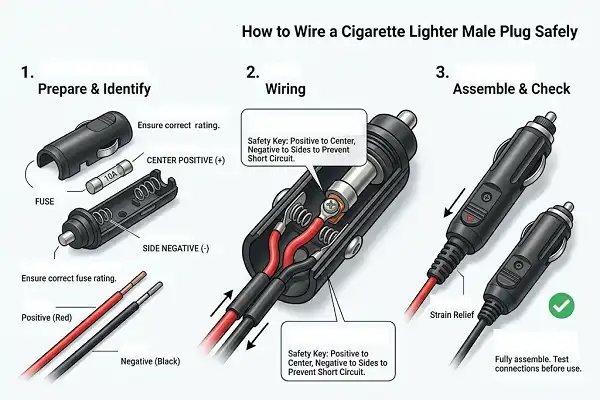
Step-by-Step Guide to Wiring a Cigarette Lighter Male Plug Safely
Using the right methods for building stops short circuits and guarantees long-term dependability. The steps below can be used for both do-it-yourself repairs and overseeing large-scale production of the cigarette lighter male plug.
Preparing Your Tools and Materials
Get a multimeter, wire strippers, crimping tools, soldering tools, heat shrink tubing, and other tools before you start any wiring project. Choose cables that are rated for the amount of current they will need to carry. For automotive use, this is usually 12AWG to 16AWG. Make sure that your plug has fuse safety that can be changed. Glass tube fuses rated for specific current loads are best. For safer soldering, make sure there is enough air flow and a stable surface to work on.
Identifying Terminal Connections
The center pin is linked to the positive wire, which is usually red or has a stripe on it, and for a cigarette lighter male plug, this polarity convention must be strictly observed to ensure safe and correct power delivery to connected devices. The side ends or outer shell connect to the black negative ground wire. Manganous steel springs in some heavy-duty models keep the contact pressure constant even when the car shakes. Before making permanent connections, use a multimeter to double-check the polarity. Reversing the polarity can damage sensitive electronics and vehicle systems.
Securing Durable Electrical Connections
About 8 mm of the end of the wire should be stripped of its insulation to reveal clean copper strands. Tightly twist the strands to keep them from fraying, and then crimp or solder the connections, depending on how you want to make the product. Crimping is faster for making a lot of things at once, while soldering is better for custom builds because it makes the connections more conductive. Cover uncovered joints with heat shrink tubing to keep water out and prevent accidental shorts. At Kuncan Electronics, we test all of our products electrically to make sure they work properly before they leave the factory.
Integrating Fuse Protection
Fuse should be placed close to the power source to protect the whole circuit from overcurrent events. Glass tube fuses let you see if the filament is intact without taking it out. Match the fuse rating to the maximum current draw of your device. For example, using 10A fuses on devices that only need 8A will keep them safe and stop annoying failures. Power transfers from one car to another are kept safest by having dual fuse setups at both ends of the wire.
Testing and Troubleshooting After Assembly
Once the plug is finished, connect it to a power source that you know works and check the voltage at the terminals. To make sure the connections are correct, the readings should be within 0.5V of the source voltage. During a 10-minute test at full load, keep an eye on the temperature of the plug housing. Good assemblies stay within 40°C of the ambient temperature. Any hot spots show connections with high resistance that need to be fixed. We use SAE J563 standards for our temperature rise tests to make sure that the thermal performance is good for more than 5,000 placement rounds.
Choosing the Right Cigarette Lighter Male Plug for Procurement
When procurement teams look for power communication solutions, they have a lot of choices regarding the cigarette lighter male plug. Strategic selection criteria take both short-term cost concerns and long-term reliability needs into account.
Evaluating Voltage and Current Ratings
Make sure that the plug's specs match the power needs of your program, leaving enough room for error. For safety reasons, plugs that are rated for at least 15A must be used with a device that draws 12A of continuous current. 20A-rated parts with extra-thick conductor cores are better for heavy-duty uses like emergency tools or industrial machines. Universal designs that work with both 12V and 24V systems make inventory easier for companies that take care of fleets of different types of vehicles.
Material Quality and Environmental Resistance
Standard ABS plastic housings change shape when heated for a long time, which can lead to loose connections and fire risks. Professional-grade options are made of UL94 V-0 flame-resistant Bakelite that stays the same size even when temperatures reach as high as +85°C. For use in marine and outdoor settings, brass terminals that have been nickel-plated are resistant to corrosion and can handle salt spray for 48 hours. These changes to the materials make the service last longer in harsh environments where replacement costs are higher than the initial premium price.
Fuse-Equipped Versus Fuse-Less Designs
Integrated fuse boxes make it easier to change safety devices in the field when they stop working after an overcurrent event. Glass tube fuses let you look at things without using any tools, which cuts down on the time it takes to figure out what's wrong. Some cheap models don't have any fuse protection at all, which means that users are responsible for fixing any electrical problems that happen. Although fused variants cost a little more, they offer a lot more protection against damage to equipment and possible fire risks in business settings.
Trusted Manufacturers and Supplier Networks
Controlled manufacturing processes and thorough testing protocols help well-known brands keep their quality high, and for a cigarette lighter male plug, this means consistent contact resistance, reliable spring tension, and durable housing materials that withstand repeated insertion and removal cycles in vehicle environments. Check for certifications like ETL, CE, VDE, and SAA that show suppliers meet regional safety standards when you are evaluating them. Businesses that need to be able to predict delivery times care about production capacity. Facilities with 300 or more employees and 17 years of operation show stability that isn't common in newer businesses. OEM customisation options, such as choosing the wire size, making custom lengths, and adding a logo, help brands stand out in markets that are very competitive.
Avoiding Common Mistakes and Ensuring Long-Term Safety
Installation mistakes cause both short-term and long-term problems with reliability. Knowing what mistakes people make a lot of the time helps procurement teams set standards for quality control for the cigarette lighter male plugs.
Reverse Polarity and Its Consequences
When you connect positive lines to ground connections, current flows through paths that weren't meant to be there. This can damage electronic control units and onboard computers. Modern cars have sensitive parts that stop working for good when they come into contact with reverse electricity. Always use a multimeter to check the polarity of newly wired plugs before turning them on. Colour-coded lines and clearly marked terminals make it easier for multiple techs to work together on bulk construction tasks at the same time.
Inadequate Insulation and Mechanical Protection
When conductors are exposed near metal surfaces, they can short circuit, which can drain batteries or start fires. Heat shrink tubing acts as the main insulator, and strain relief parts keep the wires from wearing out at the connection places. For heavy-duty uses, strong tail designs are needed to protect wire bundles from mechanical stress when the vehicle moves or when the equipment shakes. Our high-tech safety systems have many layers of protection that can handle more than 5,000 insertion and withdrawal rounds without losing their effectiveness.
Neglecting Fuse Protection in High-Current Applications
If you don't put fuses in lines that carry 10A or more, bad things will happen when the equipment breaks down. The low cost of replaceable fuse holders is nothing compared to the cost of rewiring a car or replacing damaged equipment after an electrical fire. In industrial setups, circuit safety systems that use properly rated parts that separate faults from other circuits that aren't affected are helpful. This method cuts down on downtime while fixing problems and analysing.
Maintenance Schedules for Commercial Fleets
Wear is found during routine inspections, before problems happen. Every three months, look at the plug housings for cracks, discolouration, or deformation that could mean thermal damage. Check the integrity of the fuse and measure the contact resistance once a year to look for oxidation buildup. Replace any wires that show signs of circuit rust or insulation brittleness, even if they seem to work. These preventative steps cut down on breakdowns on the side of the road and the labour costs that come with them in fleet operations, where the availability of vehicles directly affects revenue.
Procurement Strategies for Cigarette Lighter Male Plugs
Strategic sourcing is more than just unit price. It also includes the dependability of the supply chain and the ability to make changes as needed for the cigarette lighter male plugs. Comprehensive supplier evaluation helps business-to-business buyers get the best total cost of ownership.
Analyzing Pricing and Minimum Order Quantities
Volume prices are good for making bigger promises, but they keep operating capital locked up in inventory. Just-in-time inventory tactics that lower storage costs work best with suppliers who offer flexible MOQs without big price fines. When comparing international sources, you should add up all the costs of buying, such as shipping, customs duties, and inspection fees. Sample orders with turnaround times of 3–7 days let you test the product before committing to bulk purchases with production windows of 15–25 days.
Identifying Dependable Wholesale Distributors
Verified supplier status on sites like Alibaba shows a dedication to openness and honest business practices. Look for companies that have global compliance certifications like FCC, EMC, and RoHS that let them get into the market without having to wait for more testing. When a production facility gets ISO approval, it shows that it has mastered process control, which means that the quality of the products shipped is always the same. Our factory in Dongguan has been making things for 17 years, so they can provide enterprise-level solutions with full quality assurance.
Customization Options for Specialized Requirements
Standard configurations work well for most uses, but custom specifications are often needed for industrial projects. Wire gauges ranging from 12AWG to 16AWG can handle a range of current loads while keeping costs as low as possible. Custom wire lengths get rid of the need for changes in the field that aren't safe or look good. Different types of materials, such as PVC, TPE, rubber, and LSZH compounds, are used to meet the needs of different environments, such as those with chemical exposure or limited flame spread. Private label stamping and custom colour schemes help people recognise a brand in markets that are very competitive and where customers choose products based on how they vary from others.
Building Long-Term Supplier Partnerships
Transactional relationships are based on setting prices for each order individually, while strategic partnerships provide long-term value by working together to solve problems. When suppliers offer free design review and expert help, their products work better in client applications. Responding channels of communication with 24-hour turnaround times speed up the resolution of problems during production ramps or urgent needs for restocking. Warranty guarantees that cover production flaws for a year show that you trust the quality of the product and protect buyers from the costs of failure too soon.
Conclusion
Safe wiring techniques for connecting power to cars keep people and tools safe from electrical hazards. Installations that work well depend on knowing how to identify terminals, using the right fuse protection, and choosing high-quality materials for the cigarette lighter male plug. Instead of just looking at unit price, procurement professionals should judge suppliers based on how well they follow certification requirements, how much they can produce, and how easily they can adapt to specific needs. Total ownership costs are lower when you work with manufacturers who have a lot of experience. This is because there are fewer problems in the field and expert help is quick to respond. Buying well-designed parts pays off in the long run by extending the life of equipment and making it safer to use, whether you're buying them for emergency response fleets or industrial off-grid systems.
FAQ
Can I power USB devices through automotive power plugs?
Yes, you can connect USB devices that need 5V DC to a 12V or 24V power source by adding a voltage regulator. Good adapters have overcurrent protection and voltage stabilisation circuits that keep smartphones and tablets from getting damaged when the power in a car changes.
How do I verify voltage compatibility before connecting equipment?
Before inserting, use a voltmeter to check the output voltage of the cigarette lighter male plug. Most passenger cars put out 12V, while commercial trucks put out 24V. Labels on equipment say what voltage ranges are okay. Make sure your gadget works within the range that was measured to keep it from breaking.
Why do some plugs get hot during normal operation?
Electrical resistance at connection places or wires that are too small to carry a high current cause heat to be produced. Good plugs with nickel-plated brass contacts and the right wire sizes stay 40°C above room temperature. Too much heat means that the connections aren't working well and need to be fixed right away.
What amperage fuse should I use for different devices?
Choose fuses that are rated 25% higher than the continuous current draw of your device. A 10A fuse is needed for an 8A load, and a 20A fuse is needed for a 15A load. This margin keeps overcurrent protection in place and stops annoying failures during startup current surges.
Do heavy-duty plugs work with standard vehicle sockets?
With their reinforced design, professional-grade plugs can still be used with regular receptacles. Spring-loaded contacts can adjust to small changes in size while keeping the electricity flowing. The longer durability mostly helps high-cycle uses and doesn't change how basic functions work.
Partner with Kuncan Electronics for Industrial-Grade Power Solutions
Kuncan Electronics focuses on making heavy-duty power connections for cars that are made for tough professional uses. Our cigarette lighter male plugs have extra-thick pure copper cores, heat-resistant Bakelite housings, and strict safety standards-meeting dual fuse protection systems. As a manufacturer of cigarette lighter male plugs with certifications from ETL, CE, VDE, and SAA, we serve emergency services, industrial operations, and outdoor retail markets around the world that need reliable power delivery.
Our OEM customisation options include wire gauges from 12AWG to 16AWG, custom lengths, and a range of materials, such as LSZH compounds for harsh conditions. Before it is shipped, every product goes through thorough electrical and thermal testing that follows SAE J563 guidelines. Email our tech team at rhea@szkuncan.net to talk about your unique needs and get sample quotes within 24 hours.

References
1. Society of Automotive Engineers. "SAE J563: 12 Volt Cigar Lighter Standard." SAE International Standards, 2018.
2. National Highway Traffic Safety Administration. "Vehicle Electrical System Safety Guidelines." U.S. Department of Transportation Technical Report, 2020.
3. International Organization for Standardization. "ISO 4165: Road Vehicles - Cigar Lighter Receptacle." ISO Standards Catalogue, 2017.
4. Underwriters Laboratories. "UL 2089: Standard for Vehicle Battery Adapters." UL Safety Certification Database, 2019.
5. Institute of Electrical and Electronics Engineers. "IEEE Guide for Automotive Electrical Power Systems." IEEE Vehicular Technology Society, 2021.
6. American National Standards Institute. "ANSI C18.3M: Portable Rechargeable Cells and Batteries - Safety Standards." ANSI Publications, 2020.

USER EVALUATE
Here is the customer's evaluation of us
_1782463113014.webp)