
Understanding the NEMA 5-15P to C13 Power Cord
When you walk into a data center, office building, or hospital, the simple power lines that connect tools to wall outlets are usually the last thing on your mind. Still, these wires, which look pretty simple, are the basis for reliable operations in many fields. The NEMA 5-15P to C13 power cord is one of the most important ways for North American businesses and factories to link to each other. This flexible wire connects standard 125V wall outlets to equipment inlets that are the same all over the world. It can power anything from network servers to diagnostic tools. When purchasing managers, engineers, and distributors know about this cord's technical specs, safety certifications, and possible uses, they can make smart buying choices that reduce downtime and boost business efficiency.
What Is a NEMA 5-15P to C13 Power Cord?
Technical Components and Configuration
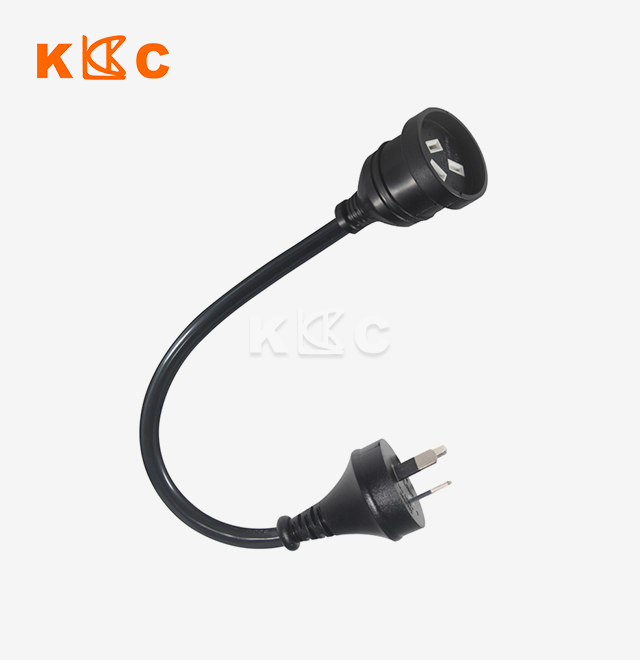
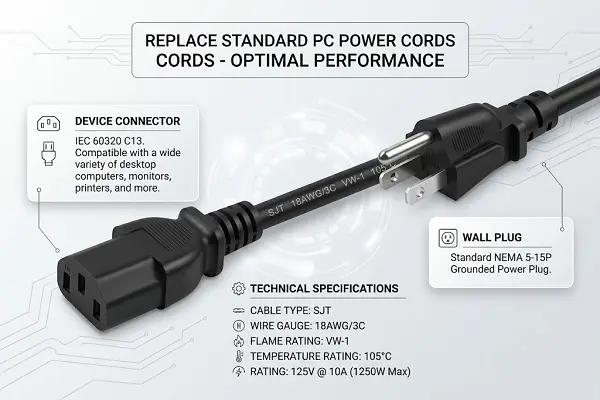
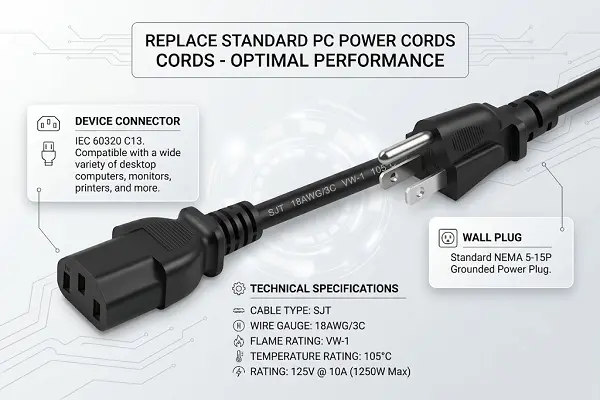
The NEMA 5-15P to C13 power cord in question has two ends that were carefully designed to work together. The NEMA 5-15P plug has three fixed blades on one end that are set up to fit normal 125V outlets in North America. The number "5-15" means that it has a 15-ampere, 125-volt voltage and is meant to be used in general-purpose grounded situations. This type of plug has two flat blades that are next to each other and are used for line and neutral connections. Below them is a round grounding pin that makes sure the equipment is properly grounded for electrical safety.
On the other end is the IEC 60320 C13 connector, which is a female inlet link that is widely standard and can be found on a huge range of electronic devices around the world. The C13 connector only takes three pins in a certain way. This makes a strong mechanical link that can't be accidentally broken during normal use. With this common interface, companies that make electronics can sell the same gadgets all over the world, and customers can just switch out the power cords to work with their area.
Between these two places is a flexible multi-conductor cable that usually has three shielded copper wires: the line (hot), the neutral, and the ground. The cable jacket, which is usually made of flame-resistant PVC, keeps the internal wires safe from the outside world while still allowing the cable to be routed through equipment racks and around barriers.
Electrical Specifications and Ratings
The safe working ranges for any power cord are set by its voltage and amperage values. Standard setups can handle 125 volts AC and 10 to 15 amps of power, based on the gauge of the wire. Most of the time, 18 AWG wire is used for normal office equipment that needs up to 10 amps of power, 16 AWG for moderate loads up to 13 amps, and 14 AWG for heavy-duty server-grade apps that need the full 15-amp capacity.
Ratings for temperature are another important characteristic. Basic cords have ratings of 60°C, which is fine for normal office settings. But industrial-grade cords have ratings of 75°C or even 105°C, which are needed for hot-aisle data center containment systems where normal conditions are much cooler than that. These higher temperature rates keep insulation from wearing out too quickly, which could be dangerous or cause equipment to break down.
You can choose from short 0.3-meter patch lines that are great for equipment racks with a lot of equipment and long 10-meter runs that connect power sources far away to computers. Choosing the right length keeps the voltage drop as low as possible over long distances and avoids having too much wire, which can be hard to handle and blocks airflow in places where temperature is important.
Common Application Environments
These power cords work great in a wide range of situations. They are used a lot in data centers to connect computers, network switches, and storage arrays that are placed on racks straight to UPS or power distribution units. The cords' adaptability makes hot-swap maintenance easier, and their standard interfaces make it easier to handle supplies in settings with products from different vendors.
People use these cords with desktop computers, monitors, printers, and phone systems in the office. Their ability to work with all kinds of equipment makes it easier to install and repair parts, and IT staff only has to worry about one type of cord instead of managing a bunch of different private ones.
In industrial settings, stronger versions of NEMA 5-15P to C13 power cord with weather-resistant SJTW jackets that can handle being exposed to oil, water, and changes in temperature are needed. These heavy-duty types are used to run control systems, sensors, and automatic machinery in factories, where their dependability has a direct effect on the continuity of production.
Differences Between NEMA 5-15P to C13 and Other Power Cords
NEMA 5-15P Versus NEMA 5-20P Plugs
People who work in procurement often get the NEMA 5-15P to C13 power cord and 5-20P plug types mixed up. The main differences are the current ratings and the actual shapes of the blades. The 5-15P has two standard flat blades that are parallel to each other. The 5-20P, on the other hand, has one standard blade and one T-shaped blade that can fit into both 15-amp and 20-amp outlets. This T-blade design stops 20-amp plugs from being plugged into 15-amp outlets. This keeps electrical safety up by stopping circuit overload.
Standard 5-15P cords have enough power for most office IT equipment that needs less than 12 amps and work with a wider range of older building hardware. But 5-20P connections are often needed for high-power computers, enterprise-level networking gear, and industrial machines so they can safely handle higher current loads without cable heating up or voltage drop problems.
C13 Versus C14 and C19 Connectors
Ordering mistakes can be avoided by knowing the different types of IEC connectors. The C13 connector fits into C14 ports on power sources for devices. At the same time, power distribution boxes have C14 outlets that let power lines be linked together in a chain. A higher-amperage option is the C19 connector, which can handle up to 20 amps and is often used with corporate computers and industrial equipment that needs a lot of power.
When you try to use plugs that don't match, compatibility problems happen. PDU outlets are linked to equipment inlets by a C13-to-C14 cable, and wall outlets are linked to equipment by a NEMA plug-to-C13 cable. By making these differences clear to suppliers during the buying process, you can be sure to get the right goods that work well with your current system.
IEC Cord Sets Versus Detachable Power Cords
Some pieces of tools have cords that are permanently connected, while others have cords that can be removed. In business settings, power lines that can be detached are very useful. They make it easier to repair broken cords, upgrade to higher-rated cables when equipment needs more power, and move equipment because the cords can be disconnected at the device instead of the wall plug.
The modular connection method in IEC 60320 standards makes this possible. Manufacturers of equipment all over the world use C14 plugs because they know that end users can find the right power lines for their area on their own. This method makes manufacturing easier and lowers the cost of shipping, and it gives buying teams control over the wire specs that meet their particular operating needs.
Benefits and Safety Standards of NEMA 5-15P to C13 Power Cords
Operational Advantages for Enterprise Deployment
Standardization is the main benefit that is causing broad adoption of the NEMA 5-15P to C13 power cord. Using only one type of cord makes managing supplies easier, makes buying things easier, and speeds up the deployment of tools. Technicians don't have to look for cords that are special to each device. This speeds up the repair and troubleshooting processes and reduces downtime.
Because of this uniformity, cost-effectiveness comes about. Buying a lot of power cords at once gets you better prices and makes sure you have enough spares on hand for quick replacements. Because the cords are universally compatible, they can be used with tools from a number of different manufacturers. This saves time and money that would have been spent on keeping a lot of different types of cables that only work in certain situations.
Characteristics of durability are very important in harsh operating settings. High-quality cords have extra strain relief at both connection places. This keeps the internal conductor from breaking, which often happens where stress is concentrated. Precision-molded connectors keep mechanical links strong so that they don't come loose when equipment is moved around in an industrial setting or while mobile medical equipment is being moved.
Critical Safety Certifications and Compliance
When it comes to electricity safety in North America, UL approval is the gold standard. Underwriters Laboratories puts cords through a lot of strict safety tests that check things like the size of the conductors, the quality of the insulation, the cords' resistance to flames, and the cords' connections. UL-listed wires have marks that can be recognized as proof that they have been independently tested for safety. This protects you from responsibility and makes sure you follow the rules.
In the same way, CSA approval from the Canadian Standards Association proves that products sold in Canada are safe. Many companies try to get dual UL/CSA approval marks on single cord designs. This helps them reach more customers and make it easier for distributors to keep track of their stock in both countries.
Hospital-grade markings, which are shown by green dots on plug faces, mean that the plug meets higher standards that are required in places where patients are cared for. The way these cords are put together and the materials they are made of give them better chemical resistance, reliability, and holding force. This is especially important in healthcare settings where power outages could put people in danger. When looking for clinical areas, people in charge of buying medical facilities should make sure they are clear about what hospital-grade standards they need.
By putting limits on dangerous chemicals, RoHS and REACH compliance helps protect health and the environment. These standards are set by European laws, but more and more global makers are using materials that meet these standards in all of their products. Cords that meet these standards don't contain lead, mercury, cadmium, or other harmful chemicals. This supports companies' efforts to be more environmentally friendly and makes sure that the cords are safe to handle and throw away.
Material Quality and Construction Standards
The material of the conductor has a big effect on performance. Pure copper that doesn't contain any oxygen is the best conductor because it has the least amount of electrical resistance, which shows up as heat when current flows. When high currents are applied continuously, lower-quality wires made of copper-clad aluminum or poor copper have higher resistance, which can lead to voltage drop, overheating, and failure before its time.
The weather protection of a jacket depends on its materials. Basic PVC jackets work well in controlled office settings, while thermoplastic rubber versions are more flexible when it's cold. Industrial-grade jackets with the designation SJTW are weatherproof and can be used outside or in harsh industrial settings with oils, solvents, and changing temperatures.
Shielded versions have aluminum foil wrapped around the internal wires to block electromagnetic interference. This stops interference that could damage sensitive network equipment or add noise to data transfer lines. Shielded power lines keep the EMI/RFI pollution that hundreds of power sources cause from slowing down networks or messing up storage systems in data centers with high-density server arrays.
Choosing the Right NEMA 5-15P to C13 Power Cord for Your Business
Industry-Specific Requirements and Considerations
When running a data center, you have to pay close attention to how you handle cables and how the space is heated. Strategies for keeping things in the hot aisles raise the temperature around them, so the NEMA 5-15P to C13 power cord used must be rated for 75°C or 105°C operation. When there are a lot of power sources in a small space, electromagnetic interference can happen. To stop this, shielded wires are used. When choosing a cable length, you have to weigh the risk of voltage drop against the ease of management. Most data centers use 1.8-meter and 3-meter lengths, which reach all of the equipment without having too much extra wire that blocks airflow.
There are different problems that need to be solved in manufacturing and industrial technology settings. The equipment has to deal with vibrations, changes in temperature, and the possibility of being exposed to contaminants. Heavy-duty 14 AWG cords with SJTW jackets are strong enough to withstand these conditions and don't react with chemicals. In small areas, right-angle C13 connections can be helpful because straight connectors might put too much stress on wires going through conduit or cable trays.
Medical facilities have to follow strict rules set by the government. In places where patients are cared for, hospital-grade standards are required to make sure that the power is always on, which directly impacts patient safety. For mobile testing equipment that is cleaned often with harsh disinfectants, compatibility with sterilization processes is important. Clear records of licenses and test results help make sure that rules are followed during building visits and accreditation reviews.
Wire Gauge and Capacity Selection Guidelines
By matching the wire gauge to the load factors, practical issues can be avoided. Find out how much power your devices can handle at its peak. 18 AWG cords, which are common for office gadgets, can easily power devices that use less than 10 amps. Drawing equipment with 10 to 13 amps needs 16 AWG construction. Heavy-duty 14 AWG cords that can safely give the full 15-amp circuit capacity are needed for industrial equipment, high-wattage printers, and powering multiple devices.
When cables are run farther, voltage drop estimates become important. Resistance goes up with length, which lowers the voltage between the outlet and the equipment's input. For important uses that need stable power, choosing the next larger gauge makes up for the losses that come with length. A 5-meter run to high-power equipment works better with 14 AWG construction, even if current alone would allow 16 AWG. This keeps the voltage stable, which keeps equipment from breaking down or working less well.
For future-proofing reasons, choosing slightly overrated cords when buying them for the first time is okay. When equipment is refreshed, it usually comes with stronger devices that use more power. If you install 16 AWG cords when 18 AWG would work today, you won't have to pay for expensive new jobs when your equipment gets better later.
Customization Opportunities and Branding Options
Customization that helps track assets and make brands visible is helpful for large operations using NEMA 5-15P to C13 power cord. In complicated setups with many power domains, the colors of the cable jackets make it easier to find the right one. Color-coding by circuit, type of equipment, or organizational area speeds up fixing and keeps important systems from being disconnected by accident during maintenance.
Custom writing on wire jackets can be used for more than one thing. Asset identification numbers help with keeping track of goods and passing audits. Labels with warnings tell repair workers about power or criticality. Corporate branding gives a business a professional look when dealing with customers and reinforces quality promises to people inside the company.
Different types of connectors solve different construction problems. Right-angle plugs make the line less noticeable against walls, which is helpful in shop or hospitality places where looks are important. Locking C13 connectors keep them from disconnecting by chance in places with a lot of shaking, like factories, or when moving mobile equipment carts. Talking about these choices with sellers early on in the planning stages of buying makes sure that the made goods exactly meet operational needs instead of making compromises around standard catalog items.
Bulk Procurement and Supplier Partnership Strategies
When you buy in bulk, you can save money and make sure you always have a supply. By building ties with manufacturers who can keep quality high across big production runs, you can avoid the quality differences that happen when you buy from a lot of small suppliers. We've helped customers with orders for thousands of units, making sure that the specifications are always the same so that the products can be used across multiple sites without any problems with usability or quality.
Sample review programs lower the risk of making big promises. Before agreeing to large orders, performance claims can be checked by asking for pre-production samples to be tested in real-world working settings. Physical inspection shows things about the quality of the construction, like how well the conductors are attached, how precisely the connectors are molded, and the properties of the jacket material that can't be seen from the catalog.
Planning for lead times keeps projects from being late. Most store things ship quickly, usually within a few days. Custom setups, such as specific colors, printing, or widths that aren't standard, take anywhere from two to four weeks to make, based on how complicated the order is and where it is in the production queue. When project timelines are shared early on, suppliers can plan their production capacity, making sure that shipping times match up with installation goals.
Conclusion
Choosing the right NEMA 5-15P to C13 power cord has a big effect on operating efficiency, safety compliance, and long-term cost management in a wide range of settings, from data centers to healthcare facilities. The standard NEMA 5-15P to C13 design is what connects North America's power grid to equipment that is uniform around the world. Procurement experts can perfectly match goods to application needs when they know technical details like wire gauge, temperature ratings, and certification standards. Being able to tell the difference between similar types of connectors keeps you from making mistakes that cost a lot of money when you order them, and having an understanding for the quality of the construction and the standards of the materials used helps you choose goods that will last in tough environments. Strategic relationships with suppliers that focus on consistent quality, the ability to make changes, and quick support turn buying power cords from a basic need into a competitive advantage that helps with business growth and practical excellence.
FAQ
What kinds of machines usually use this cord set-up?
Most IT gear, like servers, desktop computers, monitors, network switches, and storage stacks, has IEC C14 inlets that work with C13 connections. This interface is often found on office machines like printers and scanners. This type of link is often used by medical diagnostic tools, laboratory instruments, and industrial control systems. This makes these cords necessary in a wide range of professional settings.
How can I tell the difference between the needs for 18 AWG and 14 AWG cords?
Find out how much power your devices can handle at its peak. 18 AWG cords, which are common for office gadgets, can easily power devices that use less than 10 amps. Drawing equipment with 10 to 13 amps needs 16 AWG construction. Heavy-duty uses that need close to 15 amps need 14 AWG server-grade lines. When there is doubt or the equipment may be improved, choosing a heavier gauge gives you a safety cushion and protects you for the future.
Can this cord work with devices that runs on 220 volts?
The NEMA 5-15P plug can only fit into 125-volt outlets in North America and is rated at 125V. For equipment that needs to run on 208V or 240V, you need different types of cords, like NEMA 6-15P or soldered connections. Using wires that aren't rated for the power they're supposed to be used with is very dangerous and against the law.
How are hospital-grade wires different from regular cords?
Hospital-grade cords, which can be identified by the green dots on the plug faces, are built better, with stronger materials that can handle harsh disinfectants, better holding force to keep the cords from coming undone by mistake, and better assembly methods that guarantee high reliability. In areas where patients are being cared for, where power outages could put them in danger, these requirements are required. In administration areas, however, normal cords are sufficient.
Partner with Kuncan Electronics for Your Power Cord Solutions
We understand that your operations demand absolute reliability from every component, including the power cords connecting critical equipment. Kuncan Electronics brings 17 years of specialized manufacturing experience to your procurement challenges, producing NEMA 5-15P to C13 power cord solutions that meet the exacting standards of data centers, medical facilities, and industrial operations across North America. Our ETL, UL, and CSA certified products feature 100% oxygen-free copper conductors and flame-retardant jackets engineered for consistent performance. As a dedicated NEMA 5-15P to C13 power cord supplier, we offer complete customization including wire gauge selection from 18 AWG to 14 AWG, custom lengths, color-coded jackets, and logo printing supporting your brand identity. Every cord undergoes rigorous 100% continuity testing before shipment, backed by our comprehensive one-year warranty. Our production capacity supports orders from sample quantities through multi-thousand-unit deployments, shipping within 15-25 days with responsive 24-hour technical support. Contact our team at rhea@szkuncan.net to discuss your specific requirements, request samples, or receive detailed quotations tailored to your operational needs and budget parameters.
References
National Electrical Manufacturers Association. (2023). NEMA Standards Publication WD 6: Wiring Devices - Dimensional Specifications. Rosslyn, VA: NEMA.
International Electrotechnical Commission. (2021). IEC 60320-1: Appliance Couplers for Household and Similar General Purposes - Part 1: General Requirements. Geneva: IEC.
Underwriters Laboratories. (2022). UL 817: Standard for Safety Cord Sets and Power-Supply Cords. Northbrook, IL: UL Standards.
Canadian Standards Association. (2020). CSA C22.2 No. 21: Flexible Cords and Cables. Toronto: CSA Group.
Harper, C. A. (2022). Handbook of Wiring, Cabling, and interconnecting for Electronics. New York: McGraw-Hill Professional.
Institute of Electrical and Electronics Engineers. (2021). IEEE Standard 1100: Recommended Practice for Powering and Grounding Electronic Equipment. New York: IEEE Press.

USER EVALUATE
Here is the customer's evaluation of us
_1778575304578.webp)