
What is the Difference Between C13 and C15 Power Cords?
When looking for power options for mission-critical tools, it's important to know the differences between C13 and C15 power cords. The main difference is how the connectors are made and how hot the cable can handle. A C13 cable power solution can handle temperatures up to 70°C safely and has a standard three-pin female connection, which makes it perfect for desktop computers, monitors, and other common office IT equipment. On the other hand, the C15 has a notched socket design and can handle temperatures up to 120°C. It was made to work with high-temperature computer racks and industrial equipment. If you pick the wrong standard, you could end up with thermal failure, downtime for your equipment, and compliance violations, all of which are risks that no buying worker wants to take.
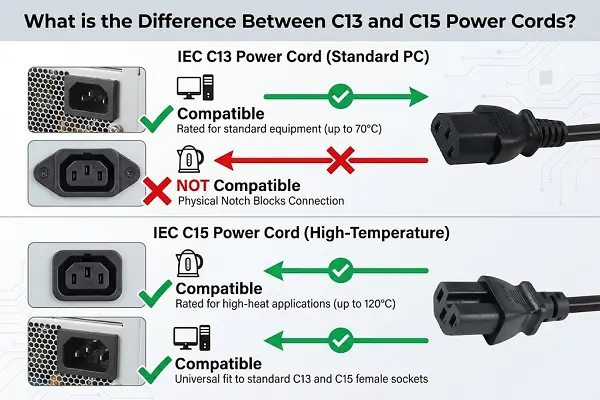
Understanding C13 and C15 Power Cords: Specifications and Functions
At first view, the C13 and C15 plugs look a lot alike, but they use very different engineering methods to send power. Both meet the international standard IEC 60320-1 for appliance couplers, which are used to connect electrical tools to the mains power. However, their different specs solve different operational problems.
C13 Power Cord Technical Specifications
The standard for "cold condition" power hookups in the business world is the C13 plug. This label means that the socket can work safely in room temperature, with a pin temperature of up to 70°C at most. The common three-pin female connection can only connect to C14 ports, which can be found on most desktop computers, monitors, network switches, and professional audio gear. For overseas markets, electrical ratings usually allow 10 amps at 250 volts. In North America, however, versions built with 14AWG conductors can handle 15 amps.
The connection has high-purity stranded copper wires inside of PVC or rubberized plastics jackets made for industrial use. These materials are resistant to oil and wear, and they have a flame retardance rating of VW-1 or FT1. For one minute, the dielectric withstand voltage can go over 2000V AC without breaking, and the insulation resistance can go over 100MΩ at 500V DC. The mechanical design makes sure that the pull-out force resistance is between 10N and 50N. This keeps the link from coming apart by mistake but lets you take it off on purpose. The testing rules say that the cables must be durable for more than 3,000 insertion-withdrawal cycles. This means that C13 cables can be used in regular office and business settings where the temperature of the equipment is normal.
C15 Power Cord Enhanced Thermal Capabilities
The C15 connector is different because it has a special notched shape that makes it physically impossible to fit into normal C14 inlets. This deliberate mismatch is a safety feature that makes sure high-temperature wires only connect to equipment that was made to work in high temperatures. The connection can safely work at pin temperatures of up to 120°C, which makes it essential for server racks with limited airflow, high-density computer settings, and heavy-duty machinery that makes a lot of heat.
C15 wires have more than just a unique notch; they also use better insulator materials and conductor specs. A lot of the time, silicone rubber or special thermoplastics that can work continuously at high temperatures are used in jacket combinations. Nickel covering on internal wires may keep them from oxidizing when they are under a lot of heat. While the electrical rates are the same as the C13 specs—10A at 250V for applications outside of North America and 15A for North American applications—the thermal performance gap makes the C15 specification necessary when environmental conditions are higher than normal. Manufacturers of equipment specify C15 inlets when internal parts produce heat that needs to be removed through the power connection or when difficult thermal zones are created by things like industrial ovens or the manufacturing process for cars.
Key Differences Between C13 and C15 Power Cords
Knowing the basic differences between these plugs helps you avoid making mistakes that cost a lot of money and makes sure that they work safely in a wide range of situations. The differences aren't just in temperature levels; they also include things like physical design, safety certifications, and compatibility issues that affect the total cost of ownership.
Physical Design and Compatibility Variations
The form of the connector for C13 cable power shows the biggest change. The C13 has a rectangular shape that is symmetrical and has three pins. The C15, on the other hand, has a horizontal notch across its face that makes a keyway that stops it from fitting into standard C14 inlets. Because of this design choice, you can't connect temperature-sensitive devices to regular plugs or standard devices to temperature-sensitive devices. The notch measures exactly according to IEC standards, which makes sure that all makers around the world follow the same rules.
The pin layouts stay the same, with three contacts for line, neutral, and ground connections, but the housing sizes are a little different. Most C15 connectors have housings made of heavier-gauge materials so they can handle cycles of heat expansion and contraction without breaking. The device for holding things in place might have stronger latches or locking parts to keep links safe even when there is vibration or heat stress. Because of these physical features, field replacement is not possible. This keeps equipment safe from thermal damage that would happen if regular wires were used in high-temperature situations.
Thermal Performance and Safety Standards
Temperature numbers show the limits of how these wire types can be used. It is safe for C13 wires to work in climate-controlled settings with pin temperatures up to 70°C and normal room temperatures. When equipment runs constantly at full load, it can raise the temperature of the connectors because of internal heat creation. The C13 design allows for this within certain limits. But being exposed to temperatures above 70°C for a long time weakens shielding, raises resistance, and makes fires more likely.
C15 wires are made with better materials and structure to handle problems that come up at high temperatures. The 120°C grade lets it work in places with high temperatures without breaking down. At high temperatures, insulation materials don't shrink, crack, or lose their dielectric qualities. Crimping or welding are used to make conductor parts that keep their low resistance even when the temperature changes. For safety standards like UL, VDE, and CE, strict testing procedures are needed. These include temperature rise tests, in which connectors work at their full allowed current while being exposed to high temperatures. C15 goods must show steady performance without breaking down or going over the allowed temperature range.
Current Ratings and Application Environments
Both types of connectors can handle about the same amount of current—10A for foreign markets and 15A for setups in North America—but which one is right for the job depends on the specifics. A computer rack that needs 8 amps might need C15 wires not because of the current demand, but because the exhaust air is getting hot (90°C). On the other hand, a desktop computer that uses 12 amps can safely be connected to an office with C13 cords and no problems.
The people who work in procurement have to look at more than just the nameplate current draw. They also have to look at the whole temperature surroundings. In data centers with hot aisles and cold aisles, C13 cables are used in cold aisles where the temperature stays below 30°C, while C15 cables are used for equipment near heat sources or in areas with poor air flow. When equipment is used near kilns, welding stations, or chemical processes that produce heat in the air, industrial automation applications usually specify C15, even if the equipment doesn't draw much power. This environmental review keeps cables from breaking too soon and makes sure that electrical rules are followed, which say that parts must be suitable for the temperature.
Choosing Between C13 and C15 Power Cords: A Procurement Perspective
Finding the right type of connection is only one part of effective buying. Other parts include evaluating suppliers, checking quality, and figuring out the total cost. There are a lot of makers of power cords, and their quality levels vary. It's important to do your research to avoid buying fakes or parts that aren't up to par and break quickly.
Equipment Specification Analysis
The first step in the procurement process for C13 cable power is a careful study of all the equipment paperwork. On equipment nameplates and in technical documents, manufacturers list the kinds of inlets that they use. For a C14 inlet, you need C13 cables, and for a C16 inlet, you need C15 cables. Physical mismatch is created when different types of connectors are used. For example, a normal C14 outlet won't fit a notched C15. But some buying teams try to use C13 cords with devices that only have C16 plugs by forcing connections or changing connectors, which is very dangerous.
Check the thermal atmosphere as well as the suitability of the connectors. Even if the maker says that C14 inlets are normal, equipment that works in closed racks, near heat sources, or in places that don't have temperature control may need C15 cables. Talk to the building engineers about taking readings of the temperature outside during peak activity. If the temperature at the connection position goes above 50°C, C15 gives it the thermal margin it needs. Ruggedized cable types with better jacket materials and strain relief may be helpful in industrial settings where there is dust, chemical contact, or vibration. These types of cables come in both C13 and C15 designs.
Quality Indicators and Supplier Verification
Not all power cords live up to what they say they can do. There are fake goods on the market that have bad insulation materials, poor conductor gauges, or fake certification marks. Tough requirements for suppliers keep these problems from hurting operations. First, make sure that third-party approvals are valid for the areas you're targeting. UL certification is for North America, VDE certification is for Europe, and CE marking means that the product meets European standards. SAA approval meets the needs of both Australia and New Zealand. Instead of depending only on what the supplier says, get certification paperwork straight from testing labs.
Look at physical building by evaluating samples. Real high-quality wires don't use copper-clad aluminum conductors, which have higher resistance and worse performance; instead, they use stranded oxygen-free copper conductors. It should feel like the insulation is all the same, with no thin spots or other problems. When it comes to longevity, molded joints are better than assembled ones because the pins may come loose over time. The wire jacket shouldn't crack when bent, and it should stay flexible instead of feeling rigid. Use accurate measuring tools to check the conductor gauge. A cable marked 14AWG should have a width of 1.628mm; any variations show that production shortcuts were taken that lower the cable's current capacity and safety.
In business-to-business partnerships, supplier track records are very important. Well-known companies that have ISO 9001 quality management certification show that they have organized ways of checking the quality of their products. Ask for audit reports, quality control methods, and statistics on the failure rate from the factory. Companies that work with controlled industries, like aircraft or medicine, tend to have higher quality standards than companies that only sell to consumers. Instead of choosing suppliers based only on price, build connections with those who offer expert help, clear communication, and honest manufacturing practices.
Procurement Optimization Strategies
Strategic buying planning is needed to meet quality standards while staying within budget and meeting delivery dates. Buying in bulk can save you money, but keeping too much goods on hand can tie up capital and cause products to become obsolete. Use consumption rates, lead times, and carrying costs to figure out the realistic order amounts. Set up blanket buy orders with planned releases to make sure there is a steady supply while minimizing the cost of keeping stockpiles.
Lead times are very different between providers. Fast delivery is available from domestic makers or distributors who keep stock in the area. For normal configurations, delivery takes three to seven working days. Lead times can go up to 15 to 25 days if you need non-standard lengths, colors, or certification combinations. This depends on how busy the factory is. Buying from Asian makers across borders can save you money, but it takes four to eight weeks for ocean freight. While air freight speeds up delivery, it also makes shipping much more expensive. Balance these things based on the budget and time limits of the job.
Minimum order amounts limit the options for getting things. Some manufacturers only take orders of 500 or 1,000 units, which can make it hard to do small jobs or repair broken equipment. Distributors usually keep smaller amounts of stock on hand so that sales can meet instant needs without having too much inventory. We support flexible buying without strict minimums, which lets businesses make the right-sized purchases while still having access to approved, high-quality goods.
Practical Applications and Case Examples of C13 vs C15 Power Cords
Real-world uses of C13 cable power show how choosing the right cables can improve operating reliability, while procurement mistakes show what can happen when specs don't match up. These examples show how to use scientific information to make decisions in the real world.
Data Center and IT Infrastructure Applications
C13 power cords are used a lot in standard office IT settings. Most secondary equipment, including desktop computers, LCD panels, network switches, and climate-controlled rooms with temperatures between 18°C and 27°C, has C14 inlets that are designed to work in those conditions. A normal business office with 200 workstations would use C13 cables all the time, possibly getting big discounts and keeping extras on hand in case they need to be replaced. The stable thermal climate takes away any worries about damage caused by temperature, and the ability to work with all devices makes managing supplies easier.
Things get more complicated in data centers. High-density blade designs in server racks make a lot of heat, especially in the exit zones where many units vent into common areas. Room temperatures can stay at 22°C even with precise cooling systems, but there can be 70–90°C hot spots near power distribution units. More and more, computers and network equipment made for these temperature ranges come with C16 inlets, which means that C15 connections are required for safe operation. A person in charge of buying things for a 500-rack data center might ask for C13 cables for control stations and peripheral equipment, but C15 cables for all computer power hookups and PDU outputs.
Industrial Automation and Manufacturing Settings
In manufacturing sites, equipment is used in harsh thermal conditions where regular office parts break down quickly. Think about a company that puts together cars and has automatic welding stations. Temperatures outside of welding tools often reach or go above 80°C, and vibrations from machines and metal particles in the air add to the stress. In these areas, control systems, sensors, and programmable logic controllers need C15 power lines so they can handle being exposed to heat for a long time. The higher thermal grade keeps the insulation from breaking down, which could lead to ground failures or short circuits and stop production.
Another place where external factors affect wire choice is a chemical processing plant. In places where process heat raises the temperature to 70 to 90°C, equipment that checks tank temperatures and controls fans may be able to work. Even if the load only needs 5 amps, the temperature conditions mean that C15 wires are needed. For these kinds of buildings, the specs for buying things should include C15 as normal for any equipment in process areas, and only C13 for climate-controlled office areas or control rooms.
Consequences of Incorrect Cable Selection
A telecommunications company had frequent power outages at a distant switching station that was located in a building that didn't have temperature control. In the summer, the equipment cover got as hot as 45°C, and the exhaust from the servers made the nearby connectors hotter than 85°C. Standard C13 wires were used for the first placement because the equipment's current draw stayed well within 10A ratings. Within eighteen months, the heat had caused damage to the connections that could be seen in the form of darkened housings and oxidized pins. When links got worse and power went out sometimes, there were multiple service outages.
An investigation showed that the temperature setting was higher than what was allowed by C13. The service company changed all the power lines to C15 cables that can handle high temperatures. After three years, the same system still works without any problems with the power. The initial cost savings from using normal cables—about $800 for 200 cords—were not real when you look at how much it cost to fix problems, pay customers, and repair cables in an emergency, which added up to over $15,000. This case shows how proper definition stops fake economies that hurt reliability.
Conclusion
If you want to choose between C15 and C13 cable power, you should look at more than just the current ratings. You should also look at the specs of the equipment, the operating area, and the temperature. The C13 works great in normal office and business settings where temperatures are kept in check. On the other hand, the C15 is necessary for high-temperature situations to keep tools and people safe from thermal problems. If procurement pros take the time to learn about these differences, check the credentials of suppliers through certification validation, and look at the total cost of ownership instead of just the original price, they will be able to build infrastructure that works better and with fewer problems. The small price difference between cable types is nothing compared to the costs of downtime, safety issues, or equipment breaking down early because the specs were not right.
FAQ
Can I use a C13 cable with equipment featuring a C16 inlet?
Physical mismatch stops this change from happening. The C15 coupler has a notch that is meant to fit only with C16 inlets, which have a groove that matches. Normal C13 plugs don't have this notch, so they won't fit into C16 ports. As a safety measure against thermal failures and possible fire risks, this design makes it impossible to use wires that aren't rated for high temperatures with equipment that needs them.
What maximum power capacity do C13 and C15 cables support?
For overseas use, both types of connectors can handle up to 2,500 watts of power at 10 amps at 250 volts. North American standards allow 15 amps at 125 volts, which is equal to 1,875 watts. The safe capacity depends on the diameter of the wire (14AWG can handle higher currents than 18AWG) and how it is installed. Continuous operation at full grade makes a lot of heat, so engineers usually lower the capacity by 20% to make it more reliable. Instead of thinking that connection type alone decides capacity, you should always check that the conductor specs fit the current needs.
How can I verify supplier certifications are legitimate?
Instead of getting copies from the supplier, ask for certification papers straight from testing labs. UL keeps an online database called UL Product iQ that you can find by maker name or file number to see if a product is certified. The VDE and other European testing groups provide the same kinds of checking services. Check the items you're looking at for certification marks. Real markings look clear and won't come off, unlike fake ones that are smudged or badly printed. Instead of general certificates, ask for test results that show real performance data. Suppliers with a good reputation always provide clear paperwork.
Partner With Kuncan Electronics for Reliable Power Solutions
Kuncan Electronics has been making approved power cords and specialized connection solutions for demanding B2B uses for seventeen years. Our C13 cable power items have been certified by ETL, VDE, CE, and RoHS, among others, so they are safe to use in all foreign markets. We are an experienced C13 cable power maker that is an Alibaba Verified Supplier. We guarantee consistent quality by following strict testing methods, such as incoming inspection, in-process tracking, and final validation. Our supply chains are also diverse to ensure stable availability.
We know that the problems with procurement go beyond product specifications and include things like being able to customize products, making sure they are delivered on time, and getting quick technology help. Our engineering team works together on OEM and ODM projects, helping you choose the right wire gauge, jacket material, special lengths, and certification packages that meet your needs. Samples are sent out within three to seven working days, and production orders are sent out in fifteen to twenty-five days, based on the number. There are no minimum order quantities that limit your options. You can talk to our team at rhea@szkuncan.net about your power cord needs, ask for samples, or get full specifications that will help you make your next purchase choice with trust in quality, compliance, and the dependability of our partnership.
References
International Electrotechnical Commission. (2015). IEC 60320-1: Appliance couplers for household and similar general purposes - Part 1: General requirements. Geneva: IEC.
Underwriters Laboratories. (2019). UL 817: Standard for Safety Cord Sets and Power-Supply Cords. Northbrook: UL Standards.
National Electrical Manufacturers Association. (2020). NEMA WD 6: Wiring Devices - Dimensional Specifications. Rosslyn: NEMA Publications.
Verband der Elektrotechnik. (2018). VDE 0620-1: Plugs and socket-outlets for household and similar purposes. Frankfurt: VDE Verlag.
Institute of Electrical and Electronics Engineers. (2017). IEEE 1100: Recommended Practice for Powering and Grounding Electronic Equipment. New York: IEEE Press.
Canadian Standards Association. (2021). CSA C22.2 No. 21: Appliance Couplers. Toronto: CSA Group.

USER EVALUATE
Here is the customer's evaluation of us