


Why Should Four Receptacle Variants Not Share One Wiring Diagram? OEM Controls for NEMA 5-20P Adapter Cords
In an OEM project, fitting a NEMA 5-20P cord with a 5-15R, 5-20R, 6-15R, or 6-20R may appear to be a simple receptacle change. In practice, it changes the current limit, voltage class, or intended conductor functions. If all four products share one ambiguous drawing, operators may wire by appearance or habit, while similar finished goods can be mixed in storage. Dongguan Kuncan Electronics Co.,Ltd recommends controlling each combination as a separate SKU supported by a dedicated drawing, point-to-point wiring table, and finished-product label to reduce wiring errors, batch rework, and acceptance disputes.
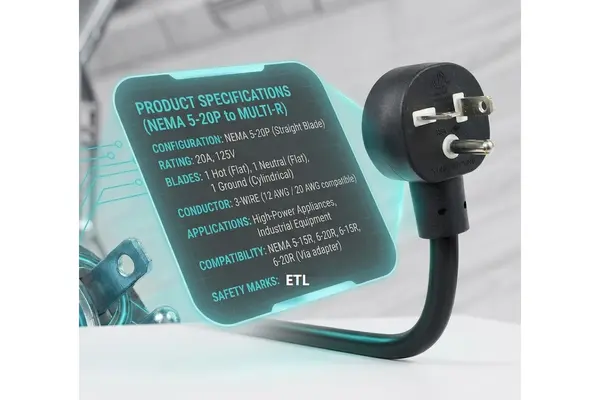
Separate the 125V and 250V Connector Systems First
NEMA 5-20P is a 20A, 125V AC, 2-pole, 3-wire grounding plug. Its supply paths normally serve line, neutral, and protective ground. The 5-15R and 5-20R belong to the same 125V family and use corresponding conductor functions. Because the 5-15R is rated 15A, the finished 5-20P to 5-15R cord must be controlled by the lower-rated component and specified at 15A, 125V maximum.
A 5-20P to 5-20R cord may be evaluated as a 20A, 125V configuration, but its final rating still depends on gauge, length, jacket, connector construction, and the approval scope of the complete cord set. A 20A plug alone does not prove that every assembled cord can carry a 20A rating.
The 6-15R and 6-20R belong to a 250V connector system that normally expects two line conductors and protective ground without neutral. A passive adapter cannot convert the 125V supply presented through a 5-20P into 250V, nor can it turn neutral into a genuine second line conductor. Consequently, 5-20P to 6-15R or 6-20R should not be produced or marketed as a general-purpose converter. It should be evaluated only as a special-purpose assembly after the equipment manufacturer confirms the input conditions, approves the pin mapping, and completes a project compliance review.
Why Does Every Receptacle Need a Controlled Drawing?
The four receptacles differ in shape, rating, or intended circuit. If the drawing says only “5-20P to optional female connector,” an operator cannot determine whether the work order uses line-neutral-ground or another specially approved arrangement. The defect may remain hidden until system testing, customer installation, or field energization, leading to unpacking, retesting, rework, or batch quarantine.
Each drawing should define:
- Complete NEMA designations for both ends;
- Contact names and point-to-point relationships;
- Current, voltage, and “No Voltage Conversion” marking;
- Wire gauge, conductor count, colors, and jacket designation;
- Finished length, tolerance, stripping, and molding requirements;
- Applicable tests, label revision, and packaging part number.
Even though 5-15R and 5-20R share line, neutral, and ground logic, they should use different part numbers and revisions because their current limits, slot geometry, and labels differ. Separate drawings give purchasing, production, quality control, and the customer one traceable definition.
How Should Wire Gauge Enter the Error-Proofing System?
For a 5-20P to 5-15R version controlled at 15A, 14 AWG/3C may serve as an engineering starting point. For a 5-20P to 5-20R version designed at 20A, 12 AWG/3C may serve as the baseline. Greater conductor cross-section can help control resistance, voltage drop, and temperature rise under defined length and load conditions, but gauge cannot be evaluated separately from cable length, ambient temperature, routing, and applicable standards.
These gauges are suggested baselines, not user-confirmed production specifications. Before mass production, buyers should verify conductor material, cable surface marking, jacket rating, connector termination capacity, and finished-cord certification. The BOM should also lock the cable part number so that similar outside diameters do not cause a different AWG or jacket type to be issued accidentally.
Which Inspections Catch Errors Before Shipment?
First-article approval should compare the drawing, BOM, physical sample, label, and packaging together. Electrical inspection should go beyond a basic continuity check. It should verify every blade-to-slot relationship against the SKU-specific point-to-point table and detect miswiring, short circuits, or an open protective-ground path. When cord length or construction changes, voltage drop, temperature rise, pull strength, flexing, and strain relief may also require reassessment.
Visual error-proofing matters as well. Separate SKUs, barcodes, color labels, fixtures, and isolated bins can reduce mix-ups between 5-15R and 5-20R or between 6-15R and 6-20R. If a project includes a 6-series receptacle, the product, packaging, and quotation should prominently state “No Voltage Conversion,” with the engineering approval record retained with the order.
How Should OEM Purchasing Lock the Four Configurations?
A purchase specification should not say only “NEMA 5-20P adapter cord.” Buyers should confirm the male end, female end, supply circuit, equipment nameplate, maximum current, gauge, length, environmental jacket, wiring table, label, and target certification. Any change in receptacle, length, or gauge should trigger drawing and BOM revision review rather than reuse of an old order.
Dongguan Kuncan Electronics Co.,Ltd recommends managing 5-20P to 5-15R and 5-20R as standard 125V products, while placing 5-20P to 6-15R and 6-20R under a special-purpose engineering approval process. Locking every configuration through a separate SKU, controlled drawing, and point-to-point test helps intercept specification errors, miswiring, material mix-ups, and misuse of certification scope before mass production, reducing field rework and after-sales disputes.


USER EVALUATE
Here is the customer's evaluation of us