
C13 vs C14 Power Cords: Key Differences, Uses, and Compatibility Explained
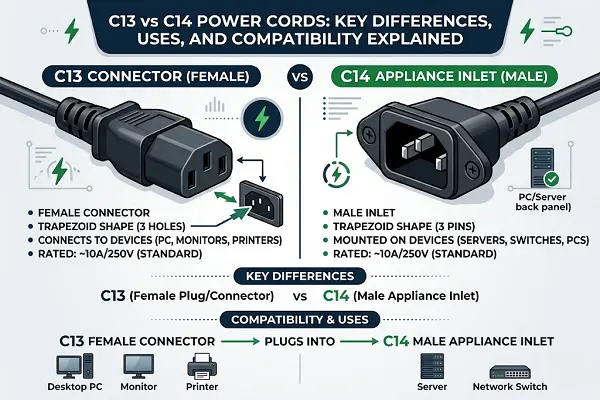
Knowing the difference between C13 and C14 power ports is essential for buying smart tools and making sure that systems work well. For example, the C13 cable power adapter is the female plug built into the housing of the equipment, and the C14 is the male plug that power lines plug into. These standard IEC 60320 parts make it possible for IT systems, industrial machinery, and consumer products to all work together. By understanding how they work together, you can avoid mistakes that cost a lot of money and make sure that your operations always have safe, steady power delivery for all of your applications.
Understanding the Basics of C13 and C14 Power Cords
What Makes C13 and C14 Connectors Industry Standards?
The IEC 60320 standard set C13 and C14 as the world standards for connecting tools to power sources. This uniformity came about because products that are sold all over the world needed to get rid of regional plug fragmentation. The C13 female connection is usually found at the end of a wire. It has three rectangular blade sockets that are meant to fit with the C14 male inlet that can be found on power supplies, server chassis, and desktop computers. With this flexible method, companies can send the same equipment all over the world; they only have to change the plug on the wall to fit different electrical outlets.
With a "cold condition" rating, these connectors can easily handle up to 10A of power at 250V AC when used outside of North America and 15A when used in North America. The average operating temperature for the pins is 70°C, which means they will work reliably in most office settings. The grounding pin design is an important safety feature for Class I equipment because it keeps users from getting electric shocks by moving fault currents away from them.
Technical Specifications That Define Performance
The integrity of the electricity relies on exact conductor specs. The building of high-purity stranded bare copper reduces resistance and heat creation when the load is on all the time. In North America, 15A circuits usually use 14AWG wires, while in other places, 0.75mm² to 1.5mm² cross-sections are used for 10A service. The insulation materials, which are usually industrial-grade PVC or rubbery thermoplastic compounds like SJT or H05VV-F, keep fires from spreading and meet VW-1 or FT1 standards. They also don't get damaged by oil or rough surfaces in harsh conditions.
The dielectric withstand voltage is higher than 2000V AC for one minute without breaking, which proves the insulation is solid. Insulation resistance readings must be higher than 100MΩ when testing at 500V DC. This stops leaking currents that could damage equipment or put users in danger. These factors make sure long-term dependability in both climate-controlled data centers and industrial areas with changing conditions.
Why These Connectors Dominate Multiple Industries?
C13 links are used by all desktop computers, monitors, printers, and professional audio boosters because they fix important problems. The standard interface gets rid of misunderstanding about compatibility when installing or replacing equipment. IT managers who are in charge of hundreds of computers like that the cords can be switched out. Any C13 power cord can be used with any C14 outlet, which makes inventory management easier and cuts down on the need to buy extra cables in an emergency.
When properly made, C13-C14 links allow for hot-swapping, which is useful for server racks. When you connect or disconnect redundant power sources, they won't cause dangerous arcing. This lets you do repair work without having to shut down the whole system. This function is very useful in mission-critical settings where downtime has a direct effect on service delivery and income.
Key Differences Between C13 and C14 Power Cords
Physical Design and Connection Mechanics
The interconnect/c13-to-c14-cable/">C13 cable power connection has three blade-shaped sockets in a trapezoidal housing. The grounding contact is set up to engage first when the connector is inserted. This order makes sure that a protective earth link is made before live wires touch. The C14 outlet has the same shape and has male pins that match. This makes a safe mechanical interlock that keeps the wires from coming apart by mistake. The binding force is usually between 10N and 50N, which is a balance between how strong the hold is and how easy it is to remove on purpose.
Connector housings are made of high-impact plastics that can handle being exposed to high temperatures for a long time. The specs for the material keep it from twisting or cracking when it's heated, so the product's dimensions stay stable over its entire life. Quality makers test longevity by putting and taking things out more than 3,000 times, which shows that the mechanical structure stays the same after all that use.
Electrical Capacity and Thermal Management
Standard C13-C14 units can handle 10A at 250V in international areas and provide 2,500 watts of power all the time. There are versions in North America that can give 15A at 125V and 1,875 watts, making them good for high-performance computers and entry-level servers. The circuit diameter directly affects the current capacity. Wires that are too small produce too much heat, which can cause fires and insulation to fail early.
High-temperature versions that can work at 105°C are used in specific situations, like near server air zones or industrial heating equipment. The silicone rubber or thermoplastic elastomer jackets used in these improved systems keep their flexibility and insulation qualities at high temperatures. If you match the cable's thermal rating to its real working climate, it will last longer and not break down.
Application-Specific Requirements
Most office technology works well within the standard C13 ratings, drawing small amounts of power for long periods of time. Different problems arise in data centers. For example, a lot of equipment squished together makes it hot, and high-quality cables are needed to keep the center running at or near its full capacity all the time. Vibration, chemical contact, and temperature changes from -40°C to +85°C are some of the other stresses that industrial automation equipment adds.
Medical facilities need power lines that are IEC-certified, have Class II insulation, and keep leaking currents below 100μA. These specialized parts have more than one safety layer and can handle being sterilized without breaking down. The precise production makes sure that both the patient and the worker are safe in medical settings where electricity problems could be very dangerous.
How to Choose Between C13 and C14 Cables for Your Business Needs?
Evaluating Your Equipment Requirements
Before making a purchase choice, you should know how your equipment works with other devices. Devices with built-in C14 plugs need power cords with C13 ends to make the link. On the other hand, power distribution units or UPS systems need to have C14 outlets for devices with captive cords that have C13 plugs. When these needs aren't understood correctly, buying mistakes happen that cause installations to be late and waste resources.
Load estimates figure out the right size of wire. Add up all the devices that share a circuit's base power ratings, then add a 125% safety range to account for inrush currents and keep the circuit from tripping for no reason. A circuit that provides 1,200 watts of steady load should be able to handle at least 1,500 watts. This will help you choose the right wire gauge and size your circuit safety.
Customization Options for Specialized Environments
Optimizing the length of C13 cable power cuts down on clutter and falling risks while still allowing for easy moving of equipment. Standard lengths range from 0.5 meters for racks with a lot of equipment to 4.5 meters for desks that are far from wall outlets. Custom lengths get rid of extra coiling that traps heat and makes it harder to control airflow in computer rooms.
Electrical interference is stopped before it can reach sensitive electronics by conductive foil or braided shields that are used in shielded cable designs. Shielded power lines keep the power flowing clean in places with a lot of electromagnetic interference (EMI), like factories with motor drives, welding equipment, or RF emitters. For noise reduction to work, the shield continuity must go all the way through the connection body and end properly at earth ground.
Budget Considerations and Long-Term Value
Premium connections cost more at first, but they work better and are worth the extra money. Better circuit materials lower resistive losses, which means that energy costs are lower over long service periods. Better insulation systems can handle weather stressors without breaking down too soon. This keeps you from having to replace things without planning to, which can cost a lot in emergency purchase fees and labor costs for finding and fixing problems.
When you buy in bulk from approved makers, you can keep costs down and be sure of the quality. Often, promises to buy in bulk open the door to tiered pricing that makes the project more cost-effective without lowering the standards. Building partnerships with providers that offer quick samples, flexible minimum order amounts, and quick technical support is very helpful when project needs change or new needs come up.
Comparison With Other Power Cords: C13 vs C15 and C19
When Standard C13 Cables Reach Their Limits?
The C15 socket type has a notched shape that makes it impossible to put into normal C14 outlets, but it can accept C13 plugs in C16 outlets. This method lets you find cables that can work at 120°C, which is important for high-temperature computers, business kitchen tools, and industrial heating systems. The higher thermal grade keeps the insulation from breaking down in harsh thermal conditions where regular C13 cables would fail too soon.
C19 plugs are used for high-power tasks that need 16A or 20A of power at 250V. The stronger housing and bigger touch area allow for more current flow without getting too hot. Blade server chassis, high-performance computing groups, and big network switches all have C20 ports that are matched to power cords with C19 ends. This newer standard keeps the flexible structure of IEC 60320 while increasing the amount of power available for demanding uses.
Cost-Effectiveness in Standard Applications
Standard C13 cable power units are most common in offices and light business settings because they meet the power needs of most equipment and are priced competitively. The large-scale production of desktop computers, monitors, and printers around the world makes the supply chain more efficient, which lowers the cost of buying things. Widespread availability makes it easy to get replacements quickly when wires break or when the building grows and needs more units.
The dependability record that spans decades of use shows that it works well in a wide range of situations. Maintenance teams like how universally known C13 plugs are—every worker knows what they are and how to install them correctly. This knowledge base cuts down on the need for training and the number of mistakes that can happen during installation that could affect safety or the way the equipment works.
Procurement Insights: Where and How to Buy Quality C13 Power Cables?
Identifying Reputable Suppliers and Certifications
Certification marks are clear proof that safety standards have been met. UL certification shows that the product meets American safety standards, and VDE certification shows that it meets strict European standards. CE marking shows that the product meets the rules for the European Economic Area, and RoHS approval shows that the product meets the rules for banned substances, which helps with environmental sustainability efforts.
Kuncan Electronics has been making approved power solutions for 17 years. Our ETL, BS, VDE, SAA, CE, and RoHS certifications let us sell our products all over the world. Our position as an Alibaba Verified Supplier shows that we are committed to being honest and doing business in an honest way. Procurement managers like how quickly our technical support team can help them understand specifications, create unique configurations, and make sure that everything works together before placing an order.
Strategic Sourcing Considerations
Lead time management affects both the schedule for a job and the cost of keeping goods on hand. Samples are sent out within 3–7 business days, which lets you make quick prototypes and test for fit before committing to large-scale production. Just-in-time shipping tactics that make the best use of working capital are supported by bulk order fulfillment in 15 to 25 days based on quantity. Flexible minimum order number rules allow for small-batch restocking needs without causing too much inventory to build up.
Stability in the supply chain makes sure that products are always available during multi-phase projects. Diversifying where you get your raw materials lowers the chance of problems caused by regional shortages or problems with transportation. Full quality control, including checking arriving materials, keeping an eye on work-in-progress, and checking the finished product, makes sure that all production runs meet specifications. The one-year guarantee against manufacturing flaws protects you financially and shows that the company that made the product is sure it will last.
Conclusion
To choose the right C13 cable power and C14 power connections, you need to know about the technical requirements, the application setting, and the supplier's skills. The female C13 and male C14 designs work well together to create standard connections that are used in many fields, from IT infrastructure to industrial systems. Knowing the electricity rates, thermal capacities, and licensing needs helps you make choices about what to buy that match your performance needs with your budget. Strategic relationships with suppliers give businesses the customization options, quick responses, and quality certification they need to stay competitive.
FAQ
Can I use C13 cables interchangeably with all C14 sockets?
Standard C13 plugs fit with C14 inlets that are rated to meet the same electrical requirements. Check to see if the cable's power and voltage values meet or go beyond what the equipment needs. Standard C14 plugs won't fit into high-temperature C16 outlets, but notched C15 connectors will. This keeps thermal grade mistakes from happening.
What safety certifications should I verify when purchasing?
Look for marks like UL, CSA, VDE, or others that show that the product has been approved by an independent testing facility. RoHS compliance means that a substance doesn't contain any banned substances and is in line with environmental laws. For medical uses, you need a certain kind of IEC 60601-1 approval that says the systems can control leakage current and provide better protection.
Should I choose shielded or unshielded cables?
High-EMI places with motor drives, welding tools, or RF transmitters can benefit from shielded buildings. Unshielded wires are cheaper because they don't need to be protected in most office settings. When shielded wires are needed, they must be properly terminated to the device ground in order for noise reduction to work.
Partner With Kuncan Electronics for Reliable C13 Cable Power Solutions
Kuncan Electronics is your only source for C13 cable power, and they offer unique connectivity options backed by 17 years of production success. Our global certifications, including ETL, VDE, CE, SAA, and RoHS, make sure that all of our target markets are met. We also offer open OEM/ODM services that let you match colors, make your own packaging, add surge protection, and print your brand. We know that procurement managers need quick samples, competitive bulk prices, and flexible supply lines that can support shipping right on time.
Our industrial-grade parts can handle high temperatures, chemicals, and vibrations in automation settings that are very tough. Medical-grade versions meet IEC 60601 standards and have fine control over leaking currents below 100μA. Smart building and security applications benefit from waterproof builds that are rated IP67 or IP68 and that work with poe. Get in touch with our team at rhea@szkuncan.net to talk about your exact needs. We'll turn your requirements into reliable, approved power solutions that keep you competitive and reduce downtime.
References
International Electrotechnical Commission. (2018). IEC 60320-1: Appliance Couplers for Household and Similar General Purposes - Part 1: General Requirements. Geneva: IEC Publications.
Underwriters Laboratories. (2020). UL 817: Standard for Safety Cord Sets and Power-Supply Cords. Northbrook, IL: UL Standards.
National Electrical Manufacturers Association. (2019). NEMA WD 6: Wiring Devices - Dimensional Specifications. Rosslyn, VA: NEMA Publications.
European Committee for Electrotechnical Standardization. (2017). EN 60320-1: Appliance Couplers for Household and Similar General Purposes. Brussels: CENELEC Standards.
Canadian Standards Association. (2021). CSA C22.2 No. 21: Appliance Couplers. Toronto, ON: CSA Group Publications.
Institute of Electrical and Electronics Engineers. (2016). IEEE 1100: Recommended Practice for Powering and Grounding Electronic Equipment. Piscataway, NJ: IEEE Standards Association.

USER EVALUATE
Here is the customer's evaluation of us