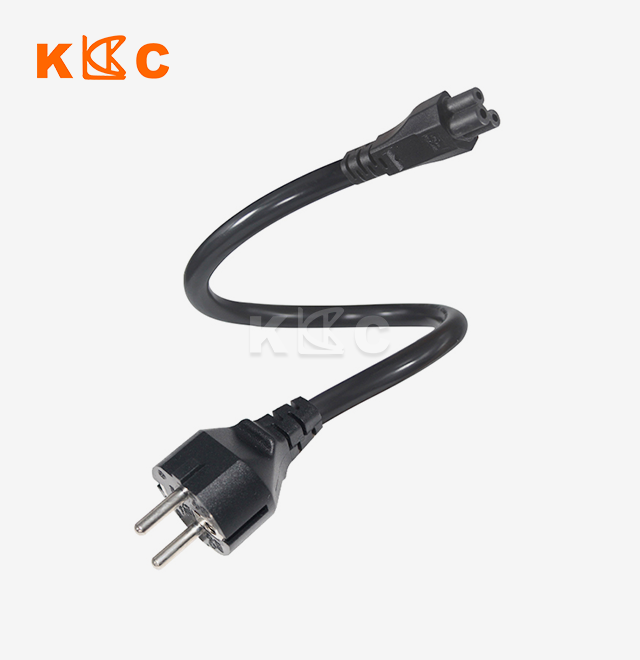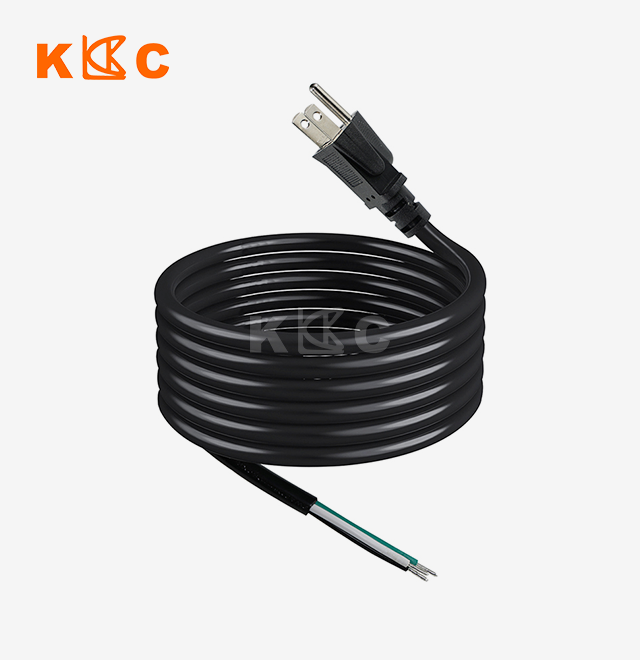

Wholesale European Power Cords: VDE Certified Manufacturer & OEM Supplier
To choose the correct European power cord, you need to know about the different plug types, voltage levels, and approval standards that exist in Continental Europe. A Europe power cord is the main connection between IEC 60320 device couplers and wall sockets that meet CEE 7 standards. It usually has a Schuko (Type F) or Europlug (Type C) plug type that works with 230V/50Hz electricity systems. To ensure cross-border compliance and eliminate voltage drops or thermal issues in high-load industrial environments, reliable European power cords must strictly adhere to VDE, CE, and RoHS safety frameworks.
Understanding Europe Power Cords: Types, Standards, and Usage
Fundamental Design and Electrical Specifications
The electricity grid in Europe runs on 220-240V and 50Hz, which is very different from the 110-120V circuits in North America. Power wires made for this market have cables that can handle higher voltage stress and shielding methods that keep the insulator from breaking down under long-term load. The harmonised naming system makes it easy to understand what a cord can do. For example, H05VV-F stands for 300/500V rated PVC-insulated flexible cable that can be used with home appliances, and H07RN-F for 450/750V rubber-jacketed cable that is made for tough outdoor conditions.
Common Plug Types and Their Applications
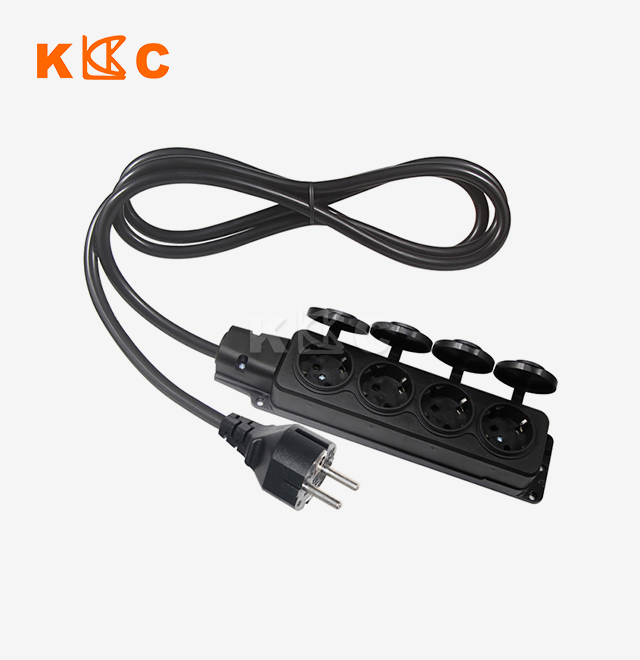
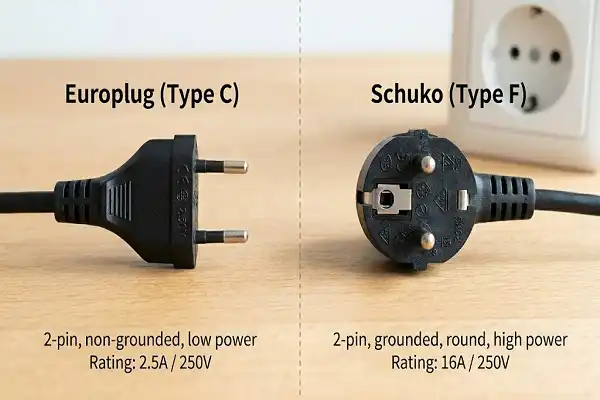
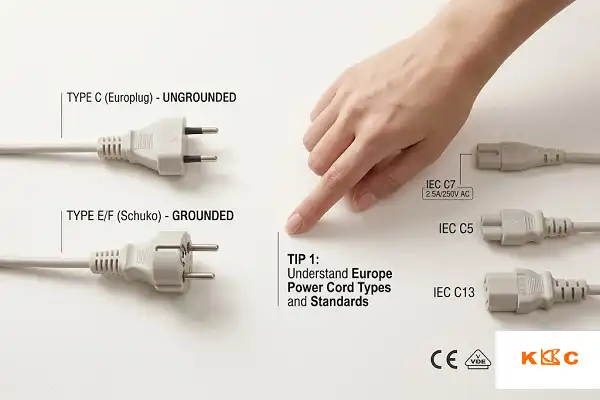
In Continental Europe, the Schuko plug (CEE 7/7) is the most common type. It has round pins and side grounding clips that work with both Type E and Type F sockets. With this combination design, a single cord SKU can work in France, Spain, Germany, and other nearby countries. The plug can handle a constant 16A current, so it can be used with high-power devices like hospital and commercial machines. On the other hand, the Europlug (CEE 7/16) is a small, ungrounded 2.5A plug for low-power Class II devices like computers and phone charges, since it doesn't need to be grounded because it has double insulation.
Instead of grounding clips, French Type E sockets have an earth pin that sticks out of the outlet. They can still accept Schuko plugs though, thanks to the CEE 7/7 hybrid design. This makes inventory less complicated for businesses that do business in more than one country. Knowing about these technical differences helps you avoid making mistakes that cost a lot of money when you buy in bulk.
Certification Requirements and Compliance Frameworks
VDE (Verband der Elektrotechnik) approval is the highest level of quality for electrical goods in Europe. This German testing group carefully checks the size of the conductors, the quality of the insulation, the rise in temperature when the load is applied, and the reliability of the machines. Products with the VDE mark have passed tests that simulate years of real-world stress. This makes buyers much less likely to be sued.
The CE mark means that the product meets the safety standards set by the Low Voltage Directive (2014/35/EU), which applies to all EU member states. RoHS rules limit dangerous chemicals like lead, mercury, and cadmium, and REACH registration deals with chemical safety. These systems work together. For example, a fully legal European cord needs all three licenses to go through customs without any problems and meet the safety standards of the end user.
Color Coding and Wiring Standards
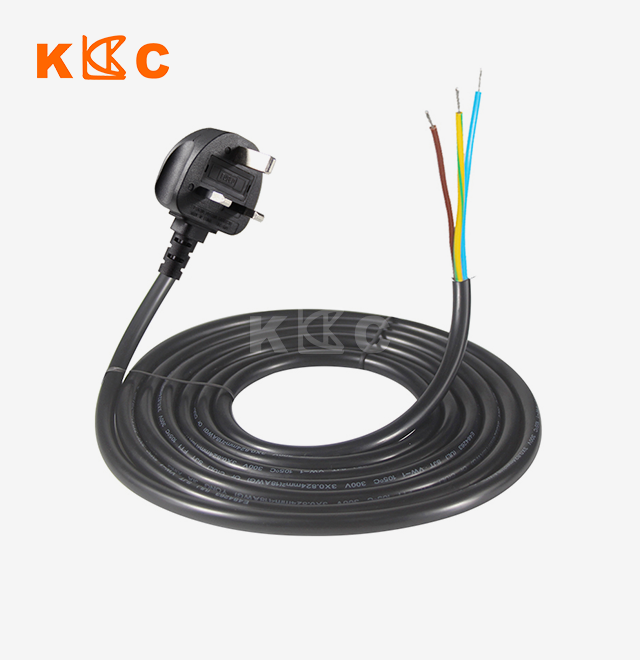
When it comes to Europe power cord, the conductors are all the same colour: brown for live/phase, blue for neutral, and yellow-green stripes for safe earth. This colour scheme stays the same for all power levels and types of cables, which makes installation easier and cuts down on wiring mistakes. For proper termination, these wires must be matched to the right ends in plugs and appliances. Earth links create the important safety path for problem current.
Europe Power Cords Comparison: Which Type Fits Your Needs?
Schuko Versus UK Configurations for Multinational Deployment
Organisations that work in both Continental Europe and the UK have to deal with plug standards that don't work with each other. British BS 1363 plugs have rectangular pins grouped in a triangle shape, which makes them literally incompatible with European outlets, even though they both use 230V. This means keeping different cords on hand or using adapter options that add connection spots that can come loose when the system shakes.
Strategic purchase planning takes this into account by defining wires that are right for the region during the equipment definition stages. Instead of using adapters that risk power purity, data center owners putting up server racks in London and Frankfurt keep a collection of specialised cords. Medical device companies that want to sell their products all over Europe often make flexible designs that let country-specific lines be swapped out. This makes it easier to get government approval and set up.
Heavy-Duty Industrial Specifications Versus Standard Office Solutions
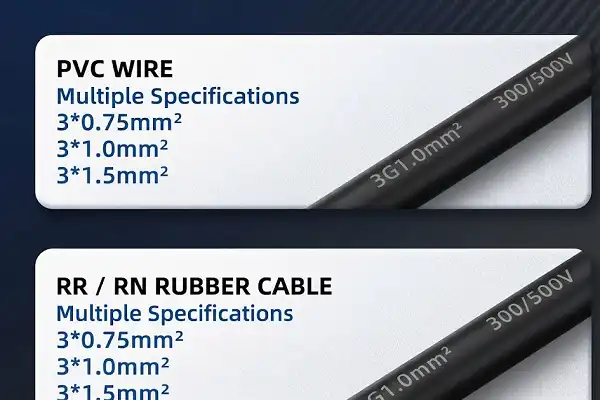
In industrial settings, mechanical safety and resistance to the surroundings need to be better. Our VDE-certified extension cords show this difference through the materials they are made of and the way they are put together. For indoor office uses, H05VV-F wire with PVC insulation works well in climate-controlled areas and gives desk-side tools a lot of freedom at a low cost.
In industrial settings, H07RN-F rubber cables must be built so that they stay flexible at temperatures ranging from -40°C to +85°C. The rubber jacket can stand up to oil, solvents, and UV light that you might find in factories and on building sites outside. Thicker wire sizes (3G1.5mm² vs. 3G1.0mm²) lower voltage drop over long distances, keeping the power going to precise machinery stable. The IP44 weather grade protects against splashes, which is important for outdoor use, and blocked entry points keep wetness out, which breaks down insulation.
These standards directly address problems that businesses have, such as cables that break in cold storage rooms, insulation that wears away when exposed to hydraulic fluid, and conductors that get too hot when running heavy equipment with wire sizes that are too small.
Length Selection and Voltage Drop Considerations
The length of an extension cord changes how well electricity works because of the resistance of the conductors. Our professional-grade solutions come in five lengths: 2m, 3m, 5m, 10m, and 20m. This makes it easy to match the exact length needed for the work. While shorter lengths keep voltage drop to a minimum and reduce trip risks in crowded offices, longer lengths are useful for building sites, outdoor events, and other situations where power needs to be reached from a distance.
When high-current loads are above 10m, voltage drop estimates become very important. For 16A loads up to 20m, a 1.5mm² wire works fine, but larger sizes are better for places where performance isn't very important. Specifications for purchases should include the real working power and the range of voltages that can be used with the linked device.
Integrated Safety Features for Specific Applications
Enhanced Ingress Protection for Industrial Resilience. For specific applications requiring robust physical protection, our Schuko connectors feature built-in shutters compliant with IP20/IP44 standards. This design prevents foreign object debris (FOD) ingress, ensuring secure contacts and preventing arc faults in dust-heavy manufacturing facilities.. This reduces liability worries for both store and home uses. Children can't use a single probe to get through these spring-loaded barriers because they need pressure on both pin holes at the same time. More and more, stores that sell extension cords to customers are requiring this feature to meet changing safety standards and lower their product risk exposure.
Procurement Guide for European Power Cords: Buying with Confidence
Supplier Evaluation Criteria and Quality Indicators
Thoroughly evaluating suppliers is the first step to successful buying. Instead of depending only on the paperwork that is given, we suggest checking the manufacturer's certifications through databases of independent testing labs. The VDE database lets you directly check the validity and scope of a certificate. This keeps you from having to pay a lot of money to replace fake certificates during customs clearing.
A manufacturing capability review should look at how much can be made, how quality control is set up, and how raw materials are sourced. Suppliers with ISO 9001 certification show that they handle quality in an organised way, and suppliers who test all of their products electrically before sending them out get rid of any faulty units before sending them out. It's important to make sure that stated powers are true by visiting the site or having a third party do an audit. This is especially important when forming relationships for important uses like medical tools or industrial control systems.
Volume Purchasing Strategies and Cost Optimization
By making production more efficient and negotiating prices, bulk purchasing can save you a lot of money. Mixed-length buying lets you build a full inventory without having to commit to single SKU amounts. This lets you find the best stock levels for different installation needs. Our flexible production can handle orders of different lengths and applies standard barcode stickers to the packaging, making it ready for sale and streamlining the processes of delivery.
It's important to think carefully about the difference between named and generic goods. Established European makers charge higher prices, but they offer a lot of paperwork to show that they follow the rules, well-established networks for guarantee service, and a well-known name that makes it easier for end users to accept the product. Generic options are cheaper for uses that need to keep costs down, as long as strict certification checks show real compliance and not just surface marks.
OEM Customization and Private Label Solutions
Private label programs let brands stand out by letting them change the way their products look and meeting other unique requirements. The choice of colour depends on the purpose. For example, high-visibility orange makes things safer in the yard and other outdoor areas, while business black looks good in an office setting. Custom wire sizes, special insulation materials (like TPE and LSZH for low-smoke uses), and unique package designs set a company apart in the market.
We offer full OEM services, such as name stamping, custom colour formulation, and package design that works with store-level marketing plans. Production tools are still locked up so that they can only be used by one client. This makes sure that there is a steady supply and protects unique designs. With this customisation feature, ordinary power lines can be turned into branded extras that help a product stand out as an expensive item and keep customers coming back.
Warranty and Compliance Documentation
Our normal 1-year guarantee for the Europe power cord covers manufacturing flaws. This shows that we're confident in the quality of our products and gives end users peace of mind, which makes it easier for us to help them after the sale. The warranty terms should make it clear what is covered, how to get a repair, and how long you have to respond. Complete paperwork packages with test results, material certificates, and compliance statements make it easier to get goods through customs and meet the safety proof needs of customers further down the line.
Making the Right Choice: Decision Support for European Power Cord Procurement
Matching Specifications to Application Requirements
Consumer electronics companies focus on making products that are both cheap and small. For example, they like Europlug setups for low-power connections and slim-profile Schuko plugs for computers and monitors. Fast-charging devices are starting to use USB-C PD protocols more and more, but standard AC cords are still needed for fixed tools and delivering large amounts of power.
For industrial automation to work, the building has to be tough enough to resist changes in temperature, pressure, and chemical exposure. Our industrial-grade solutions have stronger strain relief, wire sizes that are too big, and rubber jacketing that keeps the cables flexible while robot arms or mobile tools are moving. Certifications that meet the standards of the machinery guideline make sure that they can work with industrial systems that have the CE mark.
For medical uses, IEC 60601-1 compliance is needed, along with strict leaking current limits below 100 µA and better insulation coordination. Hospital-grade wires are tested further to make sure they can withstand cleaning agents and sterilisation processes. This is important for equipment that needs to be cleaned often. Class II double-insulated designs get rid of the need for grounding, which is very important for patient-connected devices that could be shocked by an earth problem.
Scalability and Future-Proofing Considerations
When making decisions about purchases, businesses should think about how they will grow and how regulations will change. Building ties with makers that offer full certification portfolios speeds up market growth as business development aims for new EU member states. Our certifications for multiple regions (CE, VDE, ETL, SAA, BS/UKCA) help with global rollout plans without needing to change suppliers, which could mess up supply lines that are already in place.
Sustainable buying methods are becoming more and more important in deciding what to buy. RoHS and REACH compliance are basic standards. However, forward-thinking companies look for providers who show a deeper commitment to the environment by using recyclable materials, producing with less energy, and having programs to collect used goods. These things make sure that the company's purchasing methods are in line with its environmental goals and meet the needs of all stakeholders.
Kuncan Electronics' Commitment to Procurement Excellence
Our 17-year history of making gives us a lot of technical know-how and customer-focused service models that go beyond simple business relationships. As your strategic partners, we offer application engineering support that makes sure the right cord specs are used for each situation, supply chain consulting that helps you keep your goods under control, and quick communication that takes care of pressing needs with 24-hour support.
Client reviews always show how reliable we are at meeting tight deadlines—samples are sent within 3–7 days to allow for fast development, and bulk production is finished in 15–25 days to meet product launch dates. We take advantage of the region's transportation infrastructure by being in the Dongguan/Shenzhen manufacturing hub and being able to offer open air, water, and road transport choices that balance cost and delivery time.
Conclusion
To find your way around European power cord standards, you have to balance technical compliance, application needs, and your buying strategy. Knowing the differences between Schuko and Europlug plugs, the performance differences between H05VV-F and H07RN-F wire types, and making sure the product has real VDE approval will protect your investment and make sure it works safely and reliably in all EU markets.
Strategic relationships between suppliers and makers that offer full approval, open customisation, and fast service models turn buying goods into a competitive edge. As industrial equipment, consumer technology, and medical devices change, so should your strategy for buying power cords. It should be able to adapt to new rules, use environmentally friendly methods, and make the most of suppliers' knowledge that goes beyond just doing business with them. This article gives buying workers the information they need to make smart choices that help their businesses grow and improve their operations.
| Cable Type | Insulation Material | Rated Voltage | Temp Resistance | Ideal Applications |
| H05VV-F | PVC | 300/500V | Indoor Standard | IT equipment, Medical devices (Class II), OEM appliances |
| H07RN-F | Neoprene/Rubber | 450/750V | -40°C to +85°C | Industrial automation, Outdoor construction, Heavy machinery |
FAQ
What makes European power lines different from US ones?
European cords work at 220-240V/50Hz, while North American cords work at 110-120V/60Hz. This means that the insulation grades and wire specs need to be different. European Schuko or Europlug plugs and US NEMA 5-15 plugs are technically incompatible. Voltage adapters can't fix these physical differences on their own; you also need lines that are made for your area.
Is it possible to use one line in all of Europe?
The CEE 7/7 Schuko hybrid plug works in Germany, France, Spain, the Netherlands, and Poland, among other countries in Continental Europe. The UK (BS 1363), Italy (CEI 23-16), and Switzerland (SEV 1011), on the other hand, need plugs that are made for their individual countries. Denmark used Type K in the past, but more and more new sites are accepting Schuko.
How can I be sure that my VDE license is real?
You can look for a product in the VDE Testing and Certification Institute's database by maker name or license number on their website. Real papers show a full list of tests that were done, when they are good, and if the firm has done an audit. A lot of fake certificates have writing mistakes and reference numbers that can't be checked.
Why should you use rubber cable outside instead of PVC cable?
Below 0°C, PVC becomes flimsy, and UV light breaks it down, leaving cracks that let conductors show. Rubber (H07RN-F) stays flexible up to -40°C, doesn't react with ozone or weather, and has better protection to wear and tear. The higher cost of the material means that it will last longer in harsh weather conditions, which means that it will need to be replaced less often and will have less downtime due to failure.
Partner with Kuncan Electronics for Your European Power Cord Solutions
Kuncan Electronics is ready to turn your need to buy European power cords from a compliance issue into a competitive benefit. We are a confirmed producer with full VDE, CE, and RoHS approvals. We offer professional-grade solutions that have been reliable for 17 years in medical devices, smart buildings, consumer electronics, and industrial automation.
We can do more as a Europe power cord provider than just give basic catalogue items. We can fully customise everything, from the choice of material to the measuring of the conductors to the colour specifications and retail-ready packing that fits with your brand's image. Our 3–7 day sample and 15–25 day bulk production timelines support tight market entry plans, and our flexible order numbers allow for both prototype development and volume production.
Email our tech team at rhea@szkuncan.net to talk about your unique needs. Whether you need custom cable specifications, VDE certification documentation, or a comprehensive quotation based on your BOM list, we provide engineering-backed solutions and tiered wholesale pricing to support your market expansion.
References
CENELEC Technical Committee. "Harmonized System of Designation for Cables and Cords." European Committee for Electrotechnical Standardization, 2019.
VDE Testing and Certification Institute. "Safety Requirements for Flexible Cables and Cords in European Markets." VDE Verlag GmbH, 2021.
International Electrotechnical Commission. "IEC 60320: Appliance Couplers for Household and Similar General Purposes." IEC Standards Publication, 2018.
European Commission. "Low Voltage Directive 2014/35/EU: Safety of Electrical Equipment." Official Journal of the European Union, 2014.
Schneider, M. and Weber, K. "Material Science of Electrical Insulation: PVC versus Rubber Cable Performance." Journal of Applied Polymer Science, 2020.
Deutsche Kommission Elektrotechnik. "CEE 7 Standard Plugs and Socket-Outlets for Domestic and Similar Purposes." DKE German Commission for Electrical Engineering, 2017.

USER EVALUATE
Here is the customer's evaluation of us